By George & Josh Bate
School shootings. Social media addiction. Rapidly escalating AI. Gore Verbinski’s first film in 10 years doesn’t just avoid shying away from some of the most contentious topics – it boldly and creatively weaves them in as integral pieces of a vibrant, hilarious, and distinctly of-the-moment masterpiece.
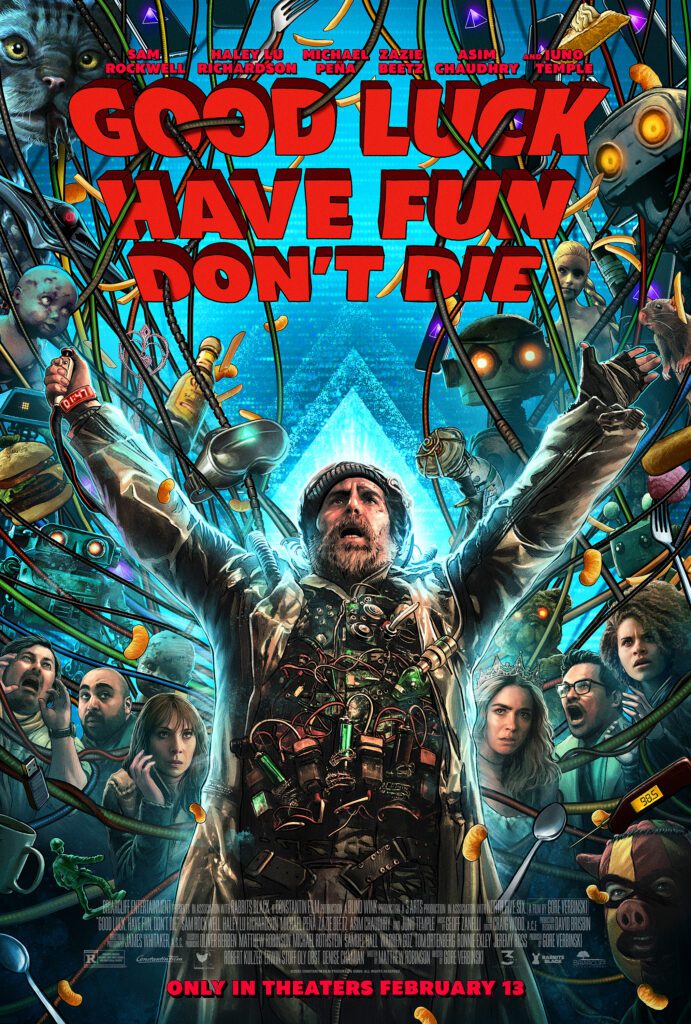
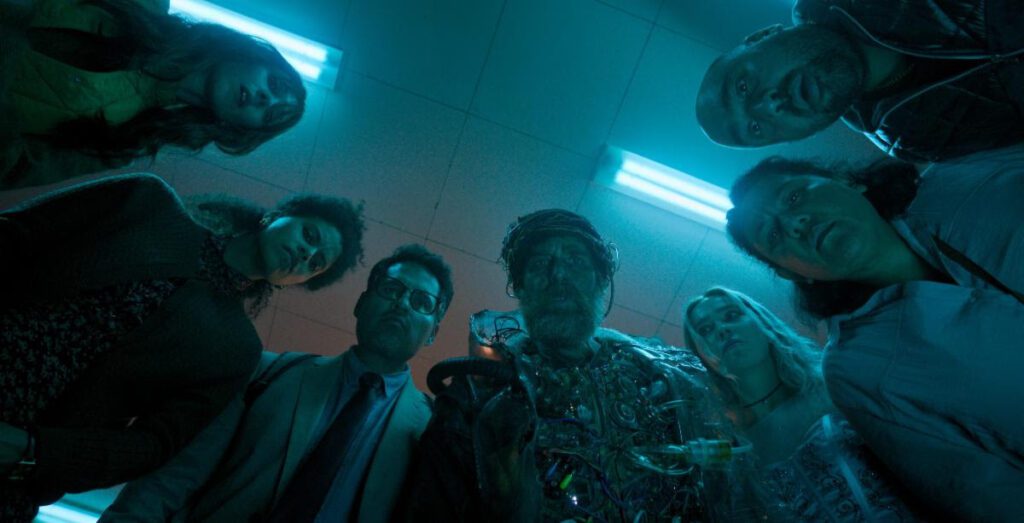
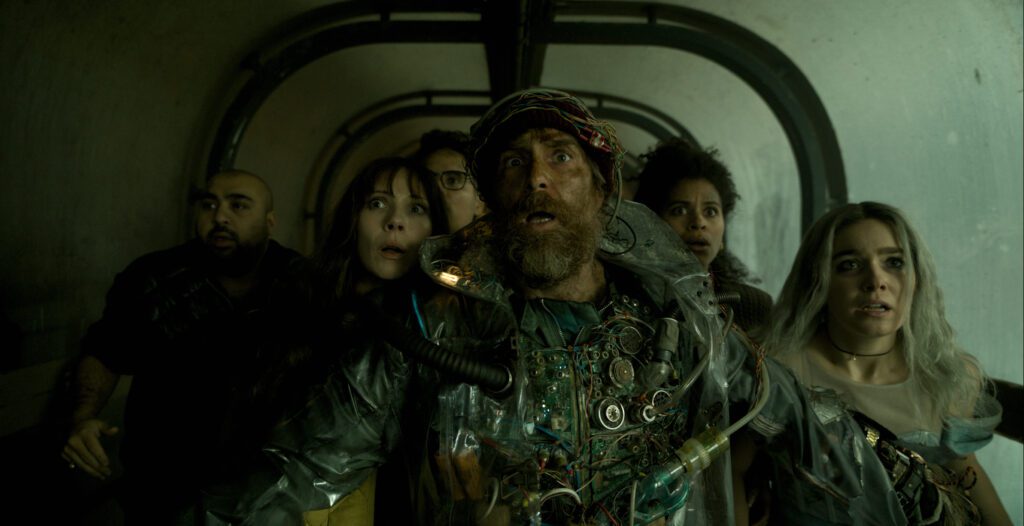
Initially making its world premiere at Fantastic Fest 2025 before it hit theaters Friday February 13. Good Luck, Have Fun, Don’t Die stars Sam Rockwell as a disheveled and eccentric man who travels from the future to the present day. His mission: to recruit patrons of a Los Angeles diner to help him save the world from an apocalyptic future caused by a dangerous artificial intelligence. Alongside an ensemble that includes Juno Temple, Haley Lu Richardson, Zazie Beetz, and Michael Peña, Rockwell’s man from the future begins his 117th attempt to save humanity and, along the way, faces skeptical strangers, brain-rotted teenagers, and algorithmic monstrosities.
The HoloFiles recently had the opportunity to speak with Good Luck, Have Fun, Don’t Die screenwriter Matthew Robinson (The Invention of Lying, Love and Monsters) about his new film, its cautionary tale about AI, finding humor in disturbing subject matter, and more.
As evidenced by the rousing reception to the film at Fantastic Fest, Good Luck, Have Fun, Don’t Die will have audiences, in equal measure, howling in laughter and widening their eyes at the subject matter it boldly addresses. Robinson touched on how humor was the perfect medium through which to express frustration toward the world’s issues. “I think comedy comes from one of two places,” Robinson reflected. “Comedy comes from a silly place where you’re just liking, enjoying giggling and having fun with your friends. And I think comedy also comes from anger and frustration. And I think they’re both wonderful, valid ways of experiencing comedy.”
Robinson continued to reflect on how he uses comedy to process the horrors humanity faces. “Usually the best way to for me to deal with things that are upsetting to me or confusing to me is to find a way to laugh about them or just to allow myself to laugh about them by how terrifying and absurd they are…. And this movie felt like a really good place to sort of take a bunch of different modern themes – tech addiction and school shootings and et cetera, and to try to have one story that sort of juggles all of them at the same time and to do it with humor and anger and frustration. And those things usually lend themselves to accentuating the comedy as opposed to bringing it down for me.”
In watching Good Luck, Have Fun, Don’t Die, one could easily be mistaken into thinking that the film was written and directed yesterday given its urgency and nuanced reflection on contemporary topics of controversy, such as AI. But this was not the case. “What’s funny is that I wrote the script almost 10 years ago before AI had proliferated in the way that it is now,” said Robinson. “But at the time I was really obsessed with understanding AI and reading a lot of books [including Nick Bostrom’s Superintelligence: Paths, Dangers, Strategies] about where it was going….There are people that are sort of considered doomers when it comes to AI. And I probably put myself in that camp. But I don’t think my brain’s capable of accepting nihilism.”
As a bizarre and scathing cautionary tale against the dangers of AI, Good Luck, Have Fun, Don’t Die parallels Stanley Kubrick’s Dr. Strangelove in comically warning of a technology-doomed future. “I guess probably how Kubrick felt when he was, not that I’m comparing myself to Kubrick, but how he felt when he was doing Dr. Strangelove,” Robinson remarked. “It was like nuclear proliferation and arms race was so terrifying that the only way you could really talk about it and not be absurd is with comedy. And that’s sort of how I felt about AI.”
Surprisingly, despite the film’s positioning as a deadly AI as its primary antagonist, Robinson does not completely oppose the usage of AI but advocates for ethical usage in areas beyond the film industry. “Am I saying I’m blanketly against AI?” Robinson asked himself. “Absolutely not. I think AI is going to cure cancer. But I also think it’s going to ruin movies. So I don’t know. I couldn’t care less about what AI wants to do in terms of writing jokes or movies. It’s just not interesting to me….Leave the stories to the humans.”
As mentioned, AI isn’t the only hot-button topic Good Luck, Have Fun, Don’t Die explores. In a decision that elicits laughs and discomfort equally, Robinson makes school shootings the butt of a disturbingly poignant running gag that pokes fun at humanity’s growing apathy and desensitization to violence. But, due to the contentious nature of the topic, the film was rejected by various studios. “Multiple studios said, ‘If you cut the school shooting stuff, we’ll buy it.’ Multiple,” Robinson recollected. “I don’t even have to name them. I think it was all of them. Everybody read the script. Everybody was excited about the genre aspect of it, the popcorn aspect of it. It’s a great character piece. It wasn’t very expensive. A lot of people were excited about it. And I was multiple times told, ‘If you take out the school shooting stuff, it’s a done deal. We’re good. We’ll make this movie.'”
Most screenwriters would have succumbed to the pressure of major studios promising to make your script a reality, but Robinson was determined to have the film retains its most controversial element. “I would like to say that I stayed on my moral high ground,” Robinson said, “but I also have children to feed and I probably would have done it if I thought it would have worked, but I don’t think the story works without that stuff. I think it’s not just an idea I like to bring up. I think literally the story doesn’t work without it. So I’m happy I was able to stick to my guns on that, but I also didn’t feel like I had a choice. I just felt like the story is not worth telling without that stuff in there.”
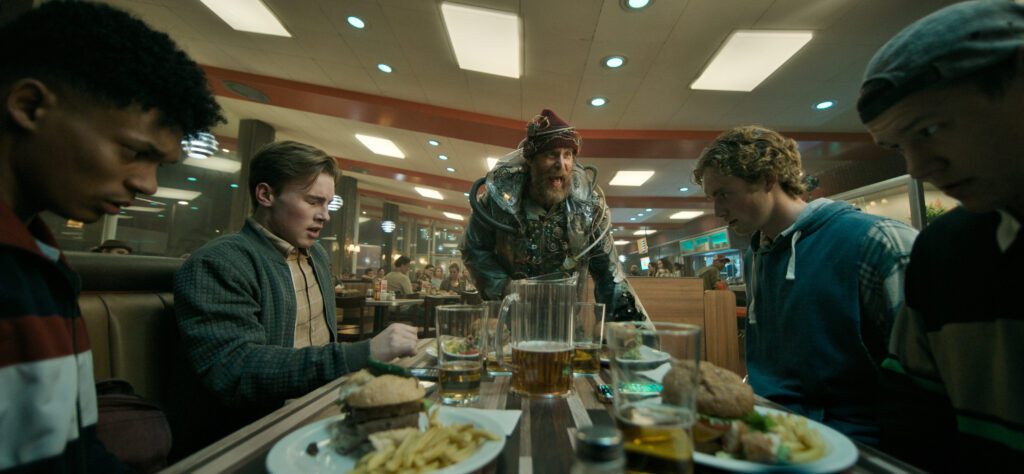
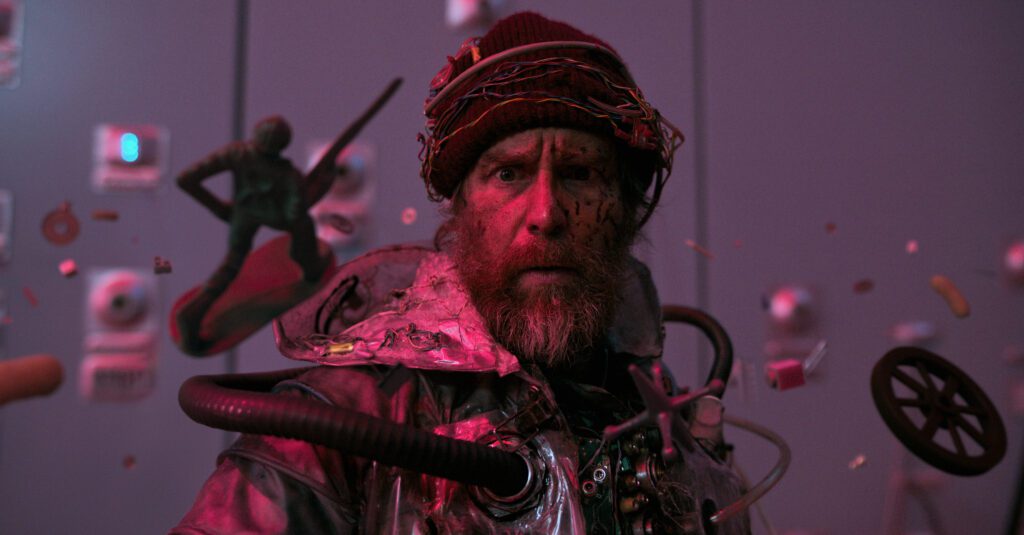
Spearheading this chaotic cautionary romp about time travel, AI, school shootings, social media addiction, and more is Sam Rockwell. The Academy Award winning actor known for his work in Three Billboards Outside Ebbing, Missouri, Jojo Rabbit, and the most recent season of The White Lotus nails the comedic and dramatic beats of his role in Good Luck, Have Fun, Don’t Die so organically and endearingly. For Robinson, it was a dream come true that Rockwell headlined his film. “Sam was the archetype from day one,” Robinson noted. “When I first finished the script and people are asking, ‘Who do you think should play the man for the future?’, I would say it’s a Sam Rockwell type.”
Robinson continued about the performance Rockwell delivers in the film, “I think he elevates it. He doesn’t just do the Sam Rockwell I had in my head. He gives us also a whole new Sam Rockwell that I had never seen before. That I think is a wonderful, wonderful performance. I think every movie that he’s in he adds something new to his arsenal of whatever he’s bringing. And it’s Sam Rockwell, but it’s also Sam Rockwell in a different way.”
Robinson is spot on as leading man Rockwell beautifully plays into the bizarreness and eccentricity of his world-saving character, while also bring an awards-worthy nuance and heart to his performance.
In a rapidly-changing film industry filled with sequels, prequels, and requels, increasingly encroached upon by artificial intelligence, Good Luck, Have Fun, Don’t Die serves as a stark reminder of the power of truly original filmmaking. Although not a horror movie, this is as scary and relevant as modern cinema gets in looking to the future, but it’s also a film imbued with incredible heart and even hope. Director Gore Verbinski and screenwriter Matthew Robinson has crafted a distinctly of-the-moment movie here that somehow proves as crowd-pleasingly entertaining as it is deeply relevant.
Good Luck, Have Fun, Don’t Die is in theaters on February 13