
By George & Josh Bate

It’s surprising that it’s taken this long for a movie like Goat to be made. The new animated film from Sony Pictures Animation plays on the dual meaning of the widely known acronym GOAT, which purportedly originated with Muhammad Ali when he was known as the greatest boxer of all time, by presenting a sports movie about a goat who wishes to become the GOAT. The result is a wholesome and vibrant, albeit fairly predictable and formulaic, blend of the sports and family animation genres that offers a light-hearted fun time at the movies.
Produced by four-time NBA champion Stephen Curry, Goat stars Caleb McLaughlin (Stranger Things) as Will Harris, a teenage goat living in an energetic all-animal world. Since he was a kid, Will has had dreams of becoming a professional roarball player and conquer his world’s faster, fiercer, and full-contact equivalent of the sport of basketball. After Will goes viral following a skirmish with the MVP of the league Mane Attraction (Aaron Pierre), he is recruited to play for the Thorns, a roarball team headlined by Will’s idol and all-star black panther roarball player Jett Fillmore (Gabrielle Union). But Will’s dreams don’t go as planned as the Thorns are bottom of their league, Jett is a far cry from the player he idolized, and those around him continue to underestimate him for being too small.
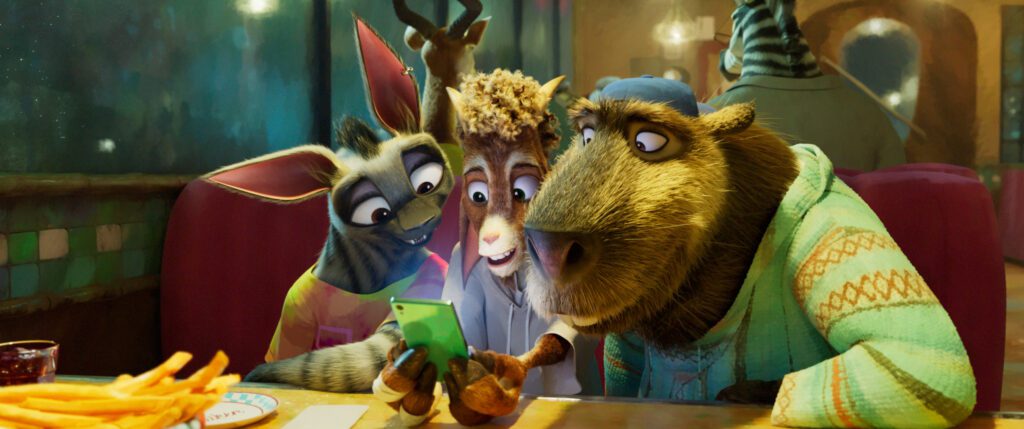
Goat comes to life with an animation style similar to Spider-Man: Into the Spider-Verse and KPop Demon Hunters. Artistic expression is prioritized over technical accuracy, with each and every frame appearing like the culmination of an artist’s work. The frames per second seems lower than most 3D animation and gives director Tyree Dillihay’s film a somewhat stuttering effect, which at times proves dizzying, but largely imbues Goat with a certain energy and dynamism. The variety of animal characters that populate the story are all cleverly designed in maximizing facial expressiveness and imbuing each animal with personalities and features that blend human qualities with qualities intrinsic to their species. The environments, meanwhile, excite and engage, whether it be Will’s home of Vineland, a sort of cross between Brooklyn and Brazil, or the myriad of other cities that his team travels to, which bear resemblance to a number of courses from Mario Kart.
Backed by inventive visuals, Goat throws audiences into a quintessential sports underdog story. This means that every beat of the plot unfolds exactly as expected, thus leaving other elements of the film to shine as points of novelty. Despite lacking in subversion, however, the story competently checks all the boxes of its exhausted tropes. There’s a compelling, likable, and perpetually underestimated lead to get behind. There’s the big break, which gives way to dreams coming true. There’s challenges with superiors, in this case between Will and his new teammate and old idol Jett. There’s the uber-confident rival without an ounce of kindness. There’s the big championship to win. And so on and so on. All of these beats have been seen countless times before, but that doesn’t take away from how rousing and emotionally effective they are nonetheless.
Where Goat stands out from other, similar sports films is the creative, lived-in world in which it takes place in. Let’s start with roarball, the sport at the center of the film that takes the basic tenets of basketball and runs with them. Roarball is co-ed and high-octane. It takes place on oversized courts filled with natural obstacles, whether that be writhing vines, sheets of ice, or falling rocks. The players are encouraged to use all of the attributes their species affords, meaning that anything goes on the court. Paws, tails, horns, snouts, wings, and tongues go flying as the film’s exceedingly entertaining games of roarball unravel. Goat does for basketball what Mario Kart does for racing – takes an established sport and injects it with color and dynamism while taking exciting liberties with the rules.
Beyond the roarball court, Goat’s world also immerses audiences. There are no humans in this all-animal world, although each and every one of the animal characters blends attributes of their species and attributes of humans. There’s a giraffe (voiced by Stephen Curry) who has a side career as a rapper. There’s a rhino dad (voiced by David Harbour) who can’t say no to his deviously destructive rhino daughters. There’s a hamster who wants to have another dozen kids after his team wins. Much of the film’s humor comes from these delightful intersections of animal attributes and human culture as, no matter how many times it happens, it’s still quite funny to see an animal say and do things we associate with contemporary humans.

The blend of animal attributes and human culture continues with the film’s embrace of basketball culture. Dillihay and his team infuse the film with tons of pop culture references, not only to basketball, but to music, fashion, art, tech, and more. Animal characters wear Under Armor jerseys. Hip-hop music often plays frequently. Will and the others use smart iPhones and their animal equivalents of Instagram, Twitter, and TikTok. It all makes for vibrant viewing and gives the film’s rich fictional world an immersive and lived-in quality.
In keeping with the traditions of its two primary genres (family animation and sports drama), Goat is wonderfully wholesome. Attempts to give Will an emotional backstory involving his deceased mother Louise (voiced by Jennifer Hudson) may not land as impactfully as expected, but there is something undeniably warm about seeing a relatable underdog tale told with such humor and heart. As stated, the story and its resolution may be predictable, and yet the emotions elicited from seeing Will overcome obstacles and unite his disparate teammates resonate strongly.
VERDICT: 7/10
Produced by NBA champion Stephen Curry, Goat is a wholesome, vibrant blend of the family animation and sports drama genres. With dynamic animation that prioritizes artistic expression over technical accuracy and resembles Spider-Man: Into the Spider-Verse and KPop Demon Hunters, director Tyree Dillihay’s film couples its visual spectacle with a rich, lived-in fictional world. Roarball, this world’s equivalent of basketball, is intense, kinetic, and makes for tons of exciting sequences in the film. Meanwhile, a world entirely populated by animals who integrate attributes of their species with parts of contemporary human culture further immerses audiences and provides some great laughs along the way. The overarching narrative may not possess the novelty of the fictional world in which it unfolds in, as the film hits every beat and trope of a sports drama without an ounce of subversion, but it still effectively provokes the emotions and inspiration one would expect from this kind of film. Although Goat may not be the GOAT of animated movies nor is it the GOAT of sports dramas, it makes up for its formulaic narrative with a rich fictional world, likable characters, and dynamic animation, all of which we hope to see more of in a sequel.