By George & Josh Bate

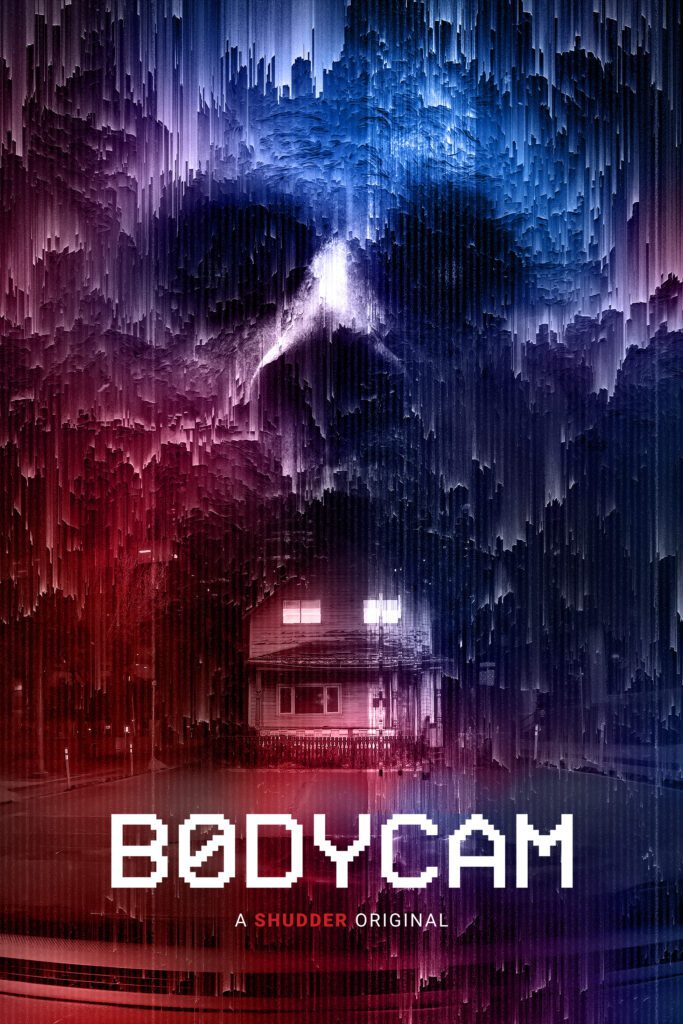
Cops meets Paranormal Activity in the unsettling and topical new horror movie Bodycam, debuting March 13 on Shudder.
From director, co-writer, and producer Brandon Christensen (Night of the Reaper), Bodycam follows two police officers (Jaime Callica and Sean Rogerson) who respond to a domestic dispute in a dilapidated neighborhood. The situation they walk into is bizarre to say the least and quickly escalates, leading to a tragic accident and frantic attempts to cover up their wrong-doing. As the night unfolds and the officers become increasingly desperate, they realize that they’ve stumbled into a situation far more dangerous and demonic than they could have possibly imagined.
The HoloFiles recently had the opportunity to speak with Brandon Christensen about his new horror movie, why it was filmed in secret, what it was like to trade traditional filmmaking for unconventional methods, the usage of the ‘Fentanyl fold’ as a key horror visual, and more.
Bodycam arrives at a time in which our culture and media appear more fascinated than ever with bodycam footage. One only needs to turn on the news or doom scroll on social media to witness the latest act of police injustice or civil unrest captured by body-worn video. Last year, a hyper-realistic tactical multiplayer shooter game (also titled Bodycam) was released to rave reviews. And, in just a few days, The Perfect Neighbor, a Netflix documentary that utilizes police bodycam footage to chronicle a fatal neighborhood dispute, is up for the Academy Award for Best Documentary. But four years ago, prior to the debuts of any of these projects and the popularization of bodycam footage as a prominent storytelling tool, filmmaker Brandon Christensen was struck with an idea to craft a horror movie using the medium.
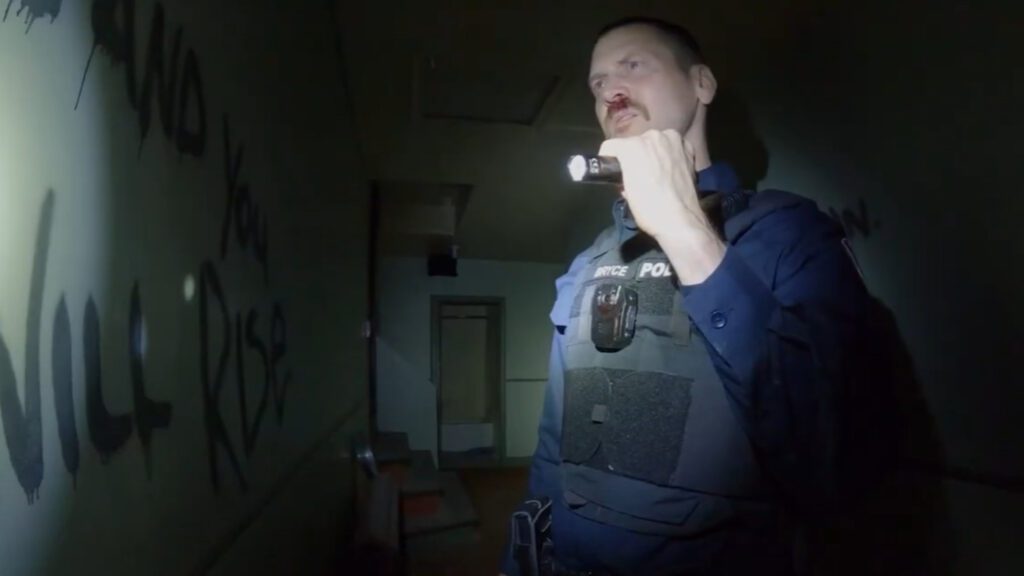
“There’s been bodycam sequences [in movies], but there’s never been a bodycam movie,” Christensen explained. “When we started writing this in 2022, we were just very aware of the fact that, in your career, you get one, maybe one, good idea. And I feel like this may have been mine.”
To avoid imitators capitalizing on his novel idea, Christensen and his team aimed to produce and release the film rather quickly, although this did not end up being the case. “If someone saw they’re doing a bodycam movie, it could have been like, ‘Oh crap, we got to.’ Because every time we tell someone, they’d be like, ‘How has this not been done yet? It’s such an obvious fit for horror. And so, when we went into it, we were expected to shoot it, edit it, get it finished, and just get it out there as fast as possible. And unfortunately, that didn’t happen.”
Christensen detailed that the lengthy post-production meant that other bodycam projects, including the aforementioned video game, were released before his movie. “It was such a long process that things like the Bodycam video game came out a year after we shot and then bodycam videos online became so influential and they’re just everywhere. And so we were just kind of watching this happen. And it was like, ‘I knew this was going to happen.’ We were just too slow to finish it.”
Despite his film taking longer to release than initially intended, Christensen ultimately feels like Bodycam “is releasing at the right time.” He explained, “Because I think people are very familiar with bodycam stuff and I think that this kind of slots right in there.”
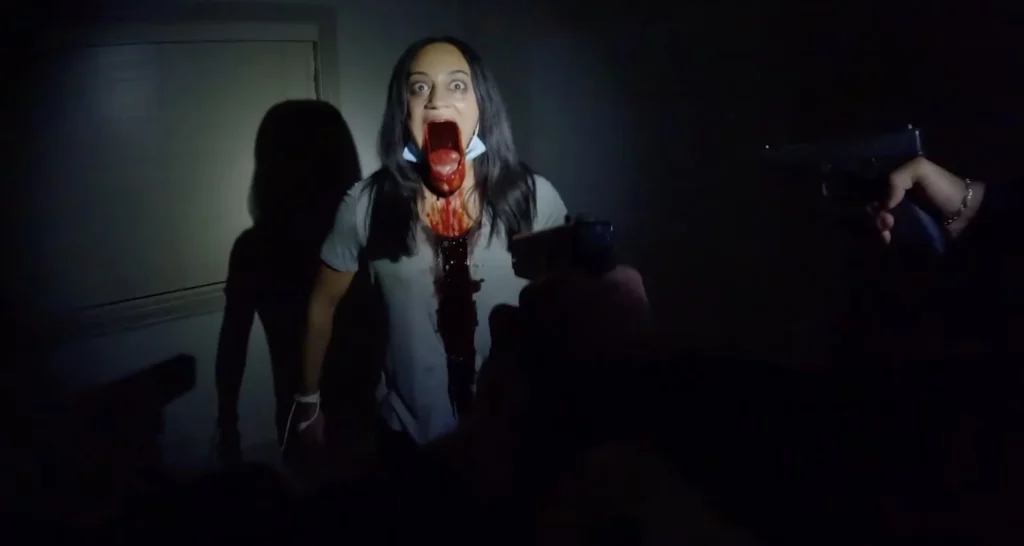
With movies like Superhost, The Puppetman, and last year’s surprise Halloween slasher Night of the Reaper under his belt, Bodycam represents new filmmaking territory for Christensen. As the entire film unfolds through bodycam footage, the director was unable to rely on traditional lighting, blocking, camera placement, and shot composition. “It was interesting, because, at the end of the day, you’re not moving the camera,” Christensen reflected. “There’s no dollies. There’s no lights. All this stuff had to be captured organically. We’d be watching a scene and we’d be blocking it, telling the actors where to move through the scene. And there’d be so many notes to take, because every scene is so long.”
The challenge of shooting a film in which everything needs to happen organically on camera is exemplified during a particularly gripping scene early in the film. “There’s a scene after the initial shooting where [Jamie Callica’s character] Jackson runs through the entire house. And, if this was a normal movie, that’s like 10 shots. But, because of the way we did it, it’s all just a continuous take that goes all the way downstairs. It was really freeing to be able to do that, but it’s also complicated, because you’re like, ‘Well, if he can go everywhere, where is the crew going to be?’ And the crew is small. So we’re usually outside the house or something like that with a wireless feed going to us. But yeah, it was just really interesting to allow the actors to just live and breathe in a real situation without having the fourth wall breaking around them with the crew or lights or anything.”
Christensen’s commitment to the bodycam medium continued into post-production when the filmmaker recognized that he couldn’t rely on musical score to evoke fear. “When we get into post-production and you realize you can’t use a stinger with music or you can’t have a score to build tension, everything has to be diegetic in the scene, right?” Christensen explored. “If something’s gonna happen, it just has to be scary on its own, for the most part, because you can’t lean on those things that you can sometimes.”
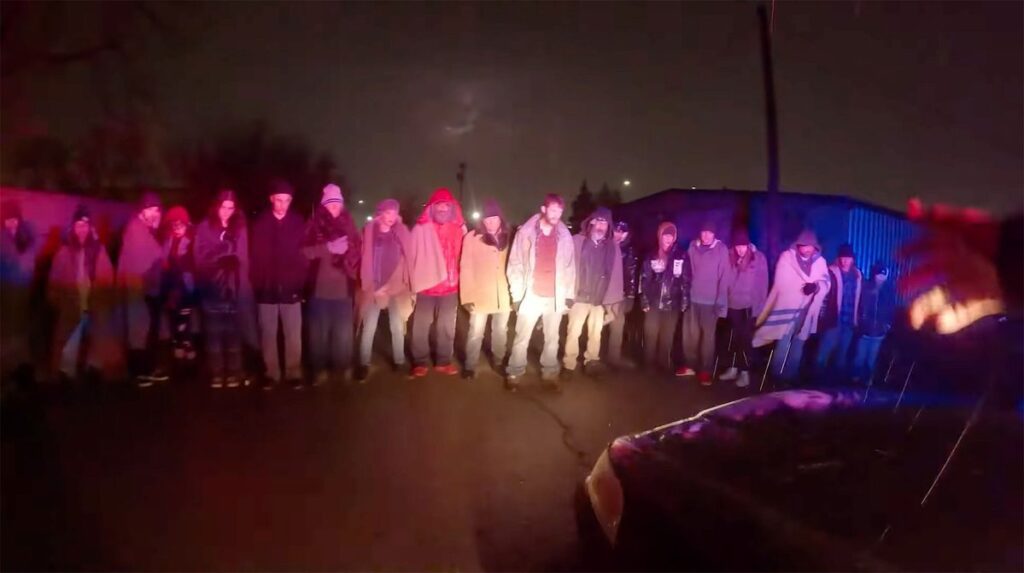
Considering the limitations imposed by his commitment to making an authentic bodycam movie, it’s a testament to Christensen’s filmmaking that Bodycam is as terrifying as it is. Although the first 10-15 minutes of the film feature an intensity most horror movies could only dream of, Christensen’s movie is perhaps at its scariest in extrapolating disturbing, real-life imagery we’re all too familiar with as the crux of the horror.
Most people have probably seen videos on the news or on social media of fentanyl users on the streets of the U.S. experiencing extreme sedation, loss of motor control, rigidity in their muscles, or, perhaps described less formally, looking and behaving like zombies. Christensen takes the inherent horror of these images and uses it as the backbone for much of his film’s scares and the crux of its topical message. “I mean, those videos by themselves are brutally scary,” Christensen stated. “That was actually one of the main reasons that we started building the script, because we had this accidental shooting idea already. But when my brother and I started to talk about these people, we were like, ‘Well, what if it’s not drugs, it’s something else controlling them.’ That was really what sort of set the story on the path that it’s going on.”
Bodycam eventually connects the ‘Fentanyl fold’ of various characters in the film to a sinister, supernatural throughline of its narrative. “It’s interesting to think maybe they’re just in waiting. They’re not slumping. They’re just in waiting. They haven’t been activated yet. It’s almost like the agents in The Matrix – they can just be taken over and used as they need to, because they’re kind of everywhere. They’re the watchful eye of this thing feeding on the city.”
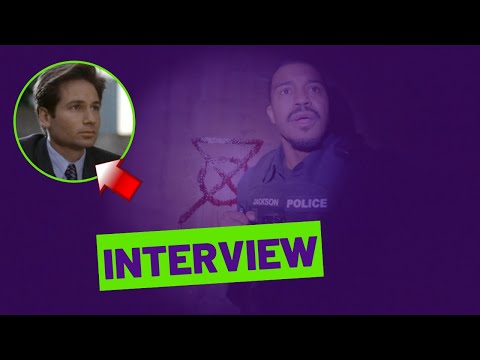
During the interview, we bonded with Christensen over our shared love for the iconic The X-Files episode “X-Cops,” which also adds an unnerving supernatural element to the brand of police footage widely known in the public lexicon. Christensen discussed how, when he first watched “X-Cops,” he thought he was simply watching an episode of Cops until Scully and Mulder show up and things go crazy. Watching his new film Bodycam mirrors the viewing experience of “X-Cops” in the best possible way. Christensen’s movie starts like a typical episode of Cops before quickly evolving into something far more gripping. Watch Bodycam on Shudder when it debuts on Friday March 13th and treat yourself to the scariest episode of Cops you’ve ever seen.
Watch the full interview with Bodycam director Brandon Christensen below….
Bodycam streams March 13 on Shudder