
By George & Josh Bate

Over the past 20 years, John Carney has carved out a unique sub-genre of his own. His musical dramas Once, Begin Again, Sing Street, and Flora and Son all showcased the Irish filmmaker’s penchant for coupling charming, uplifting stories with authentic characters and catchy songs. Carney flexes these muscles once again with Power Ballad, a beautiful, funny, heartwarming, and original movie that champions advocating for yourself, even when others don’t believe you and don’t believe in you.
Screening at this year’s Chicago Critics Film Festival, Power Ballad stars Paul Rudd as Rick Power, an American musician whose aspirations to make it as a big star have long faded. Rick now lives in Dublin, where has a wife, daughter, and a band that performs at weddings. After one of his wedding concerts, Rick bonds and jams out with Danny Wilson (Nick Jonas), a former boy band star struggling to kick start his solo career. Months after their encounter, Rick learns that Danny has stolen one of his songs that he played during their jam session. To make matters worse, the song becomes a massive hit and propels Danny into the very stardom Rick always wanted. With people around him not believing that Danny stole the song and the song’s increased popularity deepening the wound, Rick tries anything and everything to get the credit he deserves.
Paul Rudd has cultivated a memorable comedic personality that he has showcased in films like This is 40, Role Models, and even in the Marvel Cinematic Universe as Ant-Man. While Rudd certainly exhibits his trademark facial expressions and line delivery in his latest film, Power Ballad showcases a different, more nuanced side to the actor’s repertoire. Rudd anchors Carney’s film with an authentic portrayal of a man who, while content with the life has with his family, lingers on what could have been had he continued to pursue a career in music. As the film progresses and his character increasingly struggles with the fame he so desperately desired being stolen from him, Rudd leans more heavily into the inner turmoil of a troubled character but does so in a way that never reads as too heavy-handed. Consistent with the film’s ultimate message, Rudd also brings an incredible warmth to his performance, namely as a man who genuinely cares for and adores his wife and daughter.
Nick Jonas, meanwhile, finds himself in the unconventional position as an antagonist in Power Ballad. The bulk of Jonas’ scenes come a first act that depicts Danny Wilson and Rick Power’s briskly forged friendship. While he sporadically appears throughout the proceeding film, Jonas fades into the background of a story that hones in on Rick. This relegation to the periphery means that every moment counts for Jonas, who portrays a character shrouded in moral dubiousness. Much like the impression Rudd’s character has of Danny Wilson, the audience is supposed to like Jonas’ character at first, but, once he steals the song from Rick, that changes very quickly. From that point on, Jonas is tasked with portray a character that is an enemy to Rick, but not one that is wholly or cartoonishly evil. After all, Rick himself states several times that he doesn’t hate Danny, which aligns with the audience’s impression of a character. We won’t necessarily hate him, but we certainly don’t like him. All of this moral ambiguity renders Danny an interesting and nuanced character, albeit one we wish the film allocated more to understanding.
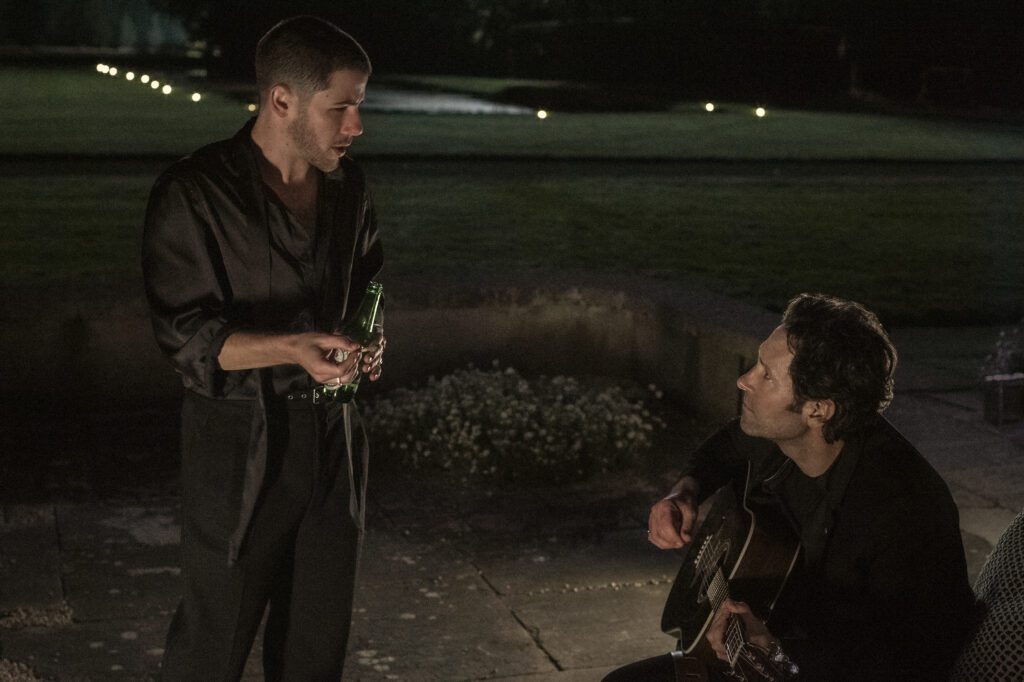
Coming off hit musical dramas like Once and Sing Street, John Carney also excels in bringing exactly what you would expect from the Irish filmmaker. Carney seamlessly integrates music in the story, rather than having characters burst onto into song and risk pulling the audience out of the narrative. The music pushes the story forward and proves integral to the story, so much so that it essentially serves as a character unto itself. The song in question that Rick alleges Danny stole from him must play upward of 15 times in the film and may test the audience’s patience with how repetitive that becomes. But Carney knows what he’s doing. By playing the song so many times, he evokes a sentiment in the audience that mirrors Rick’s. And, with a story that eventually converges on flipping the meaning of the song on its head, Carney allows the same song to be completely reinterpreted and seen through entirely different eyes come the end of the film.
Carney also infuses aspects of his own identity into the film, which contribute to the feel good atmosphere of Power Ballad. Rick is based in Ireland, harking back to Carney’s roots, as the filmmaker was born and raised in Dublin. This unconventional setting helps the story feel more authentic and natural, while also adding to the uniqueness to the film. Power Ballad could have easily taken place entirely in Los Angeles, for instance, but the Ireland setting gives Power’s world a visual and tonal flavor that purposefully differs from the glamor and glitz of Danny’s life in L.A., especially as his plagiarism propels him to stardom.
Consistent with Carney’s previous musical dramas, Power Ballad manages to tug on the heartstrings in a number of ways. Rick’s bromance with bandmate Sandy (Peter McDonald, who also co-wrote the film) makes for delightful viewing and is responsible for some of the film’s best laughs. A critical confrontation scene between Rick and Danny remarkably fosters deep empathy for both characters on opposing sides of a conflict, even one who has committed an objective wrong. And, finally, the film seals the deal with its emotional impact in exploring Rick’s unwavering dedication to and adoration for his wife and his daughter. At first, it appears as if their inclusion in the film will be secondary to the story. And, later on, the audience is put in a position that has us questioning whether they even deserve to have Rick in their life, given how dismissive they are of his complaints. But, ultimately, Carney ties things together nicely and grounds the film in a genuine love for family.
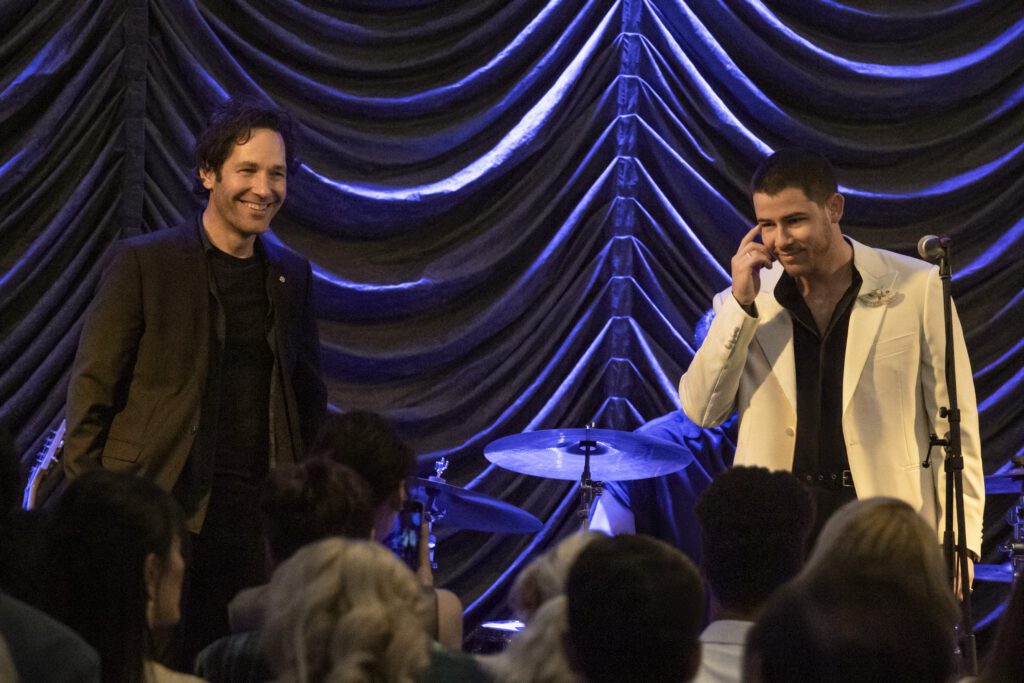
Power Ballad missteps, however, with an ending that fails to pay off in a satisfying manner. For a film that plays so much like a light-hearted crowd pleaser, it’s surprising that it doesn’t (exactly) deliver the conclusion everyone sitting in the theater watching will desperately want to see. A brief scene at the very end ensures that the story fittingly resolves, but the film allows much of the fallout from the conflict to occur off-screen. This not only squanders any opportunity to give Nick Jonas a deserving climactic moment, but it also means the story wraps up with a few unanswered questions and without the warm, fuzzy feeling inside the preceding film fostered.
VERDICT: 8.5/10
Once and Sing Street director John Carney creates another beautiful, heartwarming, and hilarious musical drama with Power Ballad, an original movie that champions advocating for yourself even when others don’t believe you and don’t believe in you. Paul Rudd delivers his best ever performance by coupling his trademark comedic line delivery and facial expressions with a more nuanced dramatic turn. Nick Jonas, meanwhile, admirably takes on the role of an antagonist and excels with the material provided to him, although the film squanders opportunities to understand his admittedly fascinating character in greater depth. The music from Carney and Gary Clark serves as a character unto itself, such is the prominent role it plays in the film, and is backed by a story that justifies the repetitive inclusion of Rick’s stole song by ultimately having us see it with completely different eyes come the end of the film. Consistent with Carney’s previous work, Power Ballad makes for delightful viewing and tugs on the heartstrings in a number of ways, namely through Rick’s bromance with Sandy (played by a standout Peter McDonald) and the endearing love he shows toward his daughter and wife. A rare misstep, however, sees the film fail to pay off its a central story in a satisying manner and wrap up with a few unanswered questions and without the warm, fuzzy feeling that characterized the proceeding film. Regardless though, Power Ballad is destined to delight audiences with its heart and humor, both of which the ever-reliable Carney delivers in spades in one of 2026’s best films to date.