
By George & Josh Bate

Ten years ago, South Korean filmmaker Na Hong-jin released The Wailing, a winding, atmospheric, and foreboding horror mystery that ranks among the best Korean cinema has had to offer this century. A decade after The Wailing, Na Hong-jin returns with a similarly ambitious, yet admittedly flawed epic – a sprawling sci-fi action survival movie that is very much a tale of two halves in terms of its quality and focus.
Hope takes place in the remote South Korean village of Hope Harbor, where police chief Bum-seok (Hwang Jung-min) and his cousin Sung Ki (Zo In-sung) are called to the scene of a grisly, mysterious murder of an animal. As the two begin parallel investigations into the nature of the brutal slaughter, they discover that a vicious creature is responsible and is wreaking havoc throughout the village. Despite concern for what the creature is capable of, Bum-seok bravely perseveres through his anxiety to restore peace to his town.
With a bulky runtime of 156 minutes, Na Hong-jin’s latest venture is epic in both scope and length. Widely reported to be the most expensive South Korean film ever made, Hope epitomizes the label ‘sci-fi epic’ and makes extraordinary use of every dollar of its budget with stunning production design and crisp cinematography from Hong Kyung-pyo. Despite unfolding within the confines of a sparse, rural town, the film takes on immense scale due to the extensive practical set design of a village ravaged by a powerful creature and the sheer threat this creature poses to everyone unfortunate enough to be in its proximity.
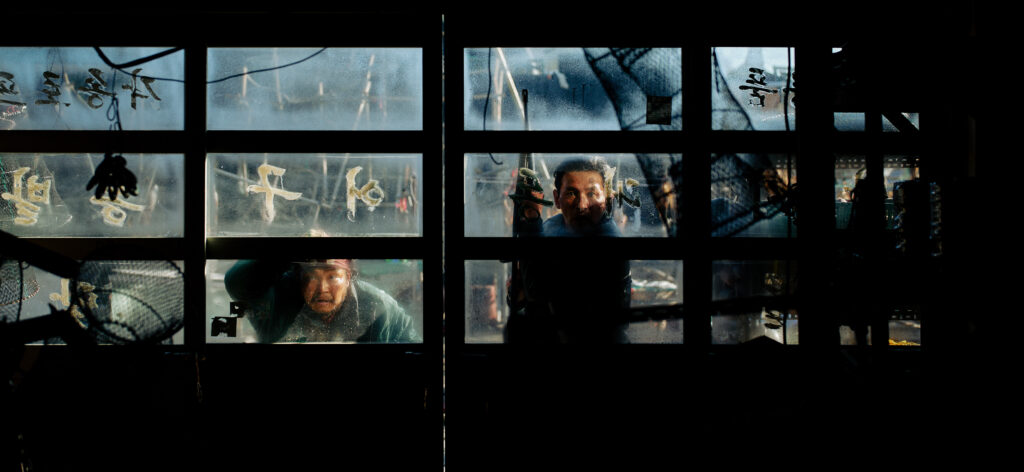
After taking its time with an initial set-up, Hope propels forward at a blistering pace and with unrelenting intensity for the remainder of its first half. Almost entirely devoid of character work or substantial dialogue, Na Hong-jin dedicates most of this first half to a prolonged chase sequence, in which the brave, shotgun-wielding police chief Bum-seok follows a path of destruction through the town of Hope Harbor in search of the creature responsible for all the mayhem.
Remarkably, Na Hong-jin sustains a palpable level of tension through this pursuit, in part due to his restraint to avoid offering the audience even a fleeting glimpse of the creature. Much like Bum-seok, who can’t seem to set his sights on the monster, the audience is deprived of visually wrapping their head around the cause of all this destruction. In turn, the film intrigues as to what this creature actually looks like and how it is capable of such havoc. Just when you think you’ll finally have a look at the creature, Na Hong-jin subverts expectations and keeps the audience on its toes. And, as arguably nothing is scarier than that which we can conjure up in our imagination, the filmmaker leaves the audience to conceptualize its own horrifying visual of the creature, rather than immediately show what the town of Hope Harbor is up against.
Disappointingly, Hope grinds to an abrupt halt and loses every ounce of the momentum and intensity that characterizes its first half upon revealing what the creature actually looks like. Unpolished visual effects that appear unfinished immediately take one out of the movie and deprive it of any semblance of immersion. The visual effects fail to improve as the runtime progresses and more creatures are introduced, all of whom interact strangely with the natural environment and are far too reminiscent of the creatures from Warcraft (a decade-old film) and Kro, the leader of the Deviants played by Bill Skarsgård in Marvel Studios’ Eternals.
With the steam decidedly taken out of the film with the creature’s reveal, Hope lapses into a lull for much of its second half. A contrast to the first half’s unrelenting action and tension, the second half slows the narrative down considerably and meanders along until the film, at last, comes alive again in its final stretch. Without particularly interesting, quirky, or distinctive characters to root for, the second half’s aimlessness renders the film a fairly slow watch and, at multiple junctions, feels like it’s never going to end.
As stated, however, Na Hong-jin injects much-needed energy into the proceedings again in the film’s final stretch. Although distracting creature effects continue to push the suspension of disbelief to its limits, an extended chase sequence through a vibrantly green wooded area and onto a long stretch of highway finally brings Hope back to the superb intensity and urgency of its first half. Na Hong-jin masterfully engineers gasps, applause-worthy moments, and pointed bursts of humor to round his film out on the same strong footing that it started.
But there’s one last obstacle for Hope to run into before its credits roll. For the overwhelming majority of the runtime, the film appears entirely disinterested in explaining what the creatures are, why they are on Earth, and what their motives are. However, in the last 5-10 minutes, Na Hong-jin perplexingly packs in a whole movie’s worth of lore, character names, exposition, rituals, and background on the creatures. Strikingly, none of this information is even remotely comprehensible and, as such, simply serves to conclude the story on a note so head-scratching one could be forgiven for thinking entire, vital scenes about the creatures were eliminated from the preceding film.
VERDICT: 7/10
Acclaimed South Korean filmmaker Na Hong-jin follows up his superb horror mystery movie The Wailing with an epic, ambitious, yet fundamentally flawed sci-fi action thriller. Widely reported to be the most expensive South Korean film ever made, Hope is the definition of ‘sci-fi epic,’ making extraordinary use of every dollar of its budget with stunning production design and crisp cinematography from Hong Kyung-pyo. For its first half, Na Hong-jin’s film propels forward at a blistering pace and with unrelenting intensity and sustained tension, in part due to the restraint exercised to withhold even the slightest glimpse of the creature wreaking havoc on the remote village. The film grinds to a halt, however, when the creature is finally shown and reveals unpolished, seemingly unfinished visual effects that test the suspension of disbelief and threaten to take one entirely out of the movie.
After a second half lull that could make one think the film will never end, Hope thankfully picks up again in its final stretch with an extended chase sequence through a vibrantly green wooded area and onto a long stretch of highway restoring the first half’s stellar intensity and urgency. The film goes off the rails again, unfortunately, in the last 5-10 minutes as an entire film’s worth of exposition, lore, and information about the creatures is dumped in a manner so perplexing that one could be forgiven for thinking massive sequences about the creatures were eliminated from the preceding film.
While certainly erring with its visual effects, pacing, and incomprehensible exposition, Hope is undoubtedly a monumental achievement destined to elicit gasps, cheers, and laughs from audiences. It’s a testament to the strengths of Na Hong-jin’s film that, despite all of its (many) flaws, Hope can still be characterized as a must-watch on the biggest screen possible.