
By George & Josh Bate

Love triangles. A conflict as old as time, yet one that garners enduring attention for its high-stakes, the binary choice at its core, and the active audience participation such a clash facilitates. Movies like Casablanca and Challengers have seemingly perfected dramatization of the love triangle, but that doesn’t mean movies like The Sun Never Sets can’t come around to do something different with one of storytelling’s most common tropes.
From writer/director Joe Swanberg, The Sun Never Sets follows Wendy (Dakota Fanning), a young woman whose life is turned upside down when her boyfriend Jack (Jake Johnson) asks for space in their relationship so that she can determine if she truly wants to be with him. Shortly into their separation, Wendy’s ex, Chuck (Cory Michael Smith), comes back on the scene and kick starts a romance with Wendy, leading Jack to regret his decision to take a break. What ensues is an emotionally charged love triangle in which Wendy struggles to make a decision of who she wants to be with.
Arguably the quality of The Sun Never Sets that makes it stand apart from the deluge of other, similarly plotted stories is the remarkable authenticity of its performances and humor. Fanning, Johnson, and Smith trade dialogue, make jokes, and interact with others in such a free-flowing manner that it seems the film was almost entirely improvised, rather than scripted. Even as the central conflict plays out largely as expected, there is something undeniably absorbing about watching three superb performers embody their characters and navigate a story so naturally.
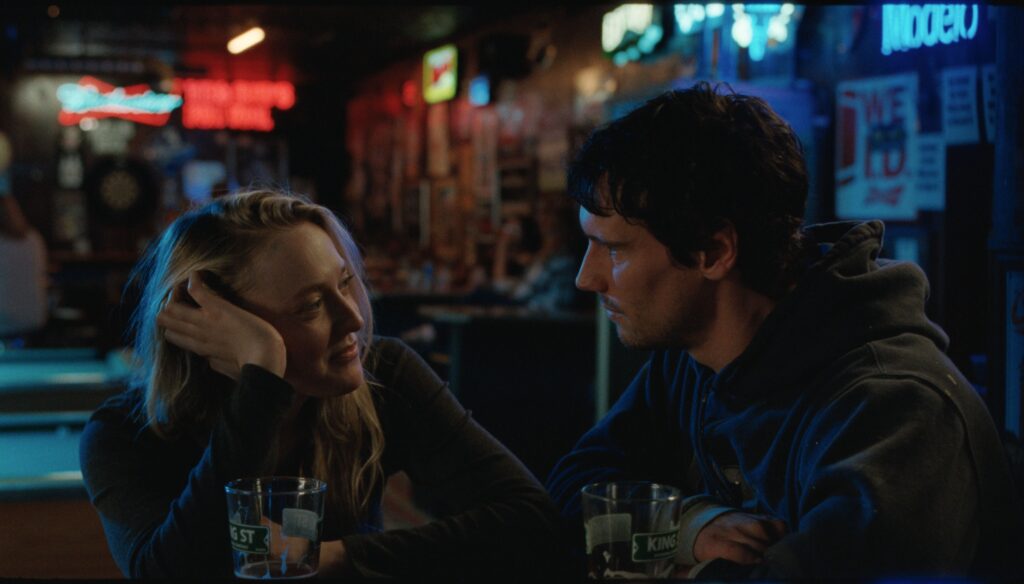
While the film compels for much of its first half, it encroaches on another level of funny and complicated as the lability of the characters’ emotions continually puts the love triangle in a state of disarray. Sometimes, within the same scene, Fanning’s Wendy or Johnson’s Jack do a complete 180, one second expressing their undying love for the other and the next indicating that they want nothing to do with them ever again. Swanberg and his performers approach the emotional fluctuations of the characters with a groundedness, however, that ensures that their frequently changing viewpoints never feel overdone or included merely for humor. Yes, it is admittedly quite funny to see Fanning tell Johnson she wants to marry him, only to tell him she never wants to see him again moments later, but the film contextualizes these oscillations less as a humorous reflection of its characters’ instability and more so to depict the suspension of logic that comes with navigating romantic relationships.
The deft balance of tone simply wouldn’t work without actors deeply attuned to both drama and humor. Fanning plays Wendy with exceeding likability and does well to keep her character accessible and relatable, even as her fluctuations become increasingly frequent. Smith, meanwhile, makes Chuck a distinctly Alaskan man, while lending a certain universality to a character most people watching the film will have known at some point in their lives. Johnson, known primarily for his comedic work, is arguably responsible for the biggest laughs of the film as his character quickly devolves from the most confident, composed person to a deeply regretful and insecure man desperate to win back the woman he so carelessly threw away. The Sun Never Sets is very much a performance-driven movie and, thanks to exceptional turns from Fanning, Johnson, and Smith, it excels where it matters most.
Besides the relative lack of novelty inherent to its premise, Swanberg’s film stumbles at the last hurdle with an abrupt ending that struggles to resolve the journeys of any of its three lead characters in a satisfying way. One character in particular seems to have nothing in the way of a concluding note, in turn rendering the film a somewhat incomplete experience.

In concluding so abruptly, The Sun Never Sets fails to take full advantage of the rich relationships at the heart of its story by arriving upon an ending that only lightly strikes an emotional chord. For a film so authentic in its characters and dialogue and so universal in its themes, one would think that Swanberg’s film would converge on a more emotionally stirring note than it ultimately does.
VERDICT: 6.5/10
The Sun Never Sets breathes new life into the love triangle by bringing remarkable authenticity to its characters, dialogue, and humor. Writer/director Joe Swanberg’s film may not break new narrative ground for romantic dramedies, but its delicate balancing of tone and exceedingly naturalistic performances make for an entertaining film that, while often humorous, never loses its groundedness. Dakota Fanning, Cory Michael Smith, and Jake Johnson all deliver stellar performances as the trio caught up in a complicated, ever-fluctuating love triangle. Unfortunately, the film concludes rather abruptly and on a note that lacks the emotional resonance one would expect from a film so authentic with its characters and dialogue and so universal with the themes it explores. As the film’s title suggests, the absorbing nature of The Sun Never Sets’ characters and their relationships refuses to fade, even as it collides with a few shadows along the way.