
By George Bate
There has arguably not been a good John Carpenter movie in nearly 30 years. And although the master of genre filmmaking’s latest movie remains 2010’s The Ward (the less said about that the better), a new great John Carpenter movie has arrived, courtesy of Adam Wingard.
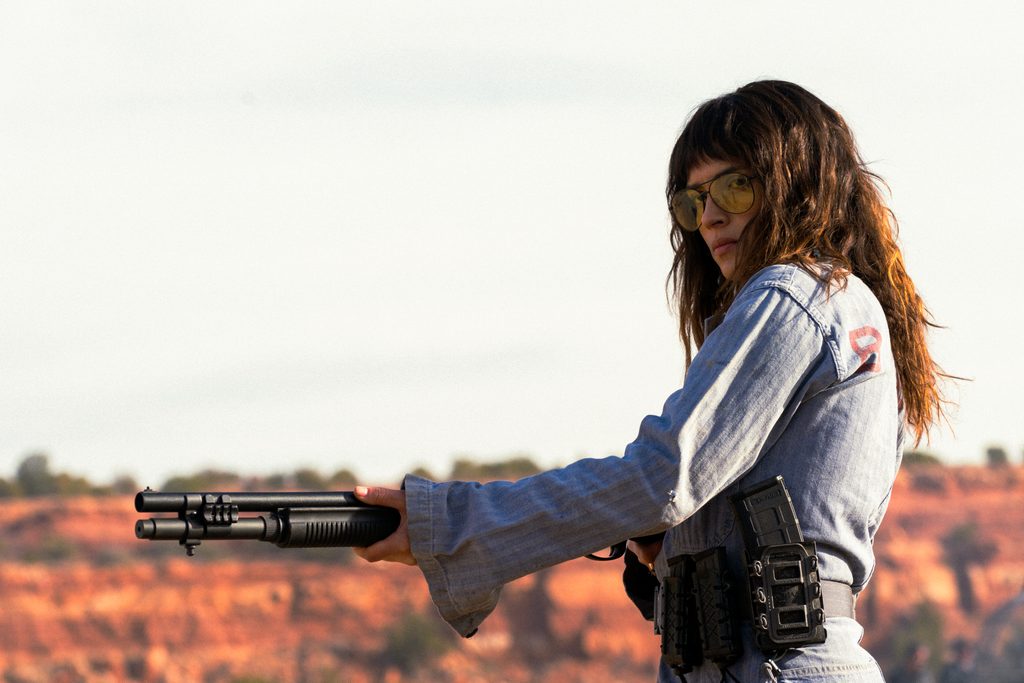
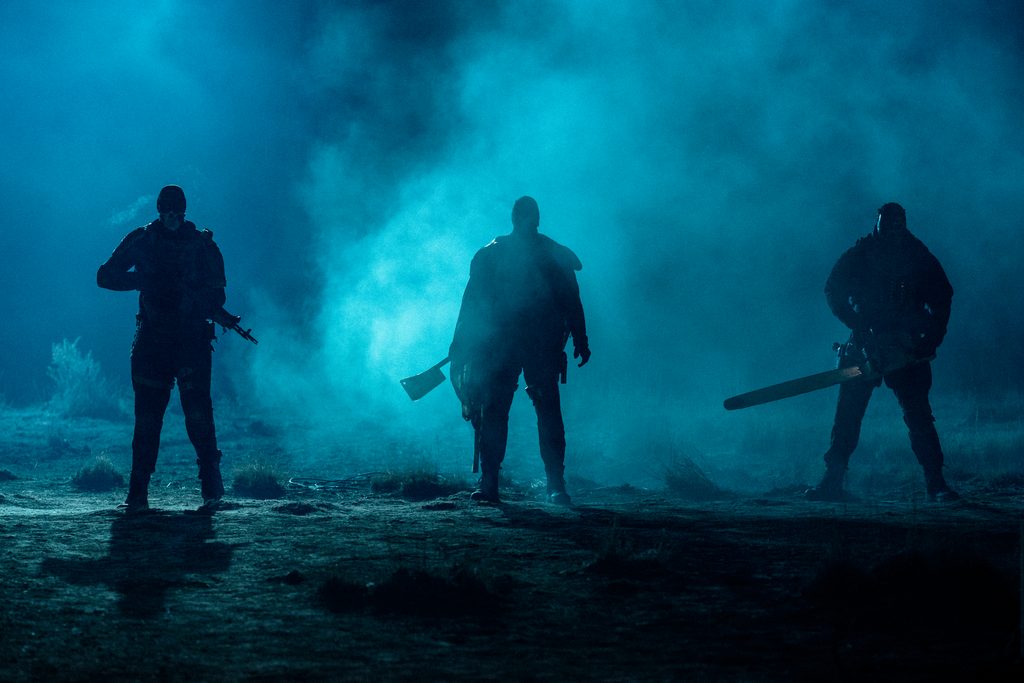
Onslaught follows Celeste (Adria Arjona), a single mother and former Army sniper struggling with PTSD while she lives inside a tiny, remote trailer-park community in the barren desert of New Mexico. While taking care of her young daughter, Celeste suddenly has to contend with three genetically engineered super-soldiers, who have escaped containment from a secret government facility and are on a merciless path of destruction.
Simply put, Onslaught is the best John Carpenter movie not made by John Carpenter. After a string of poor Godzilla and Kong movies, preceded by an abysmal adaptation of Death Note, filmmaker Adam Wingard returns to the kind of genre he initially made his name with. In conjunction with his regular collaborator Simon Barrett, Wingard masterminds the kind of throwback, pulpy, bizarre action thriller that would fit seamlessly into Carpenter’s filmography alongside the likes of Escape from New York and Halloween.
Wingard unabashedly borrows from every element of Carpenter’s filmmaking repertoire in crafting Onslaught. Matthew Pusti’s pulsating electronic score harkens back to Carpenter’s work on Halloween and The Fog. The super soldiers causing mayhem share the same ominous on-screen presence and destructive force of Michael Myers. Even the on-screen text feels strangely like it has been lifted from Carpenter movies of old. Sprinkle in some of James Cameron’s The Terminator and one arrives at a film that, while admittedly derivative, is the kind of stylized cinematic anarchy that would make Carpenter proud.
Like many great horror movies, Onslaught excels far more in its build up than fallout. Wingard takes plenty of time letting the tension mount as the audience knows the two parallel stories are going to collide once the on-screen timer lapses. While Arjona’s Celeste practices shooting her guns in the desolate dessert, a crazy Nazi scientist (Dan Stevens), his dominating wife (Rebecca Hall), and a military man (Michael Biehn) all have their hands in the creation of uber-violent super soldiers in a covert government lab. In drawing out the inevitable arrival of the super soldiers to Celeste’s remote trailer park, Wingard imbues his film with a strange mix of dread and delight – one both dreads what is coming Celeste’s way, but also delighted by the style and craftsmanship delivering such a Carpenter-esque movie to theaters.
After her impressive performance in Andor, Adria Arjona commands the screen in a decidedly different role this time around. Grappling with PTSD from her time in the Army, Arjona’s Celeste resorts to self-harm to regulate a tremor, fails to clean up her trailer, and is content living in the middle of nowhere as she believes it keeps her safe. Boy, is she wrong about the latter.
Arjona effortlessly takes on the role of a bad ass action hero, resoundingly showing Hollywood that there is a stellar actress armed and ready to lead more female-driven action movies. Unfortunately, the characterization of Celeste, her PTSD, and the distant relationship with her daughter all fail to live up to the presence of Arjona’s performance and, in turn, render Celeste a fairly uninteresting character to get behind. A painfully predictable third act twist, intended to add another layer to Celeste’s arc, falls flat on its face and underwhelmingly punctuates the journey of our protagonist.
Contrary to Celeste, much personality comes from Onslaught’s eccentric ensemble. Resembling The Tall Man from the Phantasm movies, Dan Stevens chews up the scenery as a deranged Nazi scientist subservient to his wife and utterly unfeeling as he engineers super soldiers ready to eliminate U.S. civilians without hesitation. Drew Starkey, meanwhile, delivers a scene-stealing turn as a government operative brought in to clean up the mess caused by the trio of escaped super soldiers. Starkey’s character admits early on that he took MDMA thirty minutes before being recruited for the mission, which gives the actor ample opportunities to be quirky with his line delivery and body language.

Once all hell inevitably breaks loose at the trailer park, Onslaught largely maintains its level of suspense, and couples it with some funny lines, courtesy of an excellent Eric Wareheim. But the extensive, prolonged build-up to Celeste’s conflict with the super soldiers means that Wingard places even more pressure on himself as a filmmaker to make the clash otherwise. And he doesn’t quite do that.
While the action is serviceable and the super soldiers are imposing figures, backed by incredible costume design and a clever use of light and darkness, Wingard’s film resolves far too quickly and easily. This proves so glaring that, as the film begins to wind down, one can’t help but feel the super soldiers were overhyped – that they weren’t exactly the unstoppable threat much of the movie teased them to be. The film would have benefitted from drawing out Celeste’s clash with the super soldiers and populating it with more deaths and violence, both of which would have justified such an extensive set-up.
VERDICT: 7/10
After a run of poor outings, Adam Wingard makes a triumphant return to genre fare with the best John Carpenter movie of all time not made by John Carpenter. Borrowing heavily from Carpenter classics like Halloween and The Fog, in addition to James Cameron’s The Terminator, Onslaught unabashedly embraces its myriad of influences with a pulpy, bizarre tone, a pulsating electronic score from Matthew Pusti, and antagonists that have the same ominous on-screen presence and destructive force of Michael Myers. Like many horror films, Onslaught excels more so in the build-up to the chaos than the chaos itself. Wingard maximizes tension and builds a nice concoction of dread and delight, before resolving his film’s primary conflict far too easily and quickly. Adria Arjona commands the screen as a bad ass action hero and makes a resounding case for being a new female action star Hollywood turns to, although the quality of her performance is let down by bland writing of her character. Meanwhile, scene-stealing turns from Dan Stevens and Drew Starkey add even more personality into a film brimming with style, mayhem, and craftsmanship. Usually films as blatantly derivative as Onslaught miss the mark and underwhelm in comparison to the movies they are so clearly inspired by. But somehow Wingard engineers a film so strange, suspenseful, and grindhouse-like that overlooking its lack of originality proves effortless.