
By George Bate
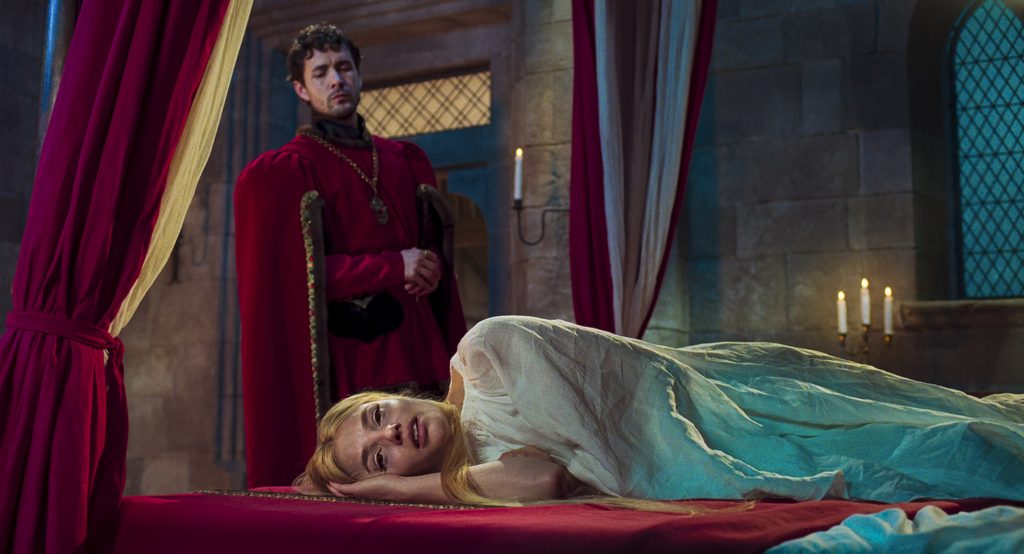
The Hammer horror movies of 1950s, 60s, and 70s remain some of the most atmospheric, colorful, and sensual horror movies of all time, and their absence from cinema for 50 years has left a gaping hole in the horror scene ever since. Enter Anne Biller, the filmmaker behind the woefully overlooked and vibrantly colored The Love Witch, who brings a meticulously crafted love letter to Hammer horror movies to this year’s Toronto International Film Festival.
Making its world premiere at TIFF, The Face of Horror is an adaptation of Tsuruya Nanboku IV’s “Yotsuya Kaidan” that transposes Japan’s most famous ghost story to 14th century feudal England. A dastardly knight named Edward (Jonah Hauer-King) murders and schemes his way into marrying Eleanor (Kristine Froseth). After being wooed by Edward’s charm and feigned chivalry, Eleanor begins to see cracks in her marriage as Edward turns his sights onto another woman.
Filmed on stunning 35mm with striking Technicolor visuals, The Face of Horror uncannily recreates the atmosphere of classic Hammer movies of the past. Biller’s efforts are so impressive that her latest film could even be mistaken for a production from the 1960s or 1970s, such is the masterful attention to detail on display in every department. The Technicolor saturation brings brilliant hues of deep crimson, emerald green, and midnight blue to the screen. The sets, most of which are interiors of castles, feel expansive and overly clean, yet delightfully low budget. The velvet costumes pop and seem to have a life of their own. Even the exposition shots setting up each scene, often from a high angle, mirror how many Hammer movies staged their scenes.
Needless to say, The Face of Horror nails the Gothic romanticism, low budget charm, and mournful sumptuousness of Hammer productions. And, thankfully, it has a story fitting the extensive behind the scenes efforts. Bringing “Totsuya Kaidan” to 14th century England is a stroke of genius as it is the exact kind of winding, fate-tempting story anchored by a morally fallible lead that Hammer would have produced back in the day.
Like many Hammer movies, The Face of Horror isn’t exactly a horror movie for much of its runtime, although those patient enough to wait for the final act will be treated to delightfully grotesque visuals that ensure Biller’s film lives up to its title.
Unfortunately, it’s also in the final act that The Face of Horror disintegrates before the viewer’s eyes. With a runtime of 120 minutes, Biller’s film misguidedly overstays its welcome by 20+ minutes. The final third is populated with punctuating moments that could easily cap the film off, yet Biller drags things out in a manner both unnecessary and frustrating. The film’s style carries so much of the audience’s enthrallment for so long, but even such elaborate attention to detail can’t carry the weight of a film that refuses to end.
The arduous slog to the finish line would be easier to reach if it wasn’t for the miscalculated creative decision to not lean into the inherent humor of a movie that so closely replicates admittedly outdated horror films from decades past. Admirably, Biller doesn’t parody the movies she is clearly inspired by, instead recreating what it was like to watch one of them with incredible faithfulness. The problem with such precision, however, is that there are opportunities for humor that go to waste – opportunities that could have given the film an extended shelf life beyond the technical proficiencies on display.
That is not to say that The Face of Horror is devoid of humor, however. Increasingly as the film moves along, Biller adds a clever feminist spin on the Hammer formula, a decision that gives way to a few decent laughs. Biller refrains from satirizing the films she loves and is inspired by with this sole exception. The Hammer productions were notoriously made with the male gaze in mind and didn’t always portray women as a meaningful, fleshed out characters (to say the least). Biller is well aware of these missteps and has fun poking fun at the absurdity and contradictions inherent to Hauer-King’s sexist and barbaric belief system.
VERDICT: 6.5/10
Making its world premiere at this year’s Toronto International Film Festival, The Face of Horror finds filmmaker Anne Biller oversee a meticulously crafted love letter to the Hammer horror movies of the 1950s, 60s, and 70s, bringing Tsuruya Nanboku IV’s “Yotsuya Kaidan” to 14th century feudal England. Filmed on stunning 35mm with striking Technicolor visuals, the film uncannily recreates the atmosphere, Gothic romanticism, low budget charm, and mournful sumptuousness of classic Hammer productions, with masterful attention to detail in every department. Biller’s adaptation is a stroke of genius, anchored by a morally fallible lead and a winding, fate-tempting story fitting of Hammer’s golden age. However, the film misguidedly overstays its welcome by 20+ minutes, while its refusal to lean into the inherent humor of its admittedly outdated inspirations leaves opportunities for laughs to go to waste. Nonetheless, Biller’s clever feminist spin on the Hammer formula provides a few decent laughs and gives the film a unique edge.