
By Josh Bate

Few Hollywood origin stories could be more perfectly suited to the movies than the story of how Rocky came to exist. A struggling actor with little money, few prospects, and even fewer believers somehow manages to turn his own desperation into one of the most enduring underdog stories in cinema history. I Play Rocky intimately understands the glorious irony at the heart of that story: before Stallone’s fictional boxer ever stepped into the ring, Stallone himself was fighting an uphill battle to get his dream made. The result is a remarkably warm, funny, and deeply affecting celebration of perseverance that does more than chronicle the birth of a classic by capturing the same inspirational magic that made Rocky such a cultural phenomenon in the first place, ultimately resulting in one of the year’s greatest movies.
Making its world premiere at this year’s Toronto International Film Festival, I Play Rocky follows Sylvester Stallone throughout the 1970s as he struggles to establish himself as an actor and eventually decides to take matters into his own hands. The film traces his journey from failed auditions and dead-end jobs to his move to Los Angeles, where repeated rejection pushes him toward writing a screenplay he can star in himself. That screenplay, of course, is Rocky. As Stallone encounters skepticism from virtually every corner of the industry, the film charts his increasingly determined efforts to protect his vision and transform an unlikely script into a feature film.
Without a shadow of a doubt, the film’s greatest asset is leading man Anthony Ippolito, who gives the kind of transformative performance that can instantly define an actor’s career. Ippolito does not merely reproduce Stallone’s distinctive voice, physicality, or mannerisms; he captures the essence of the man behind them. There are moments when the resemblance becomes almost uncanny, and yet the performance is far more impressive than a feat of mere mimicry. Ippolito finds the insecurity beneath Stallone’s bravado, the sensitivity beneath his toughness, and the stubborn conviction that allows him to continue pursuing an ambition everyone else considers unrealistic. There are shades of Jamie Foxx’s Ray Charles and Daniel Day-Lewis’s Abraham Lincoln in terms of how extensively Ippolito is able to disappear entirely into the person being portrayed.
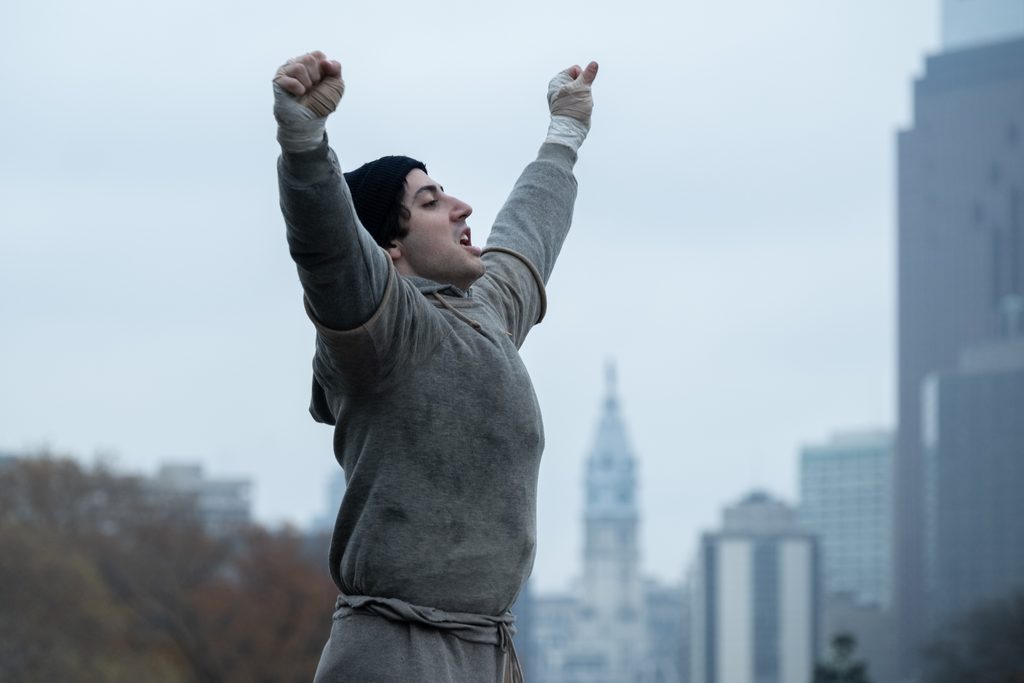
In addition to Ippolito’s phenomenal performance, what makes I Play Rocky so effective is not simply its resemblance to the movie being made within it. Farrelly recognizes that Stallone’s real-life story possesses the same fundamental emotional machinery as his screenplay. Stallone is mocked for his speech, dismissed because he lacks the conventional appearance of a leading man, and routinely underestimated by the people around him. Still, he refuses to abandon the one thing he believes he can become. Even with the ending predetermined by history and known to all who watch the movie before the first frame graces the screen, Farrelly makes the struggle itself compelling enough that the audience becomes invested in each successive setback and triumph.
All of this makes I Play Rocky an unusually potent piece of inspirational filmmaking. Yes, it doesn’t dare to subvert the mechanics of the underdog narrative, yet Farrelly’s confidence in all the expected beats proves to be an advantage. The director of Green Book once again demonstrates an almost instinctive understanding of how to manufacture a range of emotions without losing sight of the humanity underneath them.
The comedy is similarly assured. Farrelly draws much of the film’s humor from the absurdity of filmmaking itself: the frantic production process, the questionable decisions, the competing egos, and the sheer improbability of getting a movie from an idea to a finished product. These sequences offer a delightful glimpse behind the curtain while also reinforcing the central theme of the film – that making Rocky was itself an improbable gamble. Farrelly’s comedic instincts allow these moments to land without ever puncturing the sincerity of the larger story.
VERDICT: 8.5/10
Making its world premiere at this year’s Toronto International Film Festival, I Play Rocky turns the extraordinary true story of Sylvester Stallone’s struggle to get Rocky made into a soulful, funny, and deeply inspirational crowd-pleaser. Anthony Ippolito delivers a career-defining, awards-worthy performance, transforming into Stallone with uncanny precision and capturing the charisma, vulnerability, and determination behind the iconic actor. Supported by an outstanding ensemble, Peter Farrelly effectively recreates the hardship, rejection, and eventual triumph of Stallone’s journey while filling the film with tremendous heart and humor. Though it plays things pretty safe and formulaic, Farrelly’s instinct for emotional storytelling and comedy ensures that the film remains exceptionally uplifting. Most impressively, I Play Rocky mirrors the very underdog story it chronicles, ultimately becoming one of the year’s greatest movies.