
By George Bate
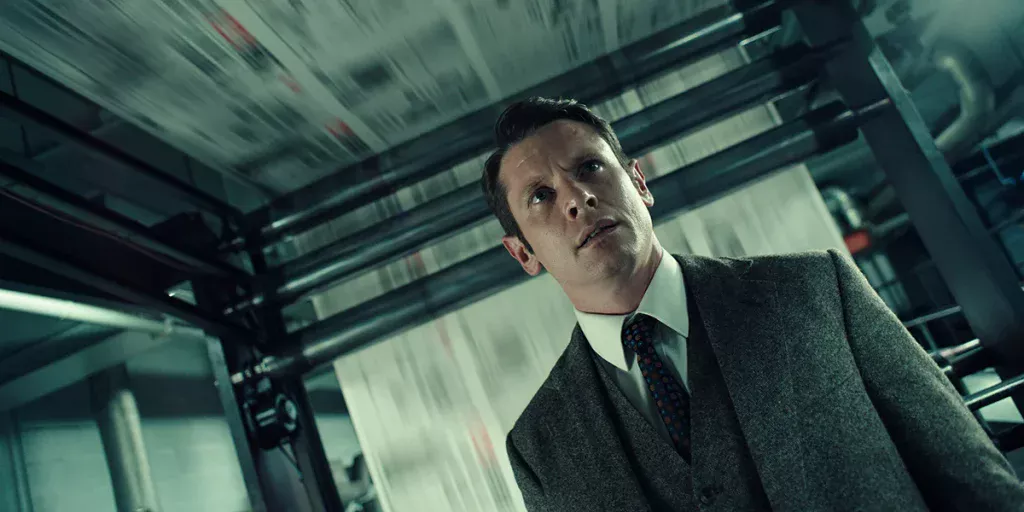
1969 was an eventful year, to say the least. Richard Nixon was elected president of the United States. Woodstock took place. People stepped foot on the moon for the first time. Even Butch Cassidy and the Sundance Kid hit theaters. But arguably no event in 1969 proved as critical to the trajectory of human history ever since than the fateful meeting between Rupert Murdoch and Larry Lamb. Unfortunately, Ink, a new film that depicts the initial fallout of this meeting, fails to capture the most powerful, relevant, and unsettling elements of the story by concluding prematurely.
Making its Canadian premiere at this year’s Toronto International Film Festival, Ink begins in 1969 as Rupert Murdoch (Guy Pierce) purchases The Sun newspaper and hires ambitious editor Larry Lamb (Jack O’Connell) to run it. Believing that the news industry is stale, Lamb radically reinvents The Sun by prioritizing entertainment over information, giving readers the most titillating ‘news’ so that they keep buying papers. But Lamb’s groundbreaking approach to news comes with consequences.
Driven by director Danny Boyle’s trademark kinetic filmmaking style, Ink plays like a The Social Network and The Wolf of Wall Street-esque underdog origin story. Like Fincher and Scorsese’s acclaimed works, the film follows a well-spoken, sharp, and morally compromised man as he ambitiously takes on completely novel approaches to established concepts. This concept in question in The Social Network was social connectivity, whereas this concept in The Wolf of Wall Street was the stock market. But Ink concerns itself with the news cycle, in particular how Lamb’s radical shake-up of The Sun set off a chain of events that forever changed the world.
Unfortunately, this point doesn’t come across. Boyle reflects on the conflation of news and entertainment, in addition to how sensationalism corrupts those disseminating it. However, the English filmmaker takes an unusual sympathetic approach to two figures, in particular Murdoch, who have had enduring and deleterious effects on society.
Offering a decent argument for why the news should be more sensationalized as it gives readers what they want and reflects their actual living, Ink begins to encroach on the controversies, privacy violations, and misinformation The Sun was responsible for, but then prematurely comes to a baffling end. The real damage The Sun inflicted, whether it be through coverage of the Hillsborough disaster, the phone hacking scandal, or countless other controversies, is relegated to a footnote at the very end of the film. In turn, Ink fails to convey the extent of harm brought into the world by The Sun, leaving its most prescient commentary disappointingly unexplored.
This fundamental issue with Ink means Boyle’s film can be best characterized as the first half of a movie in which its missing, far more powerful and relevant second half is nowhere to be seen. It’s like if The Social Network and The Wolf of Wall Street if they were too sympathetic toward their morally compromised protagonist and if the story stopped just as Facebook started taking off or Jordan Belfort launched his company.
VERDICT: 5/10
Making its Canadian premiere at this year’s Toronto International Film Festival (TIFF), Ink uses The Social Network and The Wolf of Wall Street playbook to chronicle the origin story of The Sun and comment on how news transformed into entertainment thanks to Larry Lamb and Rupert Murdoch. The issue is that the film, despite featuring Danny Boyle’s trademark kinetic style, comes to an end just when the story starts to really get interesting and particularly relevant. The immorality, privacy violations, controversies, scandals, and misinformation that the paper created are a footnote at the very end of the film, which strangely plays more like a sympathetic underdog tale than it does a scathing critique of a news giant that has caused so much harm. Yes, The Sun’s entertainmentification of the news brought something unwieldy and dangerous into the world, but Danny Boyle doesn’t allow the audience to actually see the full extent of this groundbreaking reinvention and, as a result, creates a film that feels like the first half of a movie in which its missing second half would be far more powerful, unsettling, and relevant.