
By George & Josh Bate
With just two solo directorial efforts under his belt to date, Zach Cregger has quickly established himself as one of the preeminent horror filmmakers working today. His quick ascent to renown meant that, when it was announced he was going to helm a reboot of Resident Evil, fans of the survival horror series of games from Capcom felt that finally a faithful Resident Evil movie would arrive. Continuing to cement his status as one of the most visionary and effective horror filmmakers in modern cinema, Cregger finally delivers a Resident Evil film that captures the core features and atmosphere of the games and, more generally, is a phenomenal exercise in pacing and tension building. However, an unbalanced tone that overemphasizes humor, at the detriment of horror, blunts its ultimate pact.
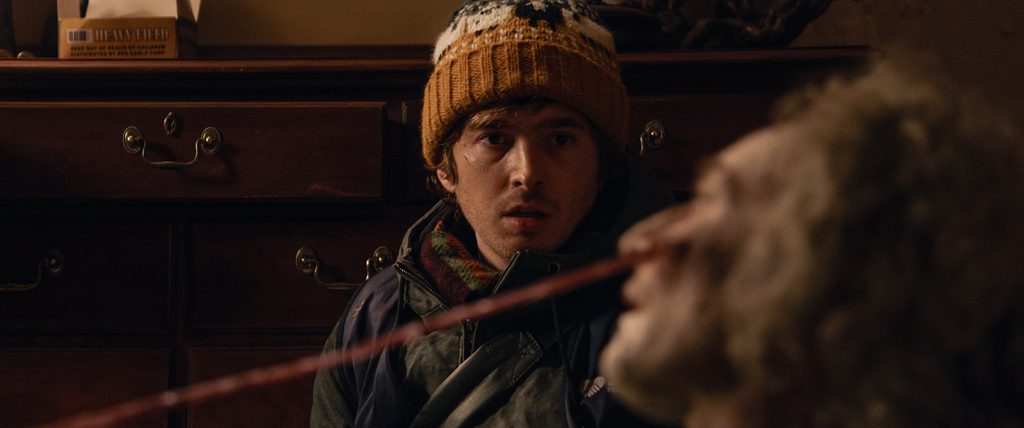
Resident Evil stars Austin Abrams as Bryan, a hapless courier tasked with delivering an organ transplant to a remote hospital. While making the journey through a snowy night, Bryan crashes into a strange woman, a fateful incident that sets off a chain of events involving a deadly outbreak and numerous mutated creatures.
Cregger has long spoken of his adoration for the Resident Evil video games and demonstrates this passion in every frame of his latest film. Choosing not to adapt a storyline from any of the games has certainly sparked debate, yet this decision should not be conflated with Cregger thinking of himself as above the franchise or believing that he can do better.
Anyone who has played a Resident Evil game will recognize the painstaking efforts Cregger has taken to make his movie the cinematic equivalent of a Resident Evil game. This doesn’t just materialize as Easter eggs and fun references (although there are plenty of those); it plays out in the very essence of his film. The unrelenting pressure, style of jump scares, and, perhaps coolest of all, resource management the games are known for all carry over seamlessly into the film. Just the very idea of knowing how many bullets Austin Abrams’ protagonist has left in his pistol or wincing every time he drops a shotgun shell because we know that’s one less he’ll have at his disposal later on will almost certainly tap into nostalgia and memories for those familiar with the pioneering survival horror franchise.
With the essential ingredients of a Resident Evil game finally brought to the big screen, Cregger attempts a decidedly different horror movie that his previous outings. Whereas Barbarian and Weapons had intriguing, winding, layered stories that reinvented themselves as they went along, Resident Evil is a far leaner beast. Gone are characters’ interconnected stories and mid-film shockers that drastically alter the course of the film. Instead, Cregger’s adaptation simply follows a protagonist as he attempts to go from point A to point B, while trying to fend off every increasingly terrifying obstacle that comes in his way.
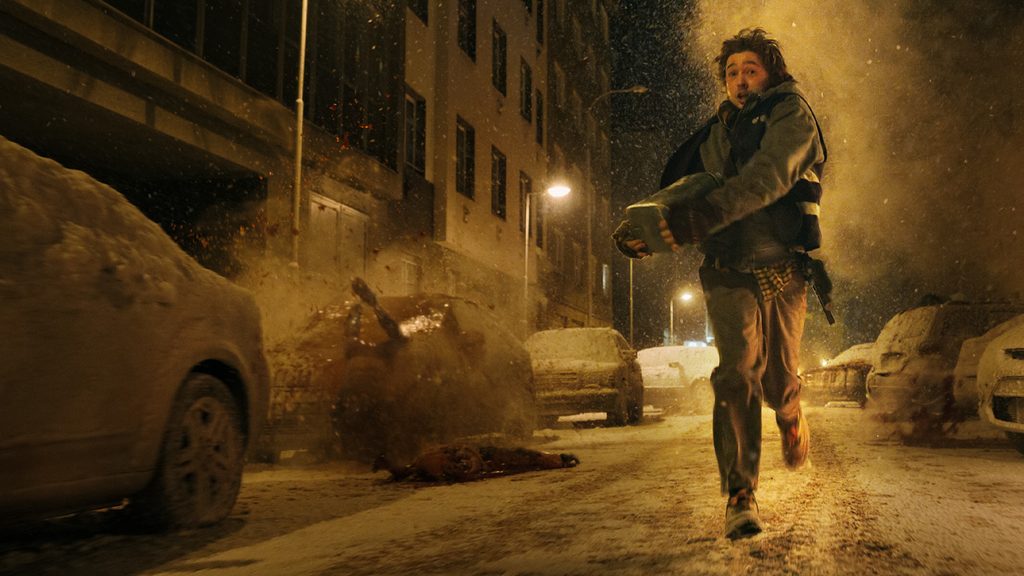
In this sense, Resident Evil feels strangely akin to Uncut Gems. Like the Safdie Brothers’ 2019 film, Cregger’s movie possesses a certain chaotic tension in which the plot functions like a compounding series of life-altering decisions. There is a domino effect reverberating through the film as everything Bryan does, even the simplest of things, changes the trajectory of his journey over the course of one crazy night.
In adopting such a frenzied, ever-moving plot structure, Resident Evil has no time nor space for breathing room. The film propels forward at a breakneck pace and rarely dedicates screentime to more quiet moments of reflection. When the film does opt to be more introspective, it feels like it is the result of Cregger recognizing that audiences and critics would find issue with him making a film completely absent of any character work. The beginning of the film introduces that Bryan’s girlfriend is pregnant and that Bryan is hesitant about whether she should have the baby, but the unrelenting momentum of the plot relegates this to the periphery for the entirety of the remainder of the film, with the exception of a single scene. While more depth to Bryan’s character would foster greater investment in his journey, the sheer underdevelopment of the protagonist suggests that the film would benefit from simply removing all these half-hearted attempts entirely.
On paper, a briskly paced survival horror movie set over the course of one snowy night would make for gripping, nail-biting viewing, but, unfortunately, Resident Evil isn’t always that. That’s because Cregger misconfigures the tone of his latest film, often prioritizing humor over horror. Once again, Cregger shows that he has a strong handling of how to craft a scare, frame a shot, and move the camera to send chills down viewers’ spines, but he undoes much of his good work by punctuating nearly every moment of the film with some kind of attempt at humor.
Almost the entirety of the film’s comedy comes in the form of reaction humor. When things inevitably get crazier and crazier for Bryan, Abrams will make a high-pitched squeal, deliver a deadpan one-liner, or fumble in his attempts to shoot a gun or leap a fence. While some of these gags work well, thanks to a fantastic Abrams in possession of sharp comedic timing, they primarily undercut the tension of any given scene. Weapons and Barbarian knew how to deftly weave in more inventive forms of humor to elicit laughs in ways that did not compromise tension or dread. Unfortunately, the same cannot be said for Resident Evil.
The miscalculated tonal balance between horror and humor admittedly gives way to a rather crowd-pleasing cinematic experience, the kind of film destined to generate big laughs and cheers from moviegoers. But Cregger’s movie deteriorates in a final act that is far less interesting than its predecessors. A reveal about Abrams’ character comes far too soon in the film and immediately deprives it of much-needed suspense, the overemphasis on humor becomes increasingly salient, and it becomes clear that the film may be just a tad too lean and straightforward for its own good. Resident Evil is crying out for some injection of reinvention or additional layers to its story, but neither ever comes.
VERDICT: 6.5/10
Continuing to cement his status as one of the most visionary and effective horror filmmakers in modern cinema, Zach Cregger finally delivers a Resident Evil film that captures the core features and atmosphere of the games, making for a phenomenal exercise in pacing, tension building, and resource management. Unfortunately, an unbalanced tone that overemphasizes humor at the detriment of horror blunts its ultimate impact, with the constant reaction humor frequently undercutting the tension and dread Cregger characteristically creates. While the film’s frenzied, ever-moving plot structure makes for a decidedly different horror movie from Barbarian and Weapons, its lean and straightforward story, underdeveloped protagonist, and increasingly salient overemphasis on humor leave the final act feeling less interesting than its predecessors. Resident Evil is a crowd-pleasing cinematic experience that successfully brings the essential ingredients of a Resident Evil game to the big screen, but it is ultimately crying out for a reinvention or additional layer that never comes.