
By Josh Bate
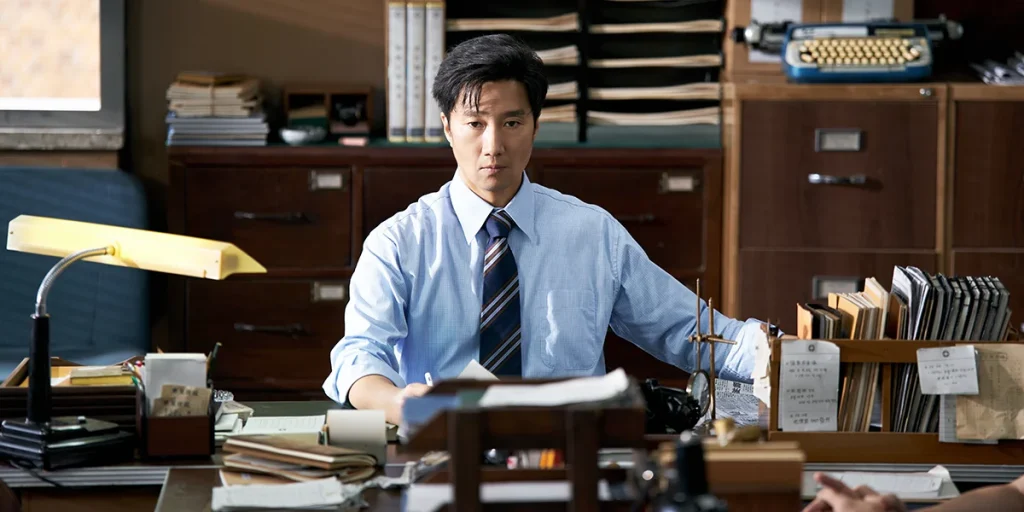
The attempted assassination of South Korean President Park Chung-hee is the kind of historical event that seems tailor-made for a conspiracy thriller. With The Assassin(s), director Hur Jin-ho turns this chilling chapter of South Korean history into a propulsive political mystery that finds its greatest intrigue not in the shooting itself, but in the government’s increasingly desperate attempts to control how the shooting is understood and the determinations of three men to figure out what truly happened.
Making its world premiere at this year’s Toronto International Film Festival, The Assassin(s) centers on three men who become increasingly suspicious of the government’s account of the assassination attempt. A veteran journalist (Park Hae-il) immediately notices problems with the official narrative, while senior police inspector (Yoo Hai-jin) finds himself caught between investigating those discrepancies and following orders from above. Rookie reporter Han Young-il (Lee Min-ho) joins them as the investigation grows, with the trio gradually discovering that the strange details surrounding the shooting may point toward something considerably larger than a lone gunman. Their inquiries are repeatedly obstructed as officials accuse investigators of communist sympathies, suppress information, and order anyone asking inconvenient questions to back off. The further they investigate, the more apparent it becomes that the real danger may not be discovering what happened, but challenging the version of events that those in power have already decided the public should believe.
Hur immediately drops audiences into the political chaos surrounding the incident and rarely lets the movie lose momentum. The Assassin(s) is structured as a fast-paced and fact-based whodunnit, but its mystery steadily expands beyond the question of who pulled the trigger. Missing bullets, contradictory testimony, questionable police behavior, strange angles, and conflicting reports all contribute to a steadily widening web of suspicion. It is not an exaggeration to say that this feels, in every sense of the word, like a Korean counterpart to the JFK assassination.
What makes the movie particularly compelling beyond its winding mystery, however, is the way that investigation exposes the machinery of censorship. The Assassin(s) is less interested in presenting a grand conspiracy for audiences to marvel at than it is in showing how easily an authoritarian government can manipulate public understanding of an event.
Such an approach gives the film’s political commentary considerably more bite than a conventional conspiracy thriller. The characters repeatedly encounter a system that has already determined what the public is supposed to know, leaving them to work backward through the gaps. The movie’s most unsettling moments therefore aren’t necessarily the violent ones. They come when an apparently innocuous question is treated as a political threat, or when an official confidently presents an explanation that the evidence plainly doesn’t support.
Rather than stopping the story for lengthy political exposition, Hur lets the characters discover the machinery of censorship themselves. Each new contradiction reveals another layer of institutional interference, while every attempt to investigate the shooting brings the trio closer to people who have a vested interest in maintaining the official narrative. The result is a thriller that keeps you guessing and on the edge of your seat, even if it doesn’t offer all the answers you may want.
Much of that tension comes from the chemistry between Park Hae-il, Yoo Hai-jin, and Lee Min-ho. Together, the three make an excellent investigative unit. Their conversations have a natural rhythm, and Hur fills the movie with tantalizing exchanges in which suspicions are raised, evidence is dissected, and assumptions are challenged. Their dynamic also gives the film a welcome human dimension amid all of its historical and political detail.
The movie’s influences are unmistakable, but they are also particularly fitting. There are shades of JFK and All the President’s Men all over this film as, like those two classics, Hur’s film is built around investigation, dialogue, and mounting suspicion rather than relying on spectacle to manufacture excitement.
VERDICT: 7/10
Making its world premiere at this year’s Toronto International Film Festival, The Assassin(s) succeeds as a suspenseful political thriller akin to JFK and All the President’s Men. Through a fact-based whodunnit filled with missing bullets, contradictory accounts, suspicious behavior, and conspiracy theories, Hur Jin-ho reconstructs a moment when censorship and government manipulation could determine not only what the public believed, but which questions people were even permitted to ask, themes that reverbrate disturbingly in the modern day. Park Hae-il, Yoo Hai-jin, and Lee Min-ho make for a terrific trio of investigators, while Hur’s strong handling of pacing and direction keeps the mystery flowing.