
By Josh Bate
John Malkovich has spent decades building one of the most distinctive careers in American cinema, moving effortlessly between eccentric supporting roles, commanding dramatic performances, offbeat comedies, and some downright strange characters. From his unforgettable work in films like Being John Malkovich and Dangerous Liaisons to the countless memorable performances that followed, Malkovich has always possessed an unmistakable screen presence.
Such an illustrious filmography and array of performances makes Malkovich’s work in Wild Horse Nine all the more remarkable. As unusual, funny, and unpredictable as Malkovich has ever been, he also finds an extraordinary depth of pain, regret, and vulnerability here. After such a long and accomplished career, Wild Horse Nine contains his finest performance.
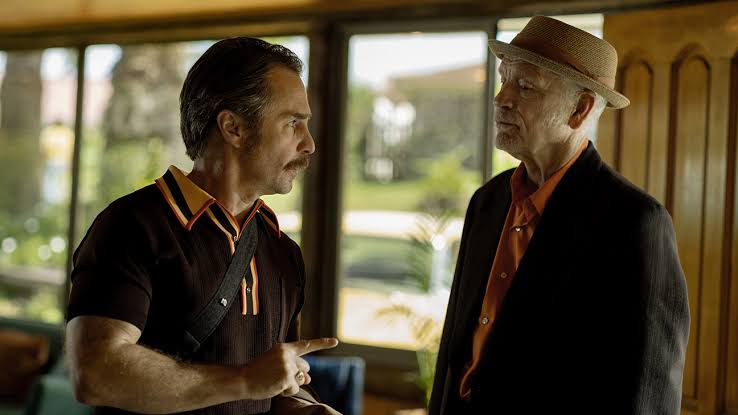
Making its Canadian premiere at this year’s Toronto International Film Festival, Martin McDonagh’s Wild Horse Nine is set in the 1970s and follows CIA agents Chris (John Malkovich) and Lee (Sam Rockwell) as they travel to Easter Island for a vacation shortly before the coup in Chile that will overthrow Salvador Allende. There, Chris reckons with his impending death due to a terminal illness, while Lee struggles to keep his CIA boss (Steve Buscemi) at bay.
For the better part of two decades, Martin McDonagh has cultivated a very specific cinematic identity. His films combine morbid humor, abrasive dialogue, absurdity, violence, and unexpectedly tender examinations of grief and loss. Wild Horse Nine fits comfortably within that tradition, but it bears an uncannily strong resemblance to In Bruges. McDonagh’s 2008 breakthrough, starring Colin Farrell and Brendan Gleeson, remains the finest movie of his filmography. Nearly two decades later, Wild Horse Nine bears so many similarities to that film that it occasionally feels less like a completely separate work and more like an unofficial companion piece.
The parallels between the two films are difficult to ignore. Both films center on morally corrupted men forced to confront their pasts. Both use buddy dynamics as the foundation for black comedy, place damaged characters within picturesque foreign environments, and allow melancholy to seep into otherwise hilarious situations. Both also feature a nasty, balding authority figure looming over the protagonists, as well as a person of short stature whose presence carries unusual symbolic importance. Those similarities inevitably make Wild Horse Nine vulnerable to comparison with In Bruges, and McDonagh’s latest does not quite reach the same heights.
Perhaps unfair comparisons aside, the new film nonetheless delivers McDonagh’s signature blend of black humor, morbid thought-provocation, and unexpected twits that audiences have come to expect from the filmmaker. Beneath all of the bizarre exchanges and potentially objectionable humor, Wild Horse Nine is ultimately a deeply melancholy story about anticipatory grief of self.
Chris is suffering from worsening cognitive impairment, while also living with a terminal illness that makes it increasingly clear that his time is running out. This knowledge transforms Chris from an eccentric McDonagh creation into something considerably more affecting, perhaps best characterized as a blend of Gleeson and Farrell’s characters from In Bruges.
Malkovich is extraordinary precisely because he does not abandon Chris’ eccentricity in order to make him sympathetic. Instead, he layers genuine pain and regret underneath it. Chris remains abrasive, peculiar, and at times deeply unlikeable, yet there is an unmistakable humanity beneath the surface. He becomes another example of the lovable, yet off-putting characters McDonagh has repeatedly mastered.
There is also a larger political dimension to Chris’ journey. After spending his career overthrowing governments as an agent of an overreaching CIA, he is forced to look back at the consequences of his actions as he comes to the end of his life. It doesn’t require much extrapolation to interpret this as McDonagh’s apparent conception of a remorseful United States government, confronting its influence on 20th-century politics with condemnation and compunction.
While the film belongs firmly to Malkovich, Sam Rockwell is every bit the reliable scene partner audiences have come to expect. His performance is remarkably expressive and he gives Lee a genuine warmth that makes his relationship with Chris feel tender and authentic.
VERDICT: 8/10
Making its Canadian premiere at this year’s Toronto International Film Festival (TIFF), Wild Horse Nine may not match the quality, originality, or emotional impact of In Bruges or The Banshees of Inisherin, but it remains yet another brilliant blend of black comedy and morbid-thought provocation that audiences have come to expect from Martin McDonagh. Its biting humor, carefully planted jokes, subversive third-act payoffs, picturesque setting, and poignant commentary on anticipatory grief of self make it unmistakably McDonagh. Yet, despite this being perhaps a somewhat too familiar outing for McDonagh, the film ultimately belongs to John Malkovich, who gives the finest performance of his career by combining his familiar eccentricity with layers of pain, regret, cognitive impairment, spirituality, and impending death. Like In Bruges, Wild Horse Nine proves to be a deeply moving, melancholic portrait of loss wrapped in a witty and mildly objectionable black comedy audiences will surely have a great (and rather emotional) time with.