
By George & Josh Bate
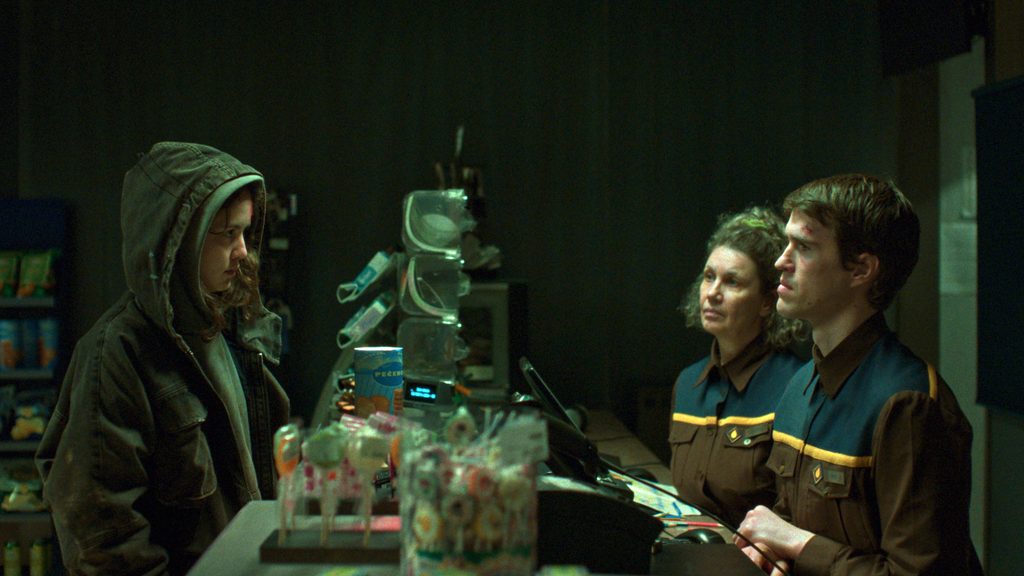
Luka Marčetić’s Slovenian black comedy Girl in the Night is an odd little film about an even odder little man, one that gradually transforms from a portrait of isolation into the most bizarre and offbeat of superhero stories.
Making its world premiere at this year’s Fantastic Fest, Girl in the Night follows Rok (Urban Kuntarič), a lonely kleptomaniac who works the night shift at a gas station and passes the time by stealing snacks from his own workplace. His aimless existence takes an unexpected turn when he encounters Iza (Lara Wolf Završnik), a mysterious young woman who spends her nights fighting petty criminals. After Rok attempts to steal her bicycle, using an absolutely ludicrous disguise in the process, the two begin an unlikely friendship that pulls Rok into Iza’s strange nighttime world. What follows is less a conventional superhero story than a character study about two outsiders finding some semblance of connection in an unfeeling world.
Visually, Girl in the Night immediately establishes itself as a film about loneliness. There is a darkness to the movie reminiscent of Let the Right One In, although Marčetić uses that darkness less for horror and more for atmosphere. The streets of Ljubljana are filled with empty space, grimy locations, and off-putting streetlights that illuminate the night in an artificial, almost sickly manner. Rok’s gas station job is similarly drab and unglamorous, surrounded by fluorescent lighting that makes a workplace feel even more depressing after midnight. Everything feels slightly cold, slightly dirty, and completely devoid of excitement. More importantly, that visual language aligns perfectly with Rok himself. The world looks the way Rok experiences it: lonely, monotonous, and largely indifferent.
The sense of monotony extends to practically every aspect of Rok’s life. His mundane gas station job, his strange roommate and his roommate’s partner, and even the most painfully awkward birthday party imaginable all reinforce the sense that he exists just outside normal society. There is something both sad and genuinely funny about watching this guy stumble through everyday interactions as though he has never quite figured out the rules everyone else seems to understand instinctively. His kleptomania only adds to that feeling. Rok stealing candy bars from the gas station where he works is hardly the stuff of a criminal mastermind; instead, it’s the solitary example of something even remotely interesting in his life.
Then, breaking through much of the mundanity, the film comes alive with the introduction of Iza. Rok initially tries to steal her bike, but the ridiculousness of his disguise makes the entire encounter immediately hilarious. From there, he discovers that Iza is something of a vigilante, spending her nights confronting people committing petty crimes and treating these encounters with an almost absurd level of seriousness. There is an inherent joke in the idea of a vigilante operating in Ljubljana, a city where there seemingly aren’t enough major crimes to justify having one. Yet Iza never treats her mission as a joke. She barely needs dialogue to communicate her intensity, with Lara Wolf Završnik giving the character a wonderfully strange presence and intimidation. She carries herself with such conviction that the absurdity of what she is doing becomes even funnier.
Rok and Iza make for an unexpectedly compelling pair because they seem completely incompatible while somehow fitting together perfectly. Their physical dynamic is humorously lopsided, with the smaller Iza possessing virtually all of the power between them. Rok’s nonchalant, passive demeanor starkly contrasts her unwavering intensity. Their relationship never needs to become romantic to be meaningful. Instead, there is something almost endearing about the way Rok looks up to Iza, despite the fact that she is younger and smaller than him. Iza is strange enough to claim that she can fly, but only when nobody else is watching. Rok, meanwhile, is strange enough to believe her — or at least be willing to entertain the possibility. Together, they create the film’s central dynamic: two deeply peculiar people who recognize something in one another that nobody else seems to notice.
The humor throughout Girl in the Night is similarly understated. The film is built around awkward pauses, deadpan reactions, dry observations, and characters who rarely emote in the way you expect them to. At its best, the comedy feels like a strange collision between the films of Yorgos Lanthimos, Napoleon Dynamite, and The Art of Self-Defense. There are moments when the humor is perhaps a little too dry for its own good, but that restraint is also fundamental to the film’s personality. Girl in the Night is equal parts melancholic and playful, finding laughs in situations that are simultaneously sad. Even Rok getting punched off his bicycle early in the film is framed in a way that makes the moment both genuinely unfortunate and bizarrely funny. It’s through this balance that, in the absence of much of a narrative with forward momentum, renders Girl in the Night such unique viewing. Loneliness, by definition, can be depressing, but it can also be quite funny.
VERDICT: 7.5/10
Making its world premiere at this year’s Fantastic Fest, Luka Marčetić’s Slovenian black comedy Girl in the Night is an odd little film about an even odder little man, gradually transforming from a portrait of isolation into a bizarre and offbeat superhero story. Visually, Girl in the Night is a film about loneliness, using the dark, moody aesthetic of Let the Right One In, empty streets, grimy locations, and off-putting streetlights to create a world that feels cold, monotonous, and indifferent, perfectly reflecting Rok’s experience of it. Yet the film comes alive upon Iza’s introduction, as her unwavering intensity and Rok’s nonchalant passivity create an unexpectedly compelling pairing. Their relationship is never romantic, but instead becomes a strange connection between two outsiders who recognize something in one another that nobody else seems to notice. Built around awkward pauses, deadpan reactions, and understated humor, Girl in the Night feels like a peculiar collision between Yorgos Lanthimos, Napoleon Dynamite, and The Art of Self-Defense, balancing melancholy and playfulness as it finds humor in situations that are simultaneously sad. There isn’t much narrative momentum, but Marčetić largely makes up for it with a uniquely offbeat atmosphere and a pair of wonderfully strange characters, ultimately proving that loneliness, by definition, can be depressing, but it can also be quite funny.