
By George & Josh Bate

In 2010, director David Fincher and screenwriter Aaron Sorkin collaborated to make The Social Network, an enthralling, razor-sharp, and precisely crafted portrait of a cipher of a man whose impact on the world remains immeasurable. But the story of Mark Zuckerberg and Facebook did not end with The Social Network, as the 16 years since the film’s release have seen the company blossom from a booming desktop social media network to an all-encompassing trillion dollar corporate empire. That growth did not come without its fair share of controversies and scandals, one of which lays at the center of The Social Reckoning, an engaging investigative journalism whistleblower drama that, while lacking the singular style and punch of Fincher’s film, makes up for its lack of stylistic and narrative novelty with a necessary, effective, and admirably scathing critique of Facebook’s amplification of misinformation and hate.
The Social Reckoning follows young Facebook engineer Frances Haugen (Mikey Madison) as she teams up with Wall Street Journal reporter Jeff Horowitz (Jeremy Allen White) to expose Facebook’s hidden practices to push content that causes anger and, in turn, higher user engagement.
Marketing The Social Reckoning as a sequel to The Social Network belies how markedly different the two films are. Whereas Fincher’s film was a sleek and fascinating character study about the intersection of narcissism and extraordinary intellect that propelled forward at the speed of a bullet, Sorkin’s follow-up operates as a more straightforward journalism drama, more akin to All the President’s Men than The Social Network. If evaluated as two companion pieces, however, as promotional materials suggest, The Social Network is a film in which the villain emerges victorious by the end and The Social Reckoning is the sequel that follows the consequences of the villain’s victory.
Divided into several chapters, The Social Reckoning mesmerizes from its very first frames as a prologue, interestingly titled ‘White Girl Wasted,’ superbly showcases why Sorkin is such a master of dialogue. Indeed, as the film progresses and fluctuates between clunky scenes and enthralling, can’t-take-your-eyes-off-the-screen moments, Sorkin’s fast, razor sharp, rhythmic dialogue endures as the highlight of the film and, in many ways, its star. There are numerous lines throughout the film that have the dramatic and thematic impact of a superhero’s epic entrance in a comic book movie or a perfectly timed needle drop in a prestige drama.
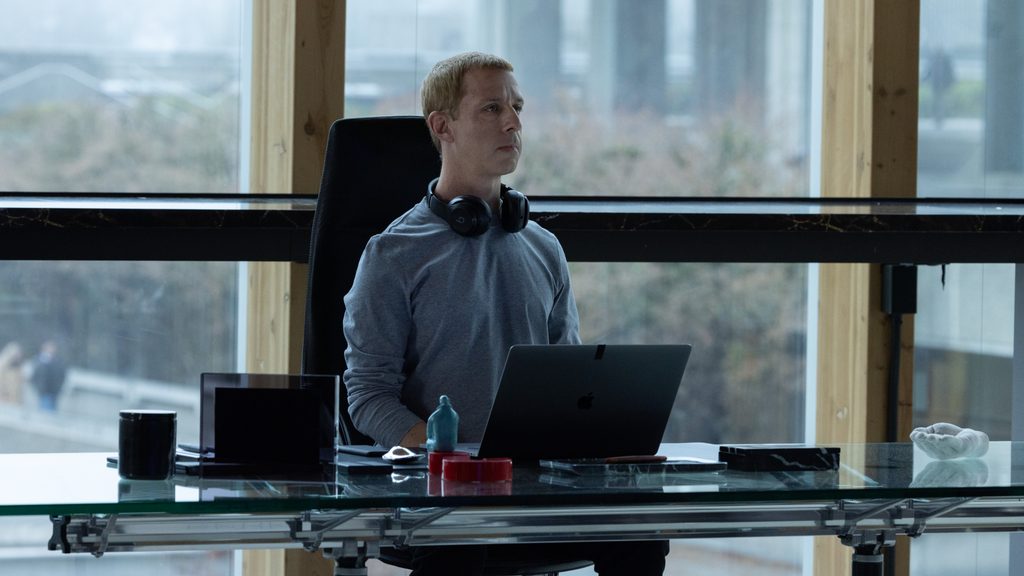
It’s due to Sorkin’s meticulously woven dialogue, rather than the characters or performances, that The Social Reckoning becomes such an engaging and prescient watch. Sorkin does not shy away from using his dialogue as the backbone for a necessary, effective, and admirably scathing critique of Facebook’s amplification of misinformation and hate. While The Social Network attempted to offer a sliver of sympathy or pity for Mark Zuckerberg, The Social Reckoning foregoes such attempts entirely, painting the Meta CEO as the architect of the vast majority of societal and political unrest in the modern day.
Speaking of Zuckerberg, the intensely analytical and high-intensity executive is brought to life this time around by Jeremy Strong, who replaces Jesse Eisenberg in the role. Eisenberg’s performance as Zuckerberg in The Social Network has received such plaudits and attention over the years that it is initially difficult to envision another actor taking on the role, especially when the actor in question often plays Zuckerberg like a carbon copy of Kendall Roy from Succession. However, as the film moves along, Strong grows into his performance and, for the most part, captures the blunt, hyper-focused, cold genius with precision and authenticity.
But Zuckerberg remains at the periphery of The Social Reckoning as the story primarily focuses on Mikey Madison’s Frances Haugen and Jeremy Allen White’s Jeff Horwitz, who team up to expose Facebook’s wrongdoings. Both actors are perfectly fine in their respective roles, delivering Sorkin’s quick dialogue effectively, while never dropping jaws in the way that previous Sorkin characters like Zuckerberg in The Social Network or Colonel Nathan Jessep in A Few Good Men have done previously.
Limiting the performances of Madison and White is a screenplay that seems disinterested in offering a substantial or nuanced understanding of their characters. Frances Haugen is portrayed as anxious, somewhat neurodivergent, and socially awkward intellect, who has strong views about the good Facebook can do, although the audience is never given a chance to understand where these views come from. Horwitz, meanwhile, is characterized as a determined, yet nonchalant investigative journalist, whose ineptitude with technology encompasses all the audience gets to know about his character.
Together, Haugen and Horwitz exchange an awkward banter that is intended to be the film’s primary source of humor. However, unlike much of Sorkin’s other writing, Haugen’s constant jabs about Horwitz’s lack of intelligence come across as more mean-spirited and juvenile than they do witty and clever. The result is multiple attempts of humor, almost all of which fall flat.

In its third act, The Social Reckoning makes for particularly harrowing viewing in the extent to which it leans into being a proximal period piece (i.e., a period piece about a period in time not too far in the past). Depicting the insurrection on January 6, 2021 on-screen and the role Facebook played in stoking vitriol allows Sorkin to tap into resonant, relevant, and unresolved issues related to one of the darkest and most shameful chapters in recent American history. Given that the fateful event seems like it only occurred yesterday, seeing it depicted on-screen and condemned so starkly fosters a strange feeling, one that solidifies just how long ago January 6, 2021 was and yet just how little has changed since. For its lack of Fincher flair and myriad of clunky scenes, Sorkin’s film excels with just how far it reaches with its critiques of Facebook and the ill-intentioned mastermind pulling the strings behind the scenes.
VERDICT: 7/10
The Social Reckoning may lack the singular style, narrative novelty, and Fincher flair that made The Social Network such an enthralling and precisely crafted film, but Aaron Sorkin’s follow-up remains an engaging, necessary, effective, and admirably scathing critique of Facebook’s amplification of misinformation and hate. While Mikey Madison, Jeremy Allen White, and Jeremy Strong all deliver perfectly fine performances, it is Sorkin’s meticulously woven, fast, razor-sharp, rhythmic dialogue that remains the highlight of the film, propelling its journalism drama forward with the same precision and punch that have long defined his best writing. Its clunky scenes, flat humor, and lack of substantial character development prevent it from reaching the dramatic and thematic heights of The Social Network, but its harrowing third act and resonant examination of January 6, 2021 demonstrate just how far Sorkin is willing to reach with his critiques. The result is a flawed but engaging and prescient companion piece to The Social Network that largely makes up for its shortcomings with a necessary and admirably scathing warning about the consequences of a villain’s victory from the preceding film.