
By George & Josh Bate
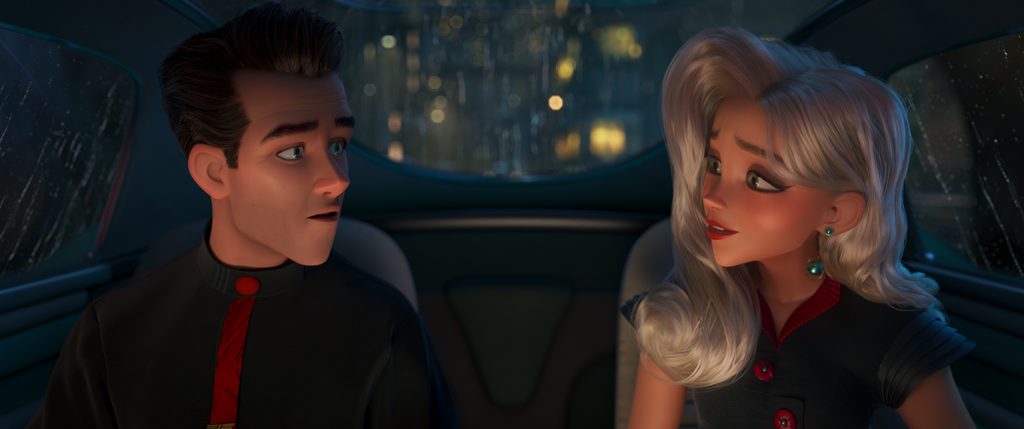
Having helmed The Iron Giant and The Incredibles, Brad Bird has more than earned his status as a legend of animated cinema. His latest effort, Ray Gunn, comes nearly 30 years after Bird heard B-52’s song “Planet Claire” and envisioned a mashup of 1930s/40s hardboiled detective noir and retro-futurism. After years of lurking in development hell, Bird finally brings his long-gestating dream project to life, delivering an intriguing, astonishing visual marvel of a film that may overstay its welcome and get a too convoluted with its plotting, yet nonetheless excels with its imaginative blend of Chinatown, Who Framed Roger Rabbit?, and Star Wars: Episode II – Attack of the Clones.
Screening at this year’s Chicago International Film Festival, Ray Gunn takes place in a retro-futuristic world inhabited by humans and aliens, the latter of whom are subjected to mistreatment and viewed as lesser. Ray Gunn (Sam Rockwell), is a former police officer and current small-time private detective, who, alongside his partner Eye-ra Kadok (Tom Waits), is pulled into a conspiracy involving popular singular Venus Nova (Scarlett Johansson), her disgruntled husband Arnold Dom (Bobby Cannavale), alien mob boss Slugsy (Matt Berry), and other colorful characters.
Across The Incredibles and Tomorrowland, Brad Bird has embraced the aesthetics of retro-futurism but never so unabashedly and unreservedly as he does in Ray Gunn. The acclaimed filmmaker makes world-building, both from a narrative and visual standpoint, look effortless as he crafts a rich, lived-in, vibrant, and unique landscape to serve as the backdrop for his noir mystery story. The city of Metropia looks like it’s been taken straight from the mind of an artist in a sci-fi pulp magazine of the 1930s imagining how the future would appear. Massive Art Deco skyscrapers, layered aerial highways, hyper-fast elevators, and more immediately evoke the specific flavor of retro-futurism Bird aims for, while seemingly inconsequential comments and tidbits of info make the world in which Ray Gunn is set feel expansive and authentic, yet never overwhelming.
The retro-futurism of Ray Gunn becomes all the more interesting due to Bird’s decision to fuse this aesthetic with trappings of classic noir films. Heavy shadows, high-contrast monochrome tones, smokey jazz clubs, and classic three-point cinematic lighting harken back to the likes of The Big Sleep and Chinatown, further giving Bird’s film a visual identity distinct from other contemporary animated movies.
Narratively, Bird also goes all-in on film noir. There’s a weary private detective investigating a mystery. There’s a mysterious, alluring femme fatale. There’s a labyrinthine plot filled with twists, turns, blackmail, and dead ends. Bird has a keen understanding of the essential elements of classic noir films and manages to weave all of them into his film without ever over-shadowing the aforementioned retro-futurism. It’s this balance between noir and retro-futurism that proves to be the ultimate triumph of Ray Gunn, despite some of its storytelling shortcomings.
Like many noir films, Ray Gunn suffers from a somewhat convoluted plot. The winding nature of the mystery is a staple of the genre, but there comes a point when noir films become just a tad too elaborate with their plotting – and Bird’s film ever so slightly crosses that line. Rather than being grounded in a central question for Ray and his partner Eye-ra to unravel, Bird opts for a more disjointed and staggered approach to building intrigue. He takes his titular character on multiple, sometimes meandering endeavors that loosely tie into a central thread, before ultimately coming all together by the end. This coming together, however, does not deliver the ‘a-ha’ moment often elicited when disparate pieces of a puzzle finally coalesce upon a story’s conclusion. Instead, they each feel like half-developed branches of a core mystery crying out for greater focus and a more straightforward question driving forward the actions of the lead detective.
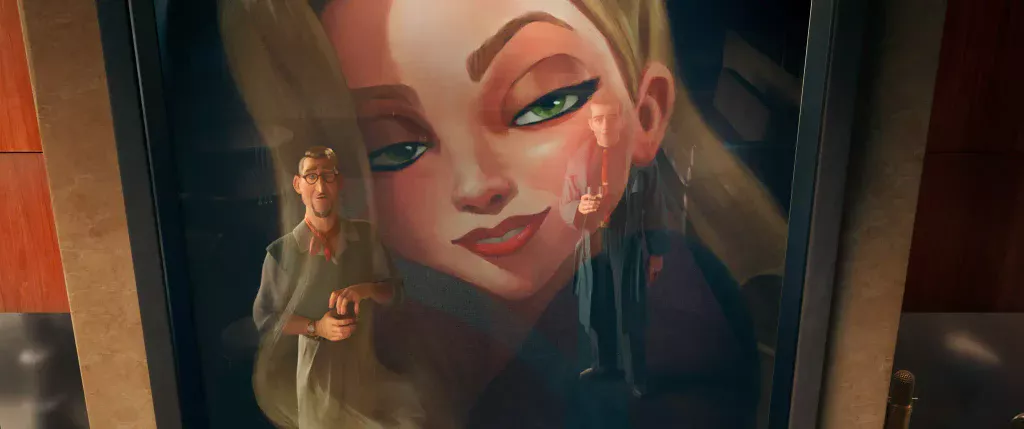
Similarly underdeveloped are multiple potentially interesting themes that Bird throws into the mix. Xenophobia, the idea that our devices are actively listening to our conversations, and the ethics of using AI to replicate the likeness of someone are all introduced into the overly ambitious story, yet none are given the attention they deserve. The xenophobic nature of Metropia represents the film’s most successful attempt at commenting on issues deeper than the central narrative, primarily through specific plot developments and Eye-ra, the character wonderfully brought to life with the deep, gravelly growl of Tom Waits. But even this rich and relevant theme is only superficially examined by Bird, who is hindered by a film that is juggling so many threads, narrative turns, attempts at world-building, and characters.
Speaking of characters, Ray Gunn bolsters a compelling ensemble, led by the ever-excellent Sam Rockwell in the lead role. The Academy Award-winner plays Raymond “Ray” Gunn with the cynicism and understated morality of a classic noir protagonist, while Scarlett Johansson nails the sultry Veronica Lake-inspired femme fatale with precision. Together, the two make for interesting characters to follow throughout the winding journey, although Johannson’s Venus Nova is given the more substantive arc to traverse.
Surprisingly, especially given the successful comedy in Bird’s previous films and the comedic talents of Rockwell, Ray Gunn’s attempts to generate laughs often fall flat. The film doesn’t always go for the kind of big gags found in Illumination movies and other studio animated films, but, when it does, most fail to pop and make the crowd roar with laughter.
The absence of effective humor couples the absence of profound emotion, another hallmark of Bird’s films. The likes of Ratatouille, The Incredibles, and The Iron Giant are shining examples of the kinds of resonant emotions animated films can provoke, making the distinct lack of such emotions in Ray Gunn all the more striking. Without much in the way of emotional specificity, the film, dragged down by a bloated runtime, seldom, if ever, tugs at the heartstrings and ultimately plays better as an aesthetically stunning fusion of retro-futurism and film noir and a shining example of seamless worldbuilding than it does a particularly captivating character-driven mystery.
VERDICT: 6.5/10
Screening at this year’s Chicago International Film Festival, Ray Gunn is an intriguing, astonishing visual marvel of a film that excels with its imaginative blend of Chinatown, Who Framed Roger Rabbit?, and Star Wars: Episode II – Attack of the Clones, while stumbling with its underdeveloped themes, convoluted plotting, and lack of resonant emotions. Legend of animated cinema Brad Bird crafts a rich, lived-in, vibrant, and unique fictional world, unabashedly embracing retro-futurism and fusing this aesthetic with the trappings of classic noir films. With heavy shadows, high-contrast monochrome tones, smokey jazz clubs, and a labyrinthine plot filled with twists, turns, blackmail, and dead ends, the film has a visual identity distinct from other contemporary animated movies. The balance between noir and retro-futurism proves to be the film’s ultimate triumph in light of a disjointed story. Led by the ever-excellent Sam Rockwell and Scarlett Johansson, the film bolsters a compelling ensemble, but its attempts to generate laughs often fall flat, and the absence of profound emotion makes it less captivating as a character-driven mystery. Ultimately, Ray Gunn excels as an aesthetically stunning fusion of retro-futurism and film noir and a shining example of seamless worldbuilding, yet falls short of the emotional heights that comes with much of Bird’s work. Throw in an intriguing, yet jumbled noir mystery to unravel and Ray Gunn makes for beguiling viewing. Like many of the noir films it draws so much inspiration from, the movie is alluring and atmospheric, but finds more success with its style than substance.
Ray Gunn was screening at this year’s Chicago International Film Festival. The film debuts on Netflix on December 4, 2026.