
By George & Josh Bate
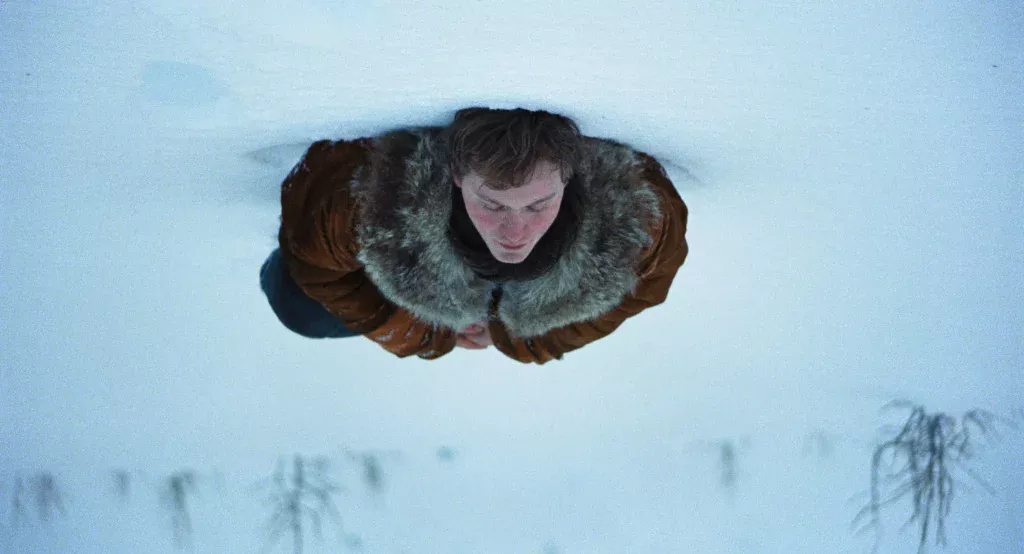
Screened at this year’s Chicago International Film Festival (CIFF), A Long Winter explores the difficulties of revealing one’s true identity in a world that offers little assurance of acceptance, a challenge that was especially daunting in the socially repressive climate of the 1950s. Even today, despite increasingly progressive politics and greater representation in mainstream media, coming out remains an intensely personal and often frightening experience, fraught with the possibility of rejection, alienation, and loss. It is a subject rich with emotional and dramatic potential, one that cinema has explored to profoundly moving effect (please go see La Bola Negra if you haven’t already). Unfortunately, A Long Winter struggles to do much with this familiar premise, revisiting the same emotional beats without developing them into anything particularly illuminating.
Set in the early 1950s in a remote Colorado home nestled among the Rocky Mountains, A Long Winter follows Mike (Fred Hechinger), a young man returning to his family’s isolated cabin just as his older brother, Tommy (Kit Connor), prepares to leave for Korea. With Tommy gone, Mike is left alone with his taciturn father, Lester (Ebon Moss-Bachrach), and his troubled mother, Louise (Caitríona Balfe), whose increasingly severe alcoholism has become an unspoken source of tension within the household. Louise attempts to conceal her drinking, sneaking alcohol whenever she can, while Lester grows increasingly frustrated with her behavior. After confronting her and throwing away the alcohol in the house, Lester leaves Louise confined indoors, prompting her to walk out into the approaching winter storm. As a blizzard descends upon the mountains, Louise disappears into the snow, leaving the family anxiously searching for signs of her whereabouts and wondering whether she has found shelter or succumbed to the unforgiving conditions. Her disappearance gradually exposes the grief, resentment, and emotional estrangement that have long defined the family, while Mike finds himself confronting his own quiet turmoil related to his sexual identity.
Despite a premise that might suggest a survival thriller or an atmospheric mystery, A Long Winter is neither particularly suspenseful nor especially interested in the mechanics of its central disappearance. Instead, it unfolds as a melancholic, occasionally bleak character study, one in which the emotional desolation of its characters gradually permeates the viewing experience. There is certainly nothing wrong with slow cinema. A deliberately measured pace can allow a film to cultivate atmosphere and deepen its characters, but here the pacing proves grating, like a projection of the characters’ pervasive depression onto the audience. The film moves at the leisure of people who have seemingly lost the will to move at all, and their emotional inertia becomes infectious to the viewer. Scenes linger, conversations trail off, and moments that might otherwise provide narrative momentum dissipate into the surrounding gloom.
As a result, the film can be difficult to engage with, not because its subject matter is inherently uninteresting, but because its restraint too often comes at the expense of dramatic development and narrative momentum. The atmosphere is undeniably effective in establishing a sense of isolation, yet atmosphere alone can only sustain a film for so long. By the time the end credits arrive, the melancholy has become so all-encompassing, rendering the film less an emotional revelation and more a monotonous strain on the viewer.
Fred Hechinger is an exceptionally talented young actor who deserves considerably more recognition than he often receives, and A Long Winter offers another reminder of his ability to convey vulnerability and inner conflict. His performance is among the film’s strongest assets, capturing Mike’s quiet torment as he finds himself trapped between familial duty and the desire to understand and express his own identity. Hechinger gives the character a tender, wounded quality, suggesting a young man who has learned to suppress his instincts and desires in order to avoid drawing unwanted attention to himself. There is a genuine sadness to the way Mike retreats further into his shell whenever the people around him reinforce the expectations of the world he inhabits. His sexuality emerges in fleeting moments of yearning, particularly in his attraction to a local police officer, and in stranger, more intimate gestures, such as a scene involving his mother’s personal effects. These moments hint at the complicated relationship between desire, shame, and the search for connection, and Hechinger brings a palpable sense of longing to them.
It is a testament to Hechinger’s acting abilities that he manages to extract such tenderness from material that often feels frustratingly thin. Simply put, Mike is not always as compelling a character as Hechinger’s performance might suggest. At times, he comes across as more caricature than character, painfully oblivious to certain realities and frustratingly passive in the face of others. His emotional journey repeatedly circles the same anxieties without developing into a particularly revealing examination of his inner life. The film seems content to revisit his repressed desires and retreating behavior rather than meaningfully complicate them, and the subtexts and potential subplots it introduces rarely receive the development necessary to make them resonate.
Visually, A Long Winter is considerably more successful. The cinematography from André Turpin makes striking use of the Colorado landscape, capturing the sweeping mountains, vast expanses of snow, and isolated stretches of wilderness. The natural lighting lends the interiors a lived-in authenticity, while the exterior shots emphasize just how small and vulnerable the characters are against the immensity of their surroundings. Long takes and carefully composed shots allow the landscape to breathe, and the film’s frequent zoom-outs create an especially effective sense of emotional and physical distance. A Long Winter is a beautiful film to look at, but not a particularly interesting one to engage with as its images possess a richness and evocative power that the narrative struggles to match.
VERDICT: 4.5/10
Screened at this year’s Chicago International Film Festival (CIFF), A Long Winter is a film whose considerable visual beauty and promising central performance are undermined by a lack of narrative momentum and emotional development. Andrew Haigh’s film’s exploration of the difficulties of coming to terms with one’s sexuality in the 1950s is worthwhile, and Fred Hechinger brings a genuine vulnerability to a character caught between the expectations of his family and the desire to live more honestly. However, the film repeatedly revisits the same emotional territory without deepening its understanding of its protagonist or allowing his journey to develop in a meaningful way. The bleak atmosphere and sweeping cinematography establish a compelling sense of isolation, but the film’s restraint becomes a liability when it leaves its characters suspended in a state of emotional inertia. What might have been a moving meditation on repression, family dysfunction, and the yearning for connection instead feels frustratingly underdeveloped, especially as its more promising subtexts and narrative possibilities left largely unexplored. A Long Winter is beautiful to look at, occasionally affecting, and elevated by an excellent performance from Hechinger, but this cannot compensate for a story that struggles to move beyond its starting line.