
By George & Josh Bate
Every so often, a film comes along that serves as a gentle but vital reminder of the values that make life worth living, encouraging us to look beyond ourselves and recognize the humanity in others. Ryusuke Hamaguchi’s latest feature, All of a Sudden, is one such film, a profoundly moving meditation on mortality, empathy, and the transformative power of human connection. Patient, contemplative, and intellectually stimulating, All of a Sudden asks its audience to slow down, listen, and consider what it means to care for another person in a world that so often seems designed to discourage it, resulting in a profoundly necessary viewing experience.
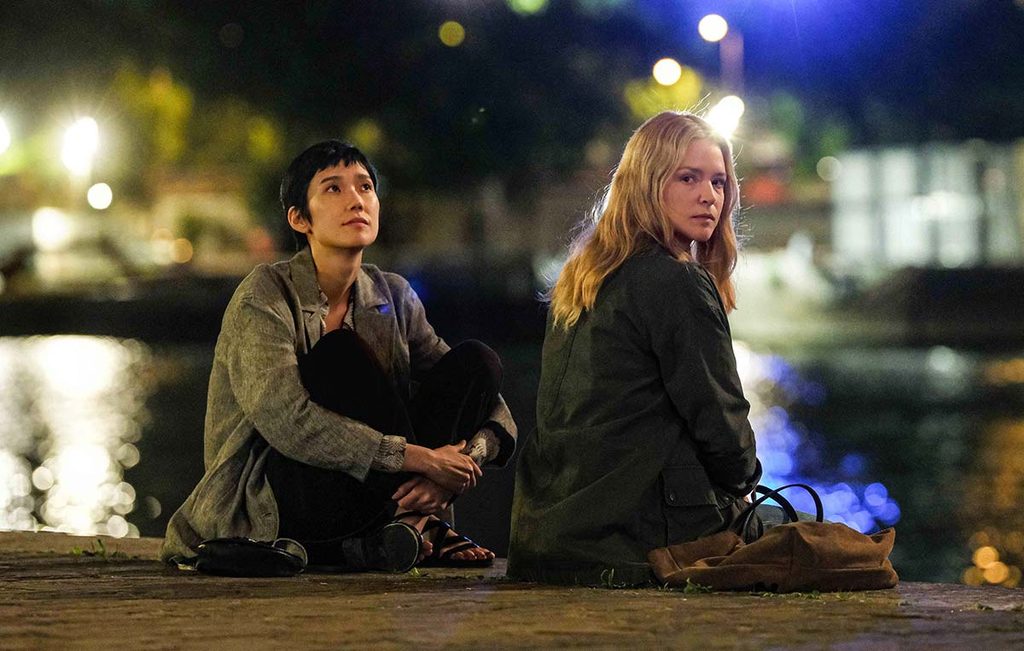
Screened at this year’s Chicago International Film Festival (CIFF), All of a Sudden follows Marie-Lou (Virginie Efira), the newly appointed director of a Parisian nursing home who struggles against staff resistance, institutional constraints, and the exhaustion of an overburdened care system as she attempts to implement Humanitude, a philosophy of caregiving that prioritizes dignity, empathy, and respect for patients living with dementia. Her commitment to treating residents as individuals deserving of compassion is tested by the practical realities of a system that often reduces human beings to problems to be managed. Her perspective begins to evolve when she meets Mari Morisaki (Tao Okamoto), a terminally ill Japanese theater director whose artistic sensibilities and philosophical outlook open up new avenues of thought. Over the course of an extended night of conversation, the two women forge an unexpected bond, exploring mortality, dignity, consciousness, and the dehumanizing pressures of late-stage capitalism. What begins as an encounter between two people from seemingly disparate worlds gradually becomes an intimate exchange of ideas that profoundly alters how each understands her place in the world.
Hamaguchi constructs All of a Sudden around an almost singular, and at times demanding, premise. Nearly the entirety of its 196-minute runtime is devoted to two women talking, often across the boundaries of language. It is an undeniably long film, and its considerable length is never entirely imperceptible. There are moments when the conversations threaten to become repetitive, and viewers accustomed to more conventional narrative rhythms may find themselves testing their patience.
However, there is something remarkably absorbing about the film’s dialogue, an intricacy and naturalism that make it surprisingly easy to forget the clock and become a fly on the wall, simply listening as these two women think aloud together. Hamaguchi and co-writer Léa Le Dimna demonstrate an extraordinary sensitivity to the nuances of language, allowing each conversation to move fluidly between the mundane and the profound. Casual observations blossom into philosophical inquiries, personal anecdotes become reflections on the human condition, and seemingly ordinary exchanges acquire an unexpected emotional and intellectual weight. The result is akin to a cinematic Socratic dialogue, or a philosophical text by Plato brought to life through the rhythms of everyday conversation. Like the great dialogues of antiquity, the film is less concerned with preaching definitive answers than it is with allowing understanding to emerge through the act of questioning and conversation alone.
For all its intellectual ambition, All of a Sudden occasionally struggles to maintain the subtlety that makes its best moments so affecting. A much-discussed whiteboard scene in which Mari lays out the shortcomings of capitalism is the most conspicuous example. The sequence feels somewhat heavy-handed and academic, spelling out ideas that the film has otherwise communicated with considerably greater elegance through its characters’ experiences and conversations. It is an overly academic moment in a film that generally trusts its audience to draw its own conclusions. The scene stands out precisely because so much of the surrounding material feels organic, allowing its social and philosophical observations to emerge naturally from the characters’ developing relationship. A handful of other exchanges also circle familiar ideas for longer than necessary, occasionally diminishing the impact of insights that have already landed. These are relatively minor frustrations, however, in a film whose intellectual richness is rarely accompanied by the sort of self-important grandstanding that can undermine similarly ambitious works.
The film’s screenplay would mean considerably less without two performers capable of bringing its words to life, and Virginie Efira and Tao Okamoto are exceptional in this regard. The duo’s performances provide the emotional foundation upon which the film’s philosophical ambitions rest, transforming what might otherwise feel like an extended intellectual exercise into something deeply human and affecting. Efira conveys Marie-Lou’s exhaustion, determination, and underlying vulnerability with remarkable restraint, revealing a woman whose commitment to caring for others is constantly tested by the institutional and emotional burdens of her work. Okamoto, meanwhile, brings an engaging mixture of intellectual curiosity, warmth, wit, and quiet sadness to Mari, imbuing her philosophical reflections with the lived experience of someone confronting her own mortality. Both performances possess an earnestness and sophistication that allow the characters’ ideas to resonate without ever feeling like mere mouthpieces for the screenplay.
Most importantly, the chemistry between the two actresses is electric. Their connection feels authentic in its gradual development, built through attentive listening and mutual curiosity. Their bond is never reduced to a convenient dramatic device. Rather, it unfolds with the unpredictability and intimacy of a genuine human encounter. The actresses make the conversations feel less like exchanges of carefully constructed dialogue and more like the spontaneous discovery of a shared language, one that transcends the literal differences between French and Japanese. It is difficult to imagine the film working nearly as well without their ability to make its words feel so lived-in, immediate, and emotionally resonant.
As the director of Drive My Car, Hamaguchi has already demonstrated an uncommon ability to turn extended conversations into compelling cinematic experiences, and All of a Sudden further solidifies his mastery of dialogue-driven filmmaking. Making a film nearly three and a half hours in length, much of which consists of two people talking, genuinely mesmerizing is no small feat. Hamaguchi accomplishes this through an astute understanding of framing, composition, rhythm, and the expressive possibilities of simply observing people as they speak and listen. His camera is often content to remain fixed on one or both women, resisting the temptation to embellish every exchange with conspicuous movement or stylistic flourishes. This restraint is not an absence of directorial vision but, rather, an expression of confidence in the screenplay, his performers, and the audience’s willingness to engage with the material on its own terms. The compositions are carefully considered, the imagery is often beautiful, and the surrounding environments possess a quiet evocative power that enriches the film without distracting from its central relationship.
Thematically, All of a Sudden is a beautiful testament to the extraordinary connections that can emerge in the most unlikely circumstances and over the shortest periods of time. Over the course of a single night, Marie-Lou and Mari develop a powerful bond, demonstrating how genuine intimacy does not necessarily require years of shared history but rather a willingness to listen, understand, and remain open to another person’s perspective. Their conversations become a means of confronting the fears and uncertainties that accompany mortality, but they also serve as an affirmation of life itself.
The film’s critique of capitalism is central to this understanding of human connection. In a system that relentlessly demands productivity, efficiency, and consumption, people are gradually exhausted to the point that extending empathy to others can begin to feel like an unaffordable luxury. Facing this universal issue, Hamaguchi proposes compassion and connection as necessary forms of resistance to an increasingly isolating world. Everyone, regardless of age, illness, circumstance, or perceived usefulness, deserves dignity and care.
The film also celebrates the healing possibilities of conversation, reminding us that the ability to communicate with one another is among humanity’s most extraordinary gifts. To speak and, more importantly, to listen is to create the possibility of being understood, of finding common ground where none seemed to exist, and of making another person feel less alone in the face of life’s most difficult realities. There is something quietly radical about the film’s faith in these simple acts.
VERDICT: 8/10
Screening at this year’s Chicago International Film Festival, All of a Sudden is an ambitious, deeply humane work that finds profound meaning in the simple act of two people talking. Though its considerable runtime, occasional repetition, and one conspicuously heavy-handed sequence prevent it from achieving perfection, these shortcomings do little to diminish the film’s remarkable emotional and intellectual strength. Ryusuke Hamaguchi’s finely tuned screenplay, assured direction, and trust in the extraordinary performances of Virginie Efira and Tao Okamoto transform an ostensibly modest premise into a sweeping meditation on mortality, dignity, capitalism, and the need for human connection reminiscent of the writings of Plato and Socrates. Above all, the film serves as a necessary reminder that compassion is not an abstract ideal but a practice that must be continually chosen, particularly in a world that makes such choices increasingly difficult. By celebrating the healing power of conversation and the bonds that can emerge when we make ourselves truly available to others, All of a Sudden leaves its audience with a renewed appreciation for the preciousness of life and the responsibility we share to care for one another. It is a moving, occasionally imperfect, but ultimately rewarding cinematic experience that makes a compelling case for empathy as the cure that will save the world and keep our humanity intact.