
By George & Josh Bate

Mercy is set to hit theaters this weekend at a moment in U.S. history in which two of the movie’s core themes also happen to be some of most talked-about and divisive subjects in our culture today: law enforcement and artificial intelligence. The idea of how society is supposed to police, judge, and serve justice in the modern era with ever-advancing technology is ripe for commentary, and has been touched upon before in other, similar films, most notably Steven Spielberg’s Minority Report. Mercy puts its hat into the ring by placing these issues front and center and, although it fails to say anything of substance about them and converges on a disappointingly pro-AI message, nonetheless compels as a tightly wound and creatively told murder mystery.
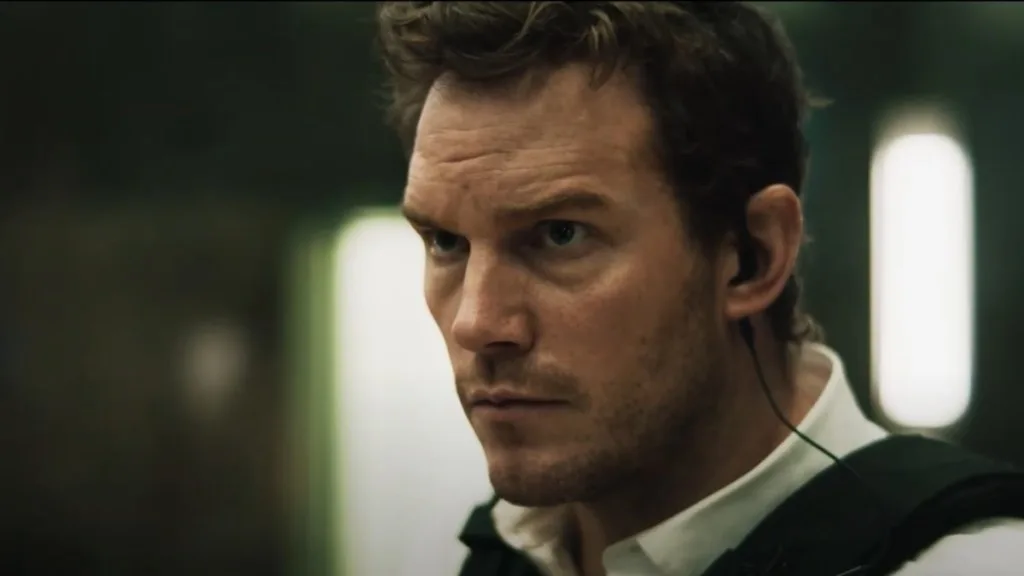
From director Timur Bekmambetov, Mercy is a mystery thriller that combines a classic police procedural murder whodunnit with sci-fi themes. Chris Pratt leads the cast as LAPD detective Chris Raven, who finds himself on the chopping block as he’s accused of murdering his wife and thrust into a futuristic justice system that places him on a quick fire 90 minute trial ruled by an AI judge. Rebecca Ferguson plays Judge Maddox, the artificial intelligence at the heart of the dystopian “Mercy Capital Court” system, which was originally advocated for by Pratt’s character. The film takes place in real-time over the course of roughly 90 minutes (which is the same amount of time Pratt’s character has to clear his name). Raven is tasked with sifting through all of the digital evidence that exists in an over-surveilled Los Angeles to clear his name and prove his innocence before the AI orders his execution.
With a runtime around the 90 minute mark, Mercy propels quickly into its story with brisk exposition and proceeds forward at a breakneck pace. Despite being confined to a single setting (for the most part), Bekmambetov’s film manages to stay alive and keep interest high as the mystery unfolds without ever dipping into sluggish territory. Much of the action centers on Pratt’s character tied up in a high-tech chair and racing against the clock as he sifts through video footage and communicates with others via video call. This could have easily felt static and lethargic, but the intelligent use of in-world technology, on-screen interfaces, and video footage (often via security cameras and social media platforms) fosters a dynamic and engaging viewing experience in which your eyes are constantly moving to track the flood of information at Detective Raven’s disposal. Having helmed/produced Unfriended, Searching, and, more recently (and disastrously) War of the Worlds, Bekmambetov is no stranger to screen-life movies, a medium which, at this point, could easily be overdone. But strong, innovative handling of screen-life here gives Mercy an immersive, kinetic quality that never ceases to entertain.

These elements help to keep Mercy feeling fresh and original, even as the mystery at the heart of the film heads in some predictable directions. There are enough twists and turns to make the conclusion of this mystery (which won’t be spoiled here) satisfying enough, generally speaking, and also evident is a wry cleverness in the way Raven unpacks the overwhelming amount of evidence at his disposal. The overall arc of the mystery leans more into formulaic and straightforward whodunnit territory, but the unique telling of the story helps one overlook these issues. The progression of Raven’s investigation, for example, goes from initial shock of his wife’s death to digging through all of the data to uncover the inner workings of his wife’s personal life to the final climactic confrontation. There are clues to detect, crime scenes to investigate, red herrings to dispel, suspects to sort through, and all the other trappings of a solid murder mystery. All of this makes for engaging storytelling, while not exactly re-writing the rules of the whodunnit genre. The journey itself is still a captivating one, and the payoff is satisfying enough emotionally and intellectually for the viewer to feel satisfied come the end of the film, even if the path to get there feels like one that they’ve walked down before.
Of course, AI is a core storytelling device for the film, which raises intriguing questions about trust, autonomy, and the potential for technology to both fail and succeed. It’s all interesting, but the messaging unfortunately gets muddled, especially as the film progresses. Without revealing too much, the film takes an ill-timed, pro-AI stance that feels strange and off-putting given the current controversies surrounding the novel technology. The general premise of an innocent man whose fate is being decided by an AI judge feels like a hint to some deeper critiques on artificial intelligence and technological overreach, but the story ends up going in the opposite direction.
Performances and filmmaking are similarly mixed. Almost the entirety of the runtime is spent with Pratt and Ferguson interacting with one another, and in many of these moments, the former is convincing as he portrays a broken man in his most desperate hour. However, there are also plenty of times in which Pratt’s performance feels unbelievable and uneven, taking one out of an otherwise immersive viewing experience. Meanwhile, Rebecca Ferguson does a decent job bringing the AI judge Maddox to life, with a measured and calculating turn as the character while still adding some subtle, mostly nonverbal, cues to add more substance to what, on paper, was likely a cold and somewhat one-dimensional role.
VERDICT: 7/10
Despite its failure to expound upon its themes of law enforcement and AI, arguably the two most controversial topics in modern America currently, Mercy excels as high stakes mystery thriller and piece of escapist entertainment. It certainly doesn’t break new ground in the mystery or sci-fi genres, and it blunders with an ill-conceived resolution that champions AI, but a compelling mystery told in an interesting manner make this blend of Minority Report and Searching worth a watch.