
By George & Josh Bate

Lingchi, the historic form of Chinese torture known also as ‘death by a thousand cuts,’ is been used by many as a succinct way to explain the cumulative effects of everyday microaggressions and more overt discrimination on the lives of racial minorities. A seemingly endless stream of cuts prove exhausting, especially when the biases of others become internalized and self-propagated. Anyone under such pressure would seek relief from the anguish, but the lead character in the new film Slanted goes to untold lengths to finally fit in.
Marking the feature directorial debut of writer and director Amy Wang, Slanted follows Joan Huang (Shirley Chen), a Chinese-American adolescent who moved to the United States when she was young with her parents. Joan idolizes conventionally attractive blonde white women and dreams of soon becoming her high school’s prom queen, while fearing that her Chinese roots will prevent her from doing so. Enter Enthos, a mysterious cosmetic surgery clinic that offers people of color the chance to become white. Joan undergoes the procedure and transforms into a beautiful blonde (Mckenna Grace), only to realize that her drastic decision comes at a steep cost.
Wang’s film features a startling concept that, if he wielded in less capable hands, could easily be seen as gimmicky, one-note, or even offensive. Centering a movie around a Chinese-American teen who undergoes surgery to turn white is inherently a premise asking for controversy and discussion, but the reason driving Wang’s pursuit of this idea is not to elicit shock and awe, rather to comment on a very real issue in decidedly ridiculous fashion.

After an upsetting prologue that sees young Joan bullied at school for being of a different race than her white peers, the film flashes forward to an adolescent consumed by desires to be someone she is not. Joan’s rooms are adorned with white-skinned, blonde-haired models and celebrities like Taylor Swift and Sabrina Carpenter. She puts a clothes pin on her nose to alter its shape, urges his parents to speak English rather than Mandarin, trades her lunch of native Chinese food with a classmate, and, overall, fluctuates between displeasure and disgust toward her ethnic identity.
The extent to which Joan has internalized others’ prejudicial sentiments toward people of color proves heartbreaking, especially as her parents, wonderfully portrayed by Viivian Wu and Fang Du, are relatively oblivious to their daughter’s insecurities and find genuine joy in immersing Joan in their rich cultural heritage. In this sense, Slanted begins like a racially-tinged coming-of-age high school drama, not dissimilar from the likes of Mean Girls. There’s high school cliques, the popular girl she envies, the boy she has a crush on, her quirky best friend, and all manner of vulnerabilities about her appearance and identity.
From its coming-of-age high school drama first act and beyond, Slanted adopts the qualities of an absurdist comedy. Wang opts not to apply an ounce of subtlety in her film and, instead, lean heavily into the exaggerated. This is demonstrated early on by Joan’s clear unease toward her ethnic identity, something that the film conveys in the most overt of ways and with little nuance. The tendency toward exaggeration continues throughout, whether it be through a meal scene involving white characters eating white food in a white room while dressed in white clothes to video testimonials of the Ethnos surgery proclaiming the benefits of turning white in the most glaring of ways.
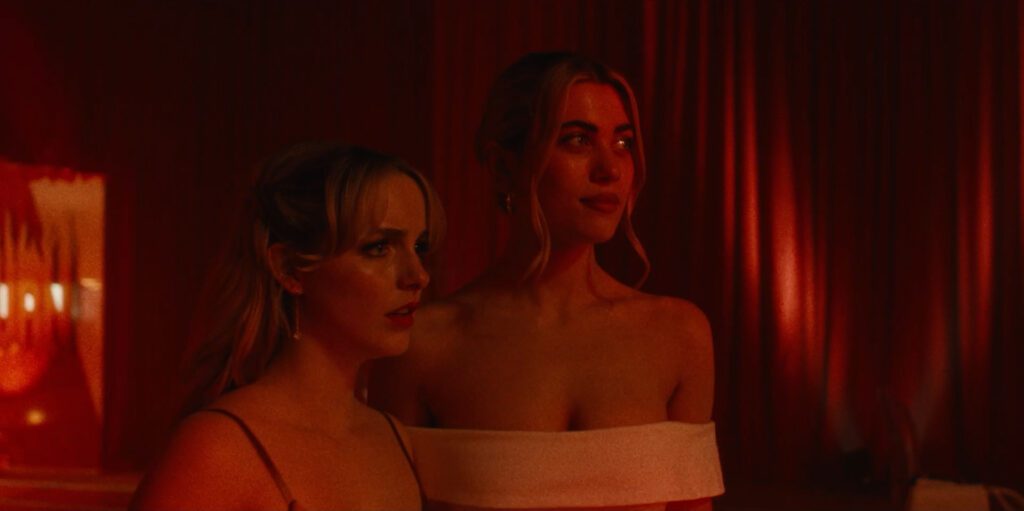
The absurdist, heightened leanings of Slanted are a double-edged sword. On the one hand, they imbue Wang’s film with great levity that prevents it from ever becoming too dour. On the other hand though, the lack of subtlety means the serious subject matter isn’t always treated with the delicacy and nuance it warrants, thus undercutting some of the emotion it provokes. Eventually, a third act that tonally reshuffles to land on a more dramatic note arrives just in time and gives the film much-needed emotional groundedness.
With a sense of absurdist comedy as its backdrop, Slanted begins to blend coming-of-age high school drama, sci-fi, and body horror as its narrative progresses. This genre collage kicks off as Joan undergoes the racial transition service and star Shirley Chen is replaced by Mckenna Grace. Wang approaches the Ethnos technology in a manner similar to Eternal Sunshine of the Spotless Mind, providing the audience with just enough technical details to satisfy curiosity while being absurd enough to make overlooking any gaps in logic effortless. At first, the surgery actualizes Joan’s greatest dreams, propelling her to the apex of high school popularity and putting in her prime position to secure prom queen come the end of the year. But things don’t go as planned.
Without delving into spoilers, Slanted embraces its inner David Cronenberg as Joan discovers the surgery she received is not exactly what she signed up for. Makeup artist Sarah Graalman triumphs in chronicling the deterioration of Joan’s surgery, initially with more subdued regressions before full-blown body horror ensues. The proximity to the Academy Award nominated horror movie The Substance means comparisons are inevitable, especially as both films address the downsides of overvaluing one’s appearance and the disastrous outcomes that can result from altering one’s body. But, for the most part, Wang does well in keeping her film unique and fresh, primarily as the body horror is surrounded by poignant messaging about internalized racism.

The commentary about internalized racism, while predictable from the film’s earliest scenes, effectively stirs a range of emotion, primarily due to the dual lead performances of Shirley Chen and Mckenna Grace. In the first act of the film, Chen plays Joan with a certain innocence and tragedy. She’s beautiful, vibrant, funny, and yet, despite all of her positive attributes, is unable to see beyond the visual dissimilarities between her and her white peers. When Joan undergoes the surgery, Mckenna Grace takes over the role of Joan and, together with Chen, achieves an incredible continuity of performance. Despite their obvious aesthetic dissimilarities, Grace and Chen deliver performances that are so in sync that you never lose sight of the fact that they are playing the same characters. From the annunciation of certain words to little mannerisms and expressions, the two deftly mirror one another and collectively create a vulnerable and emotionally complex character out of Joan.
VERDICT: 7/10
Slanted blends coming-of-age high school drama, absurdist comedy, sci-fi, and body horror, and excels in every genre it touches on. The feature directorial debut from Amy Wang bolsters a novel premise that is used, rather than to elicit shock and awe, to explore very serious subject matter in decidedly ridiculous fashion. An absurdist, exaggerated tone gives the film plenty of solid humor, although the lack of subtlety can pull one out of the story’s rich emotion at times. Things get even more heightened as a dip into the realm of sci-fi leads to full-fledged, David Cronenberg-esque body horror, brought to life through extraordinary make-up design by Sarah Graalman. Throughout this collage of genres, lead actors Shirley Chen and Mckenna Grace deliver superb performances that deftly mirror one another, ensuring perfect continuity for the character of Joan, and effectively evoke innocence, insecurity, and tragedy. Slanted may not get the balance of its tone exactly right, but it nonetheless mesmerizes with its poignant racial commentary and absurdist sense of humor.