By George & Josh Bate

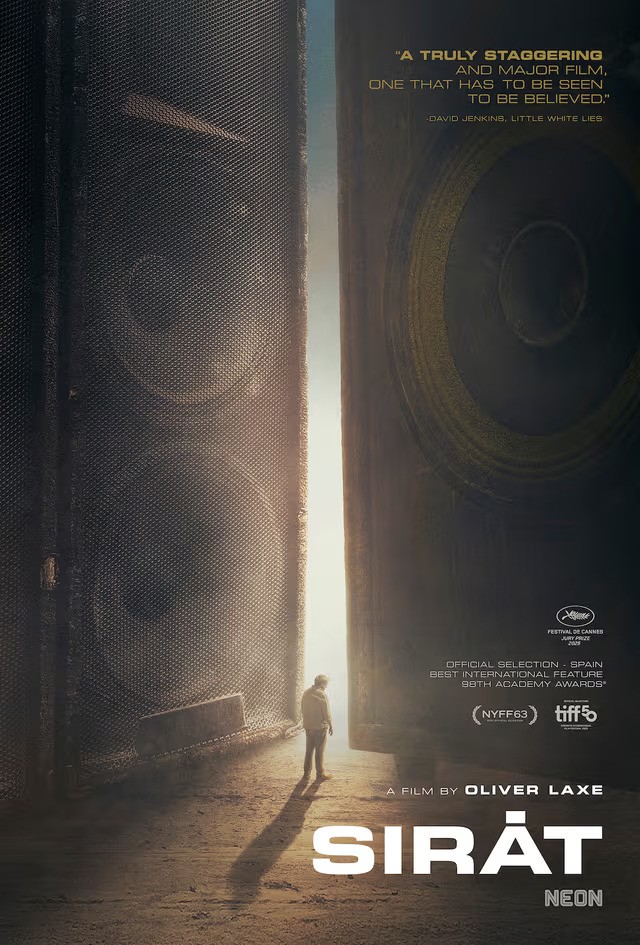
Once in a while, a movie comes around that leaves a pronounced, lasting mark on its audience – the rare film that rattles and provokes such profound emotion that, even months later, one can’t shake the visceral feeling it left you with. Sirāt is one of those movies.
From Cannes Film Festival Jury Prize winning director and co-writer Óliver Laxe, Sirāt follows a father named Luis (Sergi López) and his son Esteban (Bruno Núñez Arjona) as they try to locate their missing daughter and sister Mar at a rave in the deserts of southern Morocco. When the initial investigation proves unfruitful, Luis and Esteban decide to travel with a group of ravers on their way to another party with the hope that they will find Mar there. From there, Luis and Esteban embark on a wildly unpredictable journey fraught with danger and conflict.
The HoloFiles recently had the opportunity to speak with Óliver Laxe about his Academy Award nominated movie, the ways in which its shocking twists reflect the unpredictability of life, how the stunning locations changed the direction of the script, the use of non-professional actors, and more.
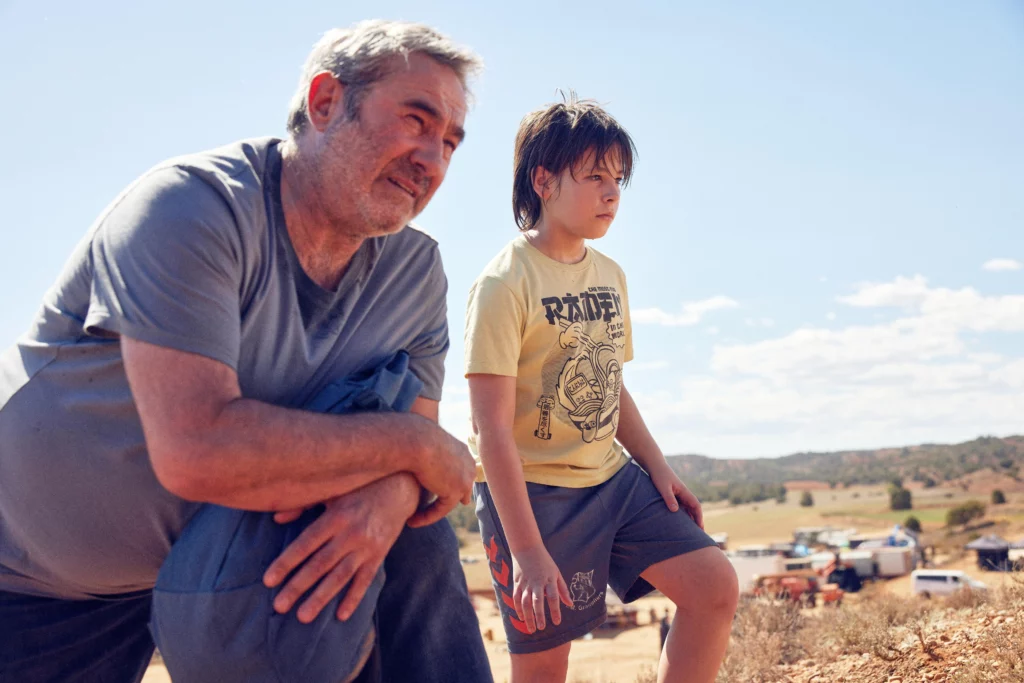
As Luis and Esteban arrive at a desert rave, populated with frenetic dancers and booming music, Sirāt provides viewers a front-row seat to an intriguing mystery. Where is Mar, Luis’ daughter and Esteban’s sister, and what happened to her? But, as the film progresses, it subverts expectations every step of the way in transcending the mystery genre and continually reinventing itself from scene-to-scene.
As such, Sirāt is rather difficult to classify from a genre perspective. “When we were starting to finance the film, we were calling it a psychedelic road movie,” explained Laxe. “So, when you use that word ‘psychedelic,’ that means that you mix realities and genres.” Laxe elaborated, “Road movie, survival movie, religious film… There are flavors of different films. It’s an adventure tale.”
The oscillation between genres was intentional from Laxe as it reflects the unpredictable nature of life itself. “That’s what life is,” reflected Laxe. “Life works like this. You can start on a comedy and your day can become a drama, or you are depressed and suddenly you fall in life. Life is changing and is shaking you…Life never calls you and tells you, ‘Be careful, next week you’re going to have a test.’”
Sirāt reflects real life beyond the genres it fluctuates between. Encompassing the journey of our protagonists are reports of a rapidly escalating World War III-type global conflict, which the characters hear about on the radio. While the stakes are evidently high as a possible apocalypse is on the horizon, Laxe’s film keeps this conflict firmly in the background, opting never to elaborate on it or provide greater context.
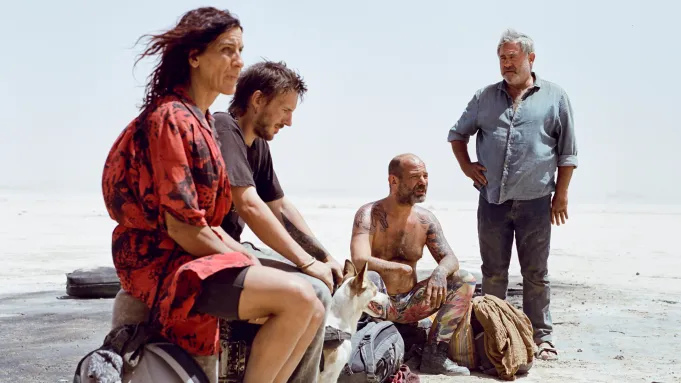
Laxe discussed why he chose to relegate such a high-stakes conflict to the background of the movie. “I mean, look at what is happening in the world,” Laxe said. “Everyone has fears today. And I belong to a generation who, since we were children, we know that this world has to change – it’s not sustainable. We know that it’s not well done. There is something that is not working [well]. That’s why I introduced [the World War III conflict] in the film, because, like my characters, I’m preparing for these shifts. So, when the radio is going on, they stop [listening to it], because, in a way, it’s all the time – they are saying the same thing. They stop it, because in a way it’s the same sound – they’re saying the same thing.”
In having his characters largely ignore an impending apocalypse in favor of finding a family member, Sirāt highlights a phenomenon all too familiar to people in the real-world navigating conflicts close to and far away from home. While war and genocide rage on in parts of the world, it is fascinating that the matters we find ourselves ruminating about and struggling with are more proximal, even menial stressors. Luis and Esteban, like the audience, disregard the unfolding global conflict as their priorities are centered around finding their lost family member.
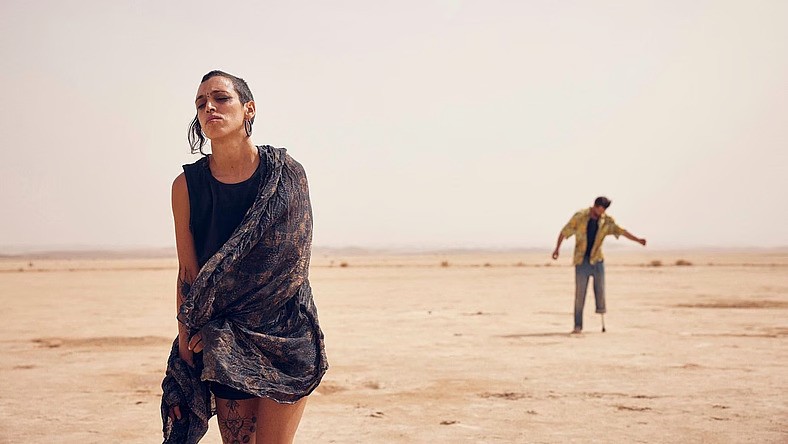
Sirāt was filmed on Super 16 mm in a number of stunning desert locations in Spain and Morocco. The simultaneously harrowing yet beautiful location serves as a character unto itself in the film as the characters encounter all manner of natural obstacles as they navigate through the terrain.
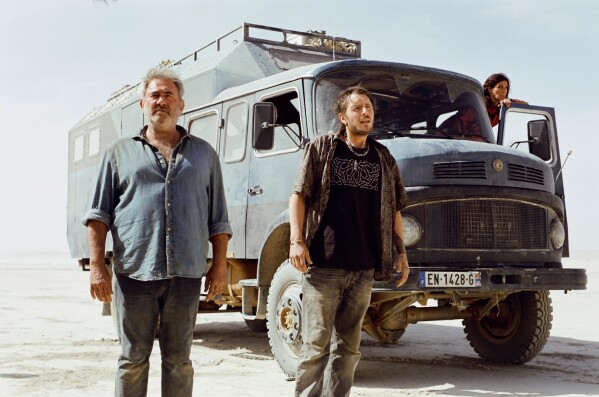
The locations proved so impactful for Laxe that he altered his screenplay and the direction of the story as a result. “That’s what is tasty for a filmmaker like me,” said Laxe. “To arrive to a place, to feel the place, and to adapt yourself to the place.” Laxe continued, “I’m not shooting in nature, because it’s just beautiful. I’m shooting in nature, because nature is manifesting. Nature is speaking to you. And it forms every moment of the film.”
Laxe went on to elaborate that key visuals/moments of the film involving a laser and a fateful mountain were tweaked as a result of the locations he chose to film at.
Besides father-son duo Sergi López and Bruno Núñez, none of the main cast members in Sirāt are professional actors, a bold decision that Laxe made to most effectively capture the humanity of his characters. “It was one of several risks that this film has,” Laxe noted. “I needed this level of fragility in the film. We are in a moment of humanity that we are fragile and we have to connect more with fragility. I needed to feel this on their faces, on their gestures, in their silences. There is a sentence that I really like – ‘if God loves you, he breaks you.’ And we see this on them. We see how they are broken.”
With a focus on vulnerable characters embarking on a tumultuous journey, Sirāt lulls viewers in with slower pacing before becoming startlingly alive with unexpected developments in its narrative. Disturbing in just how jarring these twists and turns are, it is difficult to come away from Laxe’s film unscathed.
Interestingly, however, Laxe leaves a critical element of his film unexplained (which we won’t get into here as to avoid spoilers. When asked about his decision to not provide answers to one of the film’s core mysteries, Laxe responded, “The question could be the opposite. Why in cinema do they explain everything if cinema is the art of hiding?…If everything is clear, what can spectators imagine? I think that filmmakers are the worst enemies of our work. At some point, we don’t have to use the mind so much. We have to stop. We don’t have to kill images with our thoughts and intentions.”
Laxe continued on his decision to prioritize ambiguity over answers. “Reality is complex,” the filmmaker remarked. “Ambiguity is the best way to capture this complexity. And that makes your image come alive. If you put too much brain, too much idea, you kill your images. And we are assisting a cinema that doesn’t have images. Every image is instrumentalized to say something. And when you want to say so many things, you don’t say nothing. You don’t evoke nothing.”
Whether explicitly or implicitly, Sirāt has plenty to say about the fragility and unpredictability of life, our tendency to focus on the intimate rather than the universal, and the power of ambiguity over answers. Óliver Laxe’s film may share similarities to Mad Max: Fury Road, Lost Highway, Sorcerer, Nomadland, and other acclaimed films, but it nonetheless emerges as one of the most novel and unforgettable cinematic experiences in years.
Watch our full interview with Sirāt filmmaker Óliver Laxe below….