
By George & Josh Bate

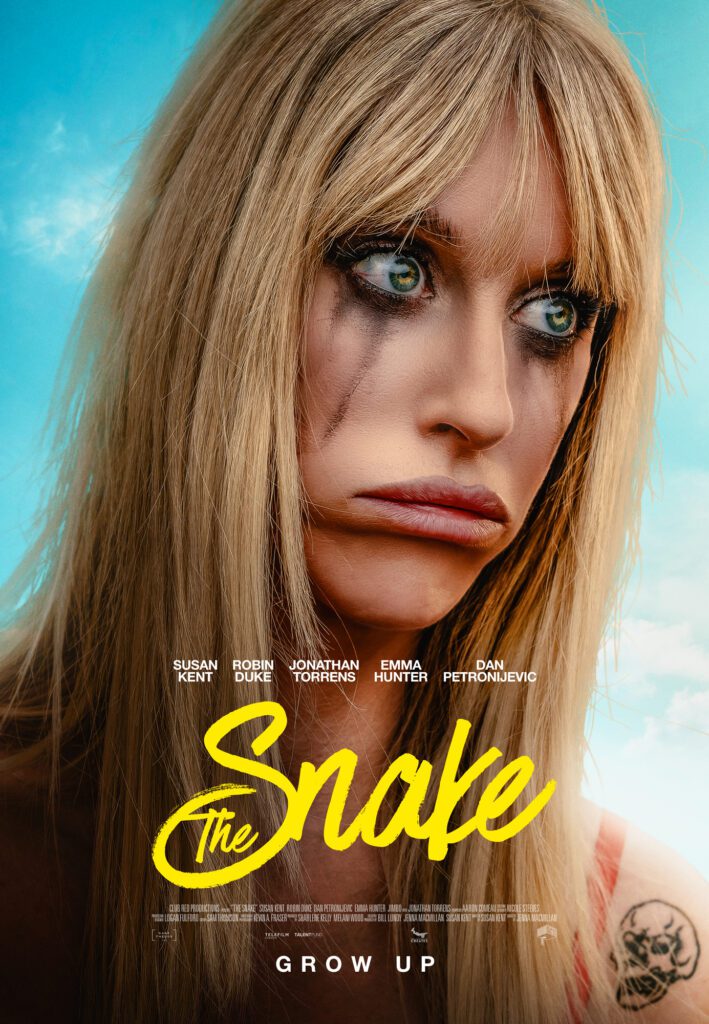
The Snake, a new dramedy premiering at SXSW 2026, completes a recent trilogy of films comprised of If I Had Legs I’d Kick You and Die My Love that follow the descent of woman in such spectacularly fashion that one can’t help but laugh and keep your eyes fixed on the screen.
From director and executive producer Jenna MacMillan and star, screenwriter, and executive producer Susan Kent, The Snake follows Jamie, an ungovernable 40 something living life like a rowdy young adult. Jamie is recently evicted, kinda sorta not really in a relationship with a guy living in his van (Dan Petronijevic), and in bed with her best friend’s husband (Jonathan Torrens) – not to mention, she’s fighting with her antagonistic mother (Robin Duke) over the ownership of their family home. While she tries to prevent her life from completely blowing up, Jamie finds an unexpected opportunity to look inward and reassess where she’s heading.
The HoloFiles recently had the opportunity to speak with The Snake director and P.E.I.’s award-winning producer Jenna MacMillan about her directorial debut, creating a movie that mirrors the dysfunction of its protagonist, directing a movie that is written by and starring another artist, threading the needle with tone, and more.
When introduced to the audience, Susan Kent’s Jamie isn’t the prototypical lead character. She wears a neon red/pink jumpsuit. She curses like a sailor. She’s branded in all manner of tattoos. And, we forgot to mention, begins the film beating the shit out of her elderly mother. In directing The Snake, MacMillan was cognizant of the fact that her leading character may not be the most endearing, at least at first. “Reading the script, I really felt like it was a ride that I couldn’t get off and wanted to honor it in the filmmaking in that I wanted the audience to be deeply uncomfortable to the point where there was no choice but to love her at some point,” MacMillan explained. “You see this person and start out thinking that she’s a hot mess, which she is, and then hopefully grow to see why she is that way and how she got there.”
The Snake’s tendency to populate its story with deeply flawed, even unlikable characters continues beyond Jamie. There’s her best friend’s husband played by Jonathan Torrens, who seems to continually arrive upon newfound depths of the word pitiful. There’s her antagonistic and spiteful mother played by Robin Duke, who gets into a number of physical altercations with Jamie throughout the film. And then there’s Dan Petronijevic’s Davey Danger, a character MacMillan describes as “kind of the worst, but the most honest.”
“It was a consideration for all the cast, because there’s various unlikability or likability with everyone,” MacMillan continued. “It was definitely like how to thread that needle. And everyone exists firmly in the gray there.”
Most of the cast had prior experience working with Susan Kent, who is known for Who’s Yer Father? and This Hour Has 22 Minutes. At times, the banter between Kent and her co-stars seems so natural that one could easily mistake the bulk of the film’s dialogue as improvised, but MacMillan stated this was not the case. “I would say that 75-80% of it was scripted,” revealed MacMillan. “But a lot of that was because the cast was coming on knowing that they’re working with the writer. Susan’s in every scene. But she gave a lot of flexibility. She’s an actor first. So she really wanted people to feel comfortable to say things the way they would say them. There was a level of play that she definitely embraced and welcomed.”
In making The Snake, MacMillan undertook a unique challenge for her directorial debut as she would be directing a film that another person wrote, stars in, and executive produces. During our interview, MacMillan described the healthy collaboration she and Susan Kent shared throughout each stage of making the film. “It’s like that old adage that the movie gets written three times – in the writing phase, in the production phase, and then in the edit,” described MacMillan. “It really felt [like] that with the process with Susan. In the writing process, she was generous in allowing me to give feedback through every draft. There were many, many drafts of the script. The script ended in very different ways. It was a totally different movie at stages of development.”
Beyond the writing process, Kent was similarly welcoming of MacMillan as a creative partner. “She “was quite welcoming to me,” said MacMillan. “But then, on set, she really had to become Jamie in a way that allowed me to also become the director. And I think we both really trusted each other and grew even more trust. I think she knew I would honor the script and I knew that she would be the Jamie we needed for this movie to work and for the story to work.”
MacMillan then described how the collaboration with Kent altered during the edit, while remaining just as healthy and friendly. “In the edit, we both have very distinct sensibilities,” MacMillan stated. “In the edit, it was more of a conversation. But, again, she was at that stage very much like, ‘It needs to be your voice.’ And then she always added and made it better through knowing the story as intimately as she does. It was very collaborative and very little friction.”
While The Snake‘s brand of humor may not be to everyone’s liking, the film converges on a remarkably and surprisingly moving third act we think will overwhelmingly resonate with most audiences. MacMillan described how she and Kent approached how they landed a dramatic ending to a largely comedic film. “I really wanted to keep it in the comedy world, but it felt like we needed to honor the drama and the relationship with the mom,” MacMillan described. “I think that in the writing of the final act there were a lot of big swings of where Jamie could end up. I think ending the way it did, not to ruin it, but having a bit of a soft landing….was trying to make it very much three days in the life of this woman…. and trying to keep the audience on board as much as we could.”
Audiences will certainly be rewarded if they keep on board for what MacMillan calls “a tough hang” with the lead character of her movie. This tough hang will take the viewer through a fittingly dysfunctional movie about a dysfunctional person before sneaking in with unexpectedly strong emotional weight.