
By George & Josh Bate

After a prolific run of studio comedies like 21 Jump Street and This is the End, Jonah Hill has taken somewhat of a backseat in recent years. His underappreciated directorial debut Mid90s in 2018 was followed by a few supporting appearances, the documentary film Stutz, and a solitary leading role in the subpar Netflix comedy You People. This year, however, the Academy Award nominated actor directs, writes, and stars in two films, the first of which is a moderately effective dramedy that examines cancel culture, performative victimhood, and the universal desire to be loved.
Premiering April 10 on Apple TV, Outcome stars Keanu Reeves as Reef Hawk, a beloved Hollywood movie star coming off struggles with drug addiction. One day, Reef receives a call from his crisis lawyer Ira Slitz (Jonah Hill), who reveals that someone is blackmailing him by threatening to release a questionable video. Desperate to maintain his successful career and pristine image, Reef sets out to make amends with all those who he has wronged over the years as he tries to figure out the identity of the blackmailer.
Outcome very much exists as a product of a film industry greatly influenced by social media and dominated by conversations about cancel culture. While other movies like Tár and The Human Stain have explored the social and professional fallout of public reckonings, Hill’s film distinctly reflects the paranoia of a day and age in which, for better and for worse, a single accusation posted on social media can swiftly decimate a respected career and public image.
Outcome finds humor in this paranoia by following Keanu Reeves’ Reef Hawk frantically try to avoid public scrutiny at all costs. In a meta wink to the audience, Reef is widely regarded as one of the film industry’s nicest and most likable figures, a distinction that Reeves himself seemingly holds in real life. In turn, there’s delight in witnessing Reeves play an exaggerated, even vain version of himself, whose idyllic public image more so reflects meticulous engineering than an authentic representation.

Reeves embodies the role of a tormented and anxiety-ridden actor well, coupling his trademark stoicism with an undercurrent of vulnerability. Much of the film sees Reeves’ character confront key figures of his past, whether that be a former manager played by Martin Scorsese or his mother played by Susan Lucci, but not for altruistic purposes. Under the guidance of his childhood best friends Kyle (Cameron Diaz) and Xander (Matt Bomer), Reef aims to use these confrontations as a means to weed out the blackmailer and thus avoid cancellation.
Along the way, Reef slowly undergoes an eye-opening journey as he reckons with his vanity and wrongdoings. In this sense, Hill’s film somewhat resembles the themes of Noah Boambach’s Jay Kelly, albeit in decidedly less heavy-handed and pretentious ways. Like George Clooney’s Jay Kelly, Keanu Reeves’ Reef Hawk is forced to come to terms with the mistakes of his past and finally recognize the discrepancy between his unblemished public image and the harm he’s inflicted on others.
Reef’s increasing introspection occasionally tugs on the heartstrings, although rarely in truly moving fashion. An early scene involving Reef confronting Red Rodriguez, a washed-up agent for young actors played by Martin Scorsese, is a particular highlight, largely due to the Academy Award winning filmmaker’s unexpectedly powerful portrayal of a man saddened by the loss of his best client. A select few other scenes evoke similar sentimentality, all of which are anchored by an authentic and stirring turn from Reeves, who makes the most of rather restrained material at his disposal.
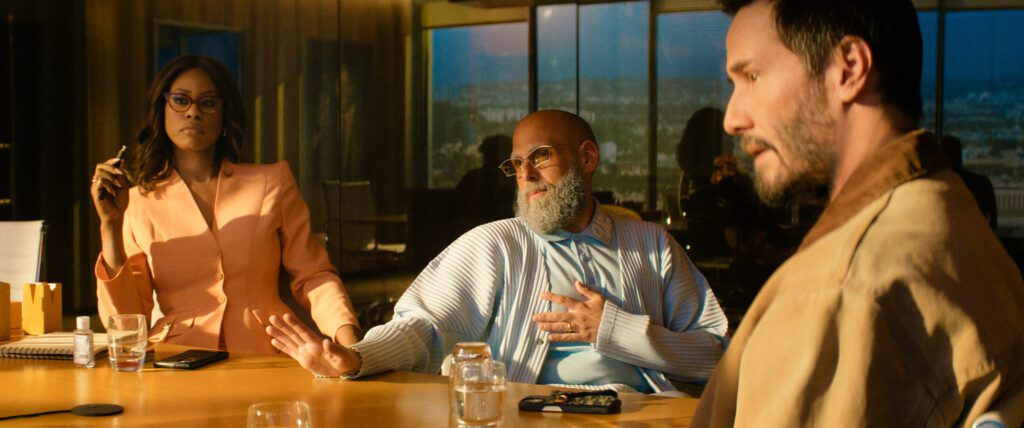
While occasionally breaching into heartfelt territory, Outcome doesn’t quite pack the intended emotional punch. The screenplay from Hill and co-writer Ezra Woods lacks the necessary cohesion and sophistication to effectively portray a Christmas Carol-esque redemption arc for Reef, even as its commentary on cancel culture and vanity feels timely.
Perhaps most egregiously, Outcome undercuts the dramatic weight of Reef’s arc with a misguided over-eagerness to elicit laughs. Hill inserts himself fairly prominently in the film as Ira Slitz, Reef’s eccentric and cringe-worthily over-the-top crisis lawyer who fluctuates from deep investment in Reef’s plight to total disregard and narcissism. Hill goes big and showy with his performance in a manner that feels ill-fitting for the broader film and the themes it wishes to explore. By going too heightened with this key character, Hill’s film often detracts from one’’s investment in Reef’s challenges. This issue would be easier to overlook if the attempts at humor incessantly spouted by Hill fosters decent laughs, but this is not the case. Almost entirely, his performance fails to evoke even the most modest of chuckles.
Largely misfiring in its attempts to elicit humor, Outcome culminates in a heartwarming, albeit predictable and uneven, ending. The trajectory of Reeves’ character can be forecast within the first few moments of the movie, and yet seeing him come to certain realizations about himself and others proves undeniably satisfying, even if not every beat lands as intended.

VERDICT: 6.5/10
Jonah Hill returns to the director’s chair with a dramedy that examines cancel culture, performative victimhood, and the universal desire to be loved. The new Apple TV movie feels distinctly of the moment as it interrogates the paranoia of a day and age in which, for better and for worse, a single accusation can swiftly decimate a respected career and public image. Outcome finds humor in this premise by following Keanu Reeves’ lead character frantically try to avoid public scrutiny that could tarnish the public’s perception of him as the nicest movie star, a nice meta wink to the audience given Reeves’ actual standing as the nicest movie star in real life. Reeves embodies the role of a tormented and anxiety-ridden actor well, coupling his trademark stoicism with an undercurrent of vulnerability that mirrors the titular character’s arc from Jay Kelly. This arc lends itself to several moving moments, namely an early scene with an excellent Martin Scorsese in a brief role, although the film overall doesn’t quite pack the intended emotional punch. More egregiously, the film is inundated with cringe-worthy and ill-fitting humor, primarily through Hill’s over-the-top crisis lawyer character. Working through the missteps with humor, Outcome culminates on a heartwarming, albeit predictable and unevening, ending. Jonah Hill’s second effort as a feature film director doesn’t hit the dramatic and emotional notes of Mid90s, but it nonetheless shows that the once-prolific comedy actor has something interesting to say when behind the camera. Next time, fingers crossed he’s able to curb the humor and tell a more cohesive story.