
By George & Josh Bate

It’s strange to think that a movie set in 2011 can be characterized as a period piece. Although initially seeming like it is unfolding in a contemporary setting, Mile End Kicks quickly establishes that it takes place against the backdrop of Montreal’s indie music scene 15 years ago, providing a slice-of-life coming-of-age romance that viewers with particularly reverence for this period and setting will delight in.
From writer/director Chandler Levack (whose previous film I Like Movies was chosen as our favorite movie of 2023), Mile End Kicks stars Barbie Ferreira as Grace, a young woman who moves to Montreal in the summer of 2011. Disgruntled by her time under a former boss (Jay Baruchel), Grace sets out a laundry list of goals to achieve this summer, including writing a book about Alanis Morissette and falling in love. The latter begins to come to fruition as Grace grows close to Archie (Devon Bostick) and Chevy (Stanley Simons), members of the aspiring indie rock band Bone Patrol, and eventually becomes their de facto publicist.
Much like Levack’s previous film, Mile End Kicks distinctly feels like a slice of its filmmaker’s life has been dramatized and put to screen. Whereas I Like Movies chronicling the experience of a high school student navigating his mental health and friendships working at a video rental store, Levack’s new film explores female sexual desire, love triangles, hook-up culture, confused career aspirations, artistic pretension, subtle misogyny, and more. The mileage one gets from Mile End Kicks will likely come from how closely these themes resonate as, without being able to relate to how these themes appear in character’s journey, one is left to reckon with a more meandering slice-of-life dramedy.
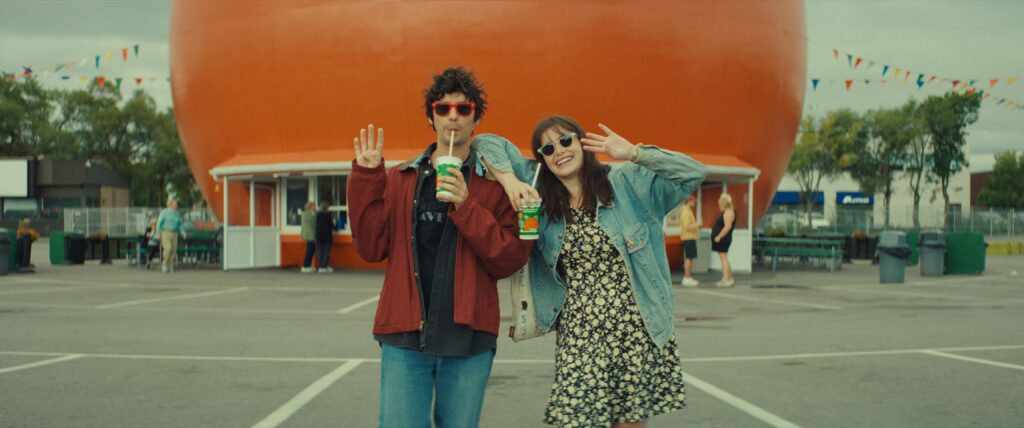
It should be mentioned just how steeped in Montreal’s indie music scene Mile End Kicks is. Levack treats this backdrop like a character unto itself, for better and for worse. At times, the film threatens to alienate the audience in spotlighting the idiosyncracies and cultural nuances of this setting. Those who enter the film with a pre-existing reverence for this period will almost certainly and overwhelmingly enjoy being transported back to this distinct setting and time, but those without such reverence may miss out on some of Levack’s finer details.
Thankfully, Mile End Kicks has enough quirks and warmth to (mostly) offset the aforementioned alienation. Barbie Ferreira delivers a lead performance that perfectly embodies the insecurities, vulnerabilities, and confusion of young adulthood. What do I want in my career? How do I balance my passions with a need to earn money? Should I leave home in pursuit of something greater? What kind of romantic and sexual partners should I pursue? Ferreira’s Grace reckons with these all-too-relatable questions and, in turn, allows the viewer to re-experience aspects of their young adulthood through the eyes of another person. Like all young adults, Grace doesn’t always make the best and most logical decisions; in fact, she occasionally makes choices that will have the audience scratching their head in frustration. But that’s the nature of a protagonist in a movie that doesn’t aim to always be a crowd-pleasing laugh riot. Instead, it’s far more interested in authentically peeling back the layers of one of life’s most difficult transitional periods.
At nearly two hours, Mile End Kicks overstays its welcome and loses some steam as it heads toward its conclusion. The meandering pacing lends itself nicely to the kind of slice-of-life, narrative-light film Levack aims to make, but it eventually starts to lull and even frustrate, especially as our protagonist runs in circles and takes her time before ultimately making the right decisions.

Although the film eventually extracts an endearing romance out of one recent cinema’s strangest love triangles, Mile End Kicks doesn’t quite have the heart and elicit the emotion that I Like Movies did. Whereas that film covered an emotional spectrum ranging from gut-wrenching to exceedingly heartwarming, Levack’s latest seems content to be a calmer, less emotionally taxing experience, albeit one that taps into vulnerable corners of our past nonetheless.
VERDICT: 7/10
Mile End Kicks may not be the phenomenally heartwarming film that I Like Movies was, but it affirms that filmmaker Chandler Levack possesses a unique ability to transport audiences back to the most vulnerable, anxiety-ridden, and unintentionally funny periods of their lives. The film explores female sexual desire, love triangles, hook-up culture, confused career aspirations, artistic pretension, subtle misogyny, and more in a way that will prove all-too-relatable for many, although its backdrop in the 2011 Montreal indie music space may alienate viewers not familiar with this specific slice of time. Barbie Ferreira delivers a strong lead performance that perfectly embodies the insecurities, vulnerabilities, and confusion of young adulthood. Her character may not always make the best nor most logical decisions, but that’s part of what being an emerging adult entails, and Ferreira ensures her less-than-ideal choices never hinder investment in her character. At nearly two hours, the film overstays its welcome and loses steam in its third act, although it converges on a warm-hearted conclusion that extracts an endearing romance out of one recent cinema’s strangest love triangles. With Mile End Kicks, Chandler Levack once again taps into the vulnerable corners of her audience’s past with a proximal period piece destined to resonate with Millennial audiences.