
By George & Josh Bate

It Ends, the feature directorial debut from writer/director Alex Ullom, is the epitome of thought-provoking cinema. The kind of cerebral movie that demands viewers look inward, query how they would react to such an existentially terrifying situation, theorize about what’s actually going on, and arrive upon an interpretation informed by one’s experiences and beliefs.
Hitting theaters on August 21 courtesy of NEON, It Ends follows four friends and recent college graduates – James (Phinehas Yoon), Day (Akira Jackson), Fisher (Noah Toth), and Tyler (Mitchell Cole) – as they head out on a late night drive for one final hangout. While driving, the four find themselves on a never-ending, two-lane road, surrounded by miles of forest. Cramped together inside an old Jeep Cherokee, the group is forced to remain in the car and keep driving as they are bombarded by vicious attackers from the forest every time they come to a stop. As the miles rack up and the road shows no sign of ending, the four struggle to remain composed and to make sense of an unexplainable dilemma.
It Ends borrows from the classic The Twilight Zone episode “The Hitch-Hiker” and Jean-Paul Sartre’s play No Exit to tell a story that, while not entirely original in conception, is novel in the profundity of thought it provokes. At first, Ullom’s film is drenched in existential dread and anxiety, operating at that fine line between horror and thriller. The situation the characters find themselves brings inconceivable concern and vicariously elicits terror and distress in the audience as one can’t help but put themselves in the shoes of the four friends.
The ability to immerse viewers within the characters’ plight continues to evidence itself as the friends engage in conversations that would mirror the kinds of conversations anyone in the real world would have, should they find themselves in such a situation. Contained within the walls of the old Jeep, the friends speculate as to what is happening to them. Some posit this is some kind of divine punishment for how they’ve behaved in life. Others believe it could be the result of an ancient curse, while others claim that they crashed and died while driving and that this is the afterlife.
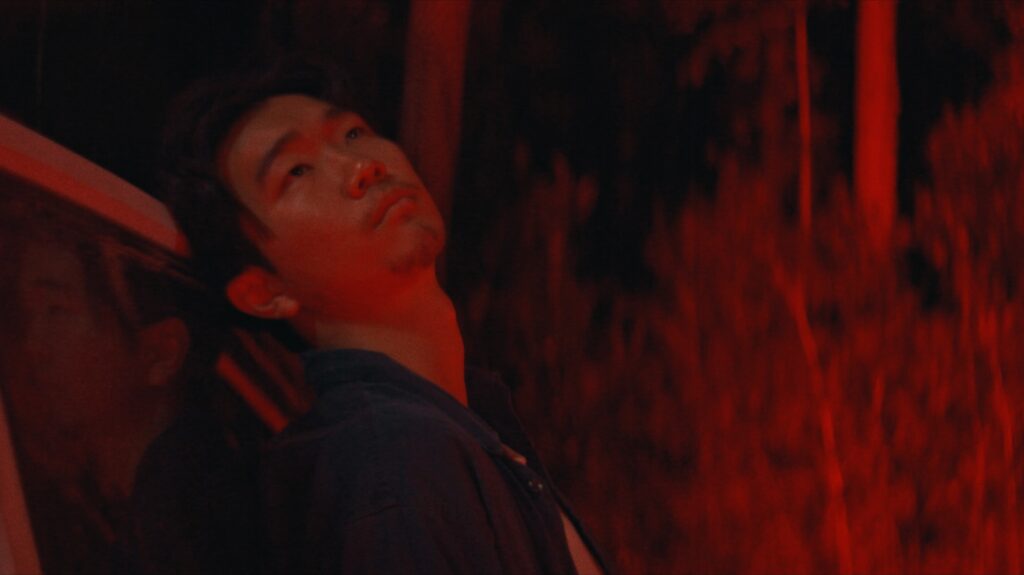
These conversations among the characters allow the audience to feel like they are situated inside the Jeep Cherokee alongside them. Their anxiety becomes our own. Their theories and speculation mirror our own. And, unfortunately, their frustration becomes our own.
In other terms, much like the characters themselves, It Ends can’t quite escape the repetition and monotony inherent to its premise. As the runtime progresses and the journey shows no sign of changing, never mind ending, Ullom’s film begins to drag and feel far longer than its 87-minute runtime. Even solid performances and unexpected bursts of humor aren’t able to prevent the film from being a tad too immersive in ensuring the audience feels the same agitations, tedium, and tiresomeness of its characters.
Eventually, although the four friends struggle to make a turn on the never-ending road, the film itself turns a corner away from its initial nihilism and toward a deeply contemplative, even optimistic note. Ullom ultimately makes it clear that the plight his characters are in mirrors that of the plight every human being on the planet faces by being alive and navigating the trials and tribulations of life. Some seek meaning for their suffering or try to make sense of an inconceivable world through religion, spirituality, and various belief systems. Others, meanwhile, embody the lesson from the Story of Job and accept that true autonomy is a myth, life is entirely out of our hands, and we have to stop fighting for control in order to be liberated.
In exploring these ideas, Ullom holds a mirror up to the history of humanity and interrogates, within the confines of an 87-minute horror-adjacent film, the spectrum of ways in which people approach life. Rather than cast judgment on one way or another, the film culminates in a message that champions the importance of human connection above all else and touchingly demonstrates that this comes about in the most seemingly menial of ways, such as a playful debate about which combination of creatures would come on top in a hypothetical brawl.
VERDICT: 7/10
Beginning as an existentially terrifying horror movie before becoming a tad too immersive in having the characters’ tedium traversing a never-ending road mirror the frustrations of the audience, It Ends cements its status as one of the more thought-provoking films in recent memory – the kind of cerebral movie that demands viewers look inward, query how they would react to such an existentially terrifying situation, theorize about what’s actually going on, and arrive upon an interpretation informed by one’s experiences and beliefs. Drawing influence from the classic The Twilight Zone episode “The Hitch-Hiker” and Jean-Paul Sartre’s play No Exit, director Alex Ullom’s feature directorial debut features solid performances and unexpected bursts of effective humor, but it proves most successful in a third act that leaves its initial nihilism behind in favor of a profound, nonjudgmental, and ultimately optimistic reflection on the different ways in which people approach and conceptualize life. Although not a crowd-pleaser by any stretch of the imagination, It Ends lives and breathes as a movie with relevance that transcends the medium in which it exists. Intimacy, companionship, suffering, and control are just some of the lofty ideas Ullom deftly juggles and, in turn, leaves the audience pondering over long after the credits roll.