
By George Bate
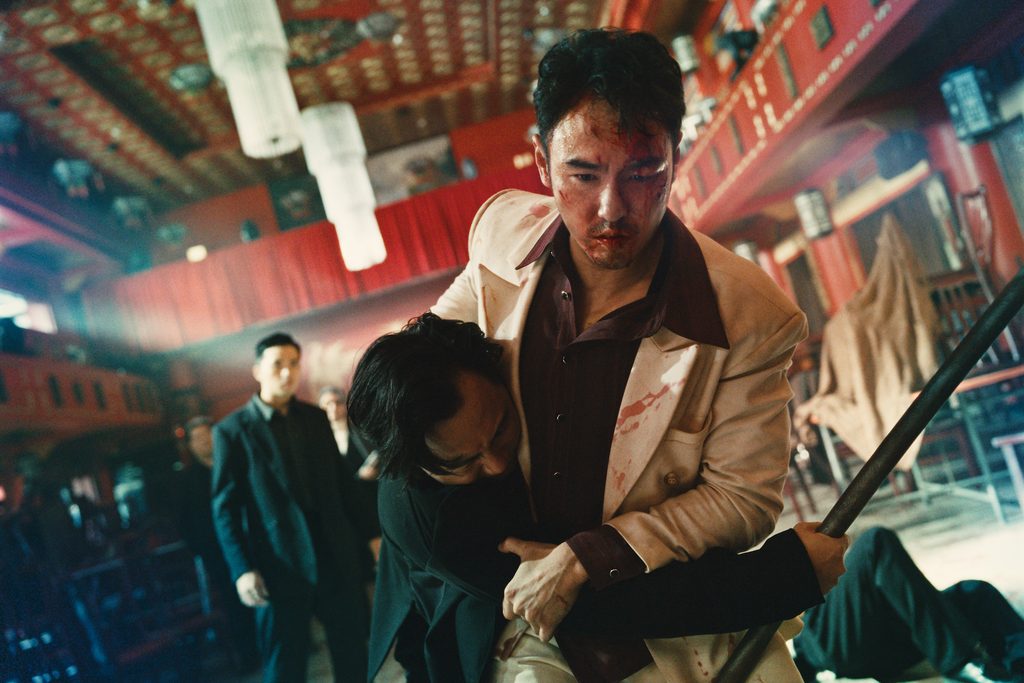
After a run of more stylistically diverse movies that have tapped into fantasy, social drama, and heartfelt family stories, renowned Japanese filmmaker SABU returns to frenetic, pulpy genre fare with Arrested Memory, an absurdist comedy remix on Memento that lacks the storytelling precision of Christopher Nolan’s film and ultimately never quite comes together.
Making its North American premiere at this year’s Toronto International Film Festival, Arrested Memory follows Captain Lee (Ethan Juan), a capable cop suddenly hit with memory loss. Such a plight would be a challenge for anyone, but it proves particularly problematic for Lee as he is tasked with retrieving the kidnapped son of a Japanese oligarch (Shin’ichi Tsutsumi) from unidentified criminals. With his mind rapidly deteriorating, Lee finds himself pursued by police, petty criminals, and the Yakuza alike, forcing him to rely on his hand-to-hand combat training and detective instincts to get him out of an increasingly complicated bind.
Much like the fractured memory of its wandering protagonist, Arrested Memory can be best characterized as scattered. After a messily cobbled together cold open, SABU’s film gains its footing with an interesting set-up: a cop, whose memory is quickly slipping away, has to rescue a kidnapped kid. Lee doesn’t remember who he is, what occupation he holds, or even what his overarching mission is, leading to a nightlong trek through crime-ridden streets and people out to get him.
Unfortunately, an interesting premise and solid delivery of exposition aren’t enough to carry Arrested Memory. Unlike Memento, the audience is always multiple steps ahead of Captain Lee, a creative decision that deprives the film of a potentially clever narrative structure. With a protagonist exceedingly disoriented and an audience that (hopefully) is not, SABU’s film works far better as an absurdist comedy than crime thriller and martial arts action movie. That’s because Lee’s obliviousness (and often inadvertent contribution) to the frenzy all around him makes for moderately humorous viewing. A scene in which two characters have a conversation over the phone right next to one another without realizing that they are speaking to each other reflects the kind of heightened, often deliberately illogical humor that SABU goes for and mostly succeeds in achieving.
But with a narrative that stops and starts far too often, cycles side characters in and out, and never quite has a firm grasp on the premise it all spawns from, Arrested Memory hardly coheres. Flashes of style, such as a breakout dance number in a club, occasionally inject the film with a bit of spectacle and energy, but it largely can’t find its way above and beyond storytelling that misguidedly mirrors the discombobulated psyche of its protagonist.
The occasional flurries of action similarly fail to impress. Each set piece can essentially be reduced to Captain Lee throwing enemies down onto the ground in a handful of different ways. Amplified by stuttered pacing to its action sequences, the film doesn’t have the most inventive choreography when compared to other, similar movies in recent years.
To give SABU his due, however, the filmmaker miraculously manages to tie up all the loose ends of his disjointed story rather well. By the end, the film reaches a satisfying resolution, albeit not one clever nor resounding enough to forgive its earlier missteps.
VERDICT: 4.5/10
After a run of more stylistically diverse movies, SABU returns to frenetic, pulpy genre fare with Arrested Memory, an absurdist comedy remix of Memento lacking in the storytelling precision of Christopher Nolan’s mystery. Making its North American premiere at this year’s Toronto International Film Festival, SABU’s latest can be best characterized as scattered, with an interesting premise and solid delivery of exposition that ultimately never quite comes together. The film works far better as an absurdist comedy than crime thriller and martial arts action movie, as lead character Lee’s obliviousness makes for moderately humorous viewing, but a narrative that stops and starts far too often, cycles side characters in and out, and never quite has a firm grasp on the premise means Arrested Memory hardly coheres. Flashes of style occasionally inject the film with spectacle and energy, but the occasional flurries of action fail to impress. Quite surprisingly given the disorientation of the preceding film, SABU manages to tie up all the loose ends of his disjointed story rather well, and by the end, the film reaches a satisfying resolution, albeit not one clever nor resounding enough to forgive its earlier missteps.