
By Josh Bate
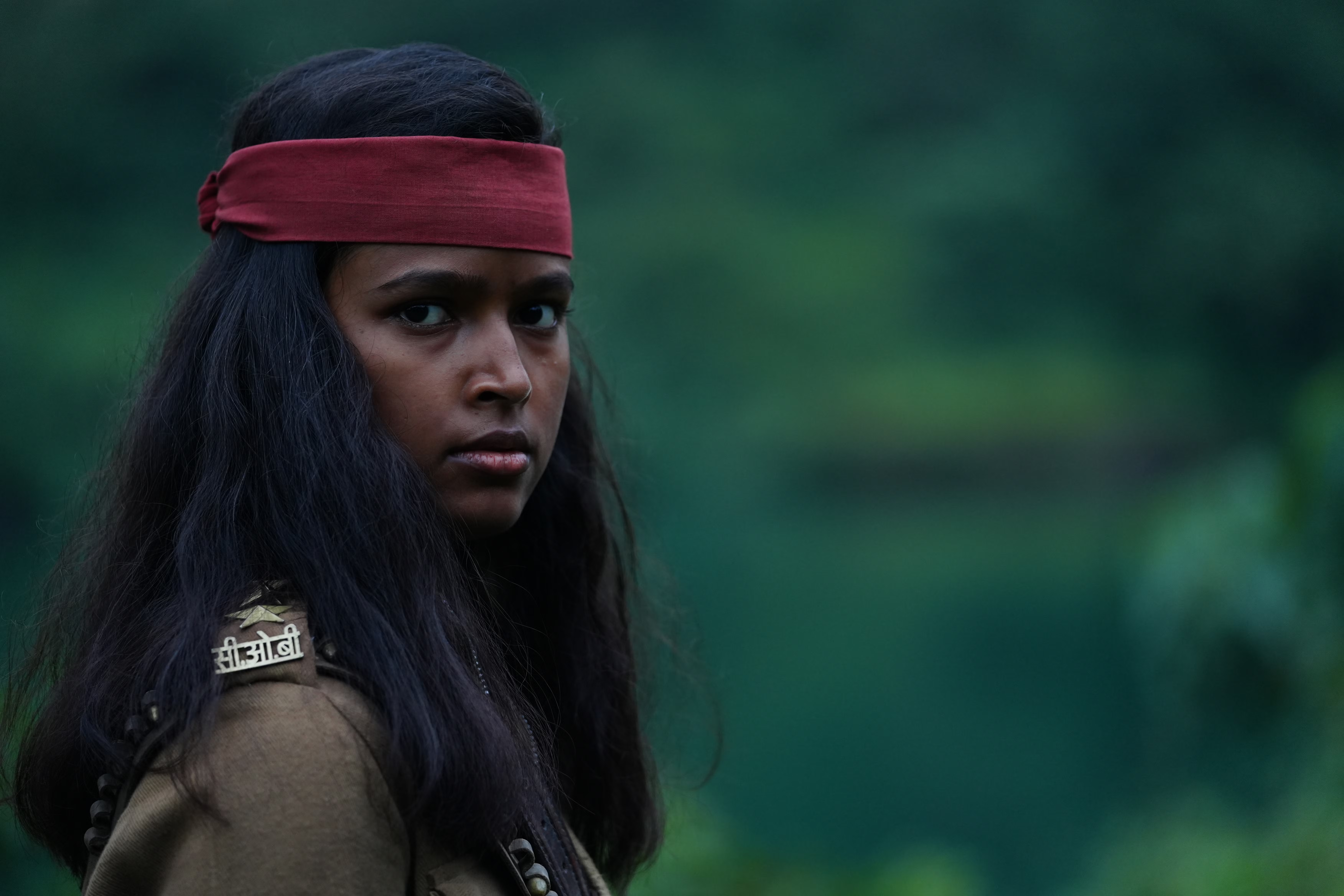
The opening moments of Phoolan immediately communicate the staggering imbalance at the center of its story. More than 2,000 armed military men descend upon a tiny village, all mobilized to capture a sole 17-year-old girl. It is an almost unbelievable image, made all the more striking by the fact that it is rooted in disturbing reality. Premiering at this year’s Toronto International Film Festival, Richie Mehta’s Phoolan uses this extraordinary manhunt as the framework for a tense, occasionally uneven, but often compelling portrait of a young woman who became an enduring symbol of resistance to gender discrimination.
Set in central India in 1979, the film follows Phoolan Devi (Sneha Kumari) over roughly 48 hours as she attempts to evade the enormous military force closing in around her. Devi would eventually become one of the most famous outlaws in Indian history, earning the nickname “Bandit Queen” after carrying out Robin Hood-like robberies against higher-caste communities and taking violent action against men who had raped her. Rather than attempting to chronicle every chapter of her short 37-year life, however, Mehta deliberately keeps the story contained to this particular period.
A conventional biopic covering Devi’s entire life could easily have become an overloaded and unwieldy historical drama struggling to give adequate attention to decades of complicated experiences. Instead, Phoolan focuses on a very specific period in its titular character’s life, which perfectly encapsulates her remarkable role in Indian history.
For audiences unfamiliar with Phoolan Devi, the opening raises an intriguing question: what could a teenage girl possibly have done to provoke an operation of this magnitude? Mehta withholds much of the answer at first, then fills in the gaps through short flashbacks that appear throughout the story. These glimpses establish the trauma that shaped Phoolan, her unwillingness to quietly accept injustice, and the fierce personality that would eventually turn her into a notorious outlaw.
The flashbacks are particularly insightful as they prevent Phoolan from becoming merely a bland action hero fending off an army. Mehta is careful not to suggest that Phoolan is someone who inherently seeks confrontation. In Sneha Kumari’s performance, she comes across instead as a young woman who wants to be left alone but continually finds herself subjected to violence, discrimination, and exploitation. In other terms, conflict repeatedly comes looking for her. Her eventual willingness to fight back feels less like a sudden transformation into an aggressive figure and more like the emergence of someone who has finally reached her limit and is ready to advocate for other women harboring similar struggles.
Kumari is exceptional in the role and easily one of the film’s greatest strengths. She gives Phoolan a mixture of vulnerability and defiance that makes the character feel considerably more complicated than the larger-than-life reputation she would later acquire. The actress is convincing during the film’s physical sequences, portraying a teenager desperately attempting to stay alive while being hunted by an overwhelming force, but she is even more effective in the quieter flashback material.
Unfortunately, the film’s action does not match the strength of its central performance or premise. Once Phoolan commits to the 48-hour manhunt, the movie becomes heavily reliant on its siege elements, with Phoolan and her two allies repeatedly hiding from soldiers, scrambling through buildings, dodging bullets, and searching for ways to escape. There is nothing inherently wrong with using action sparingly in a story this serious, but the film’s combat lacks the raw, visceral intensity needed to make the danger feel immediate.
More damagingly, the movie spends too much time with the people hunting Phoolan. The central appeal of a David and Goliath story comes from feeling the overwhelming power of Goliath, but Phoolan occasionally weakens that dynamic by shifting attention away from its protagonist and toward antagonists who aren’t particularly interesting. This is where the film falls short of the best siege movies.
Even with those shortcomings, the historical and thematic weight of the story gives Phoolan significance beyond its action mechanics. Although the movie takes place nearly half a century ago, its examination of gender inequality, abuse, entrenched social hierarchies, and resistance to seemingly unbeatable forces feels far from confined to the 1970s.
That broader relevance is ultimately what allows the movie to transcend some of its technical shortcomings. Phoolan Devi’s story is extraordinary enough on its own, and Mehta recognizes that he does not need to explain every detail of her life to demonstrate why she became such an important figure. The concentrated structure instead offers a snapshot of a woman facing almost impossible odds and refusing to simply accept the circumstances imposed upon her.
VERDICT: 6.5/10
Making its world premiere at this year’s Toronto International Film Festival, Phoolan is an occasionally uneven but compelling biopic that turns a remarkable true story into a concentrated David and Goliath battle. Sneha Kumari gives a ferocious breakout performance, portraying Phoolan as a vulnerable, yet defiant young woman pushed toward resistance by gender discrimination, trauma, and repeated violence. The film’s siege sequences lack the intensity and clarity of the top-tier action thrillers, particularly when the story shifts focus toward its less interesting antagonists, but its broader themes remain disturbingly relevant. Ultimately, Phoolan succeeds as a focused portrait of an enduring symbol of resistance and a compelling introduction to Phoolan Devi’s extraordinary story.