
By George & Josh Bate
There comes a point in adulthood when everyone seems to be moving according to a schedule you somehow missed. Friends get married, have children, buy homes, change careers, and post carefully framed evidence that life is unfolding exactly as planned. Meanwhile, you start wondering whether you are falling behind, or simply following a different roadmap. Happily Ever After lives in that uncomfortable space between the life we imagined for ourselves and the life we are actually building, asking what happens when the milestones we are told should make us happy don’t necessarily make us feel whole.
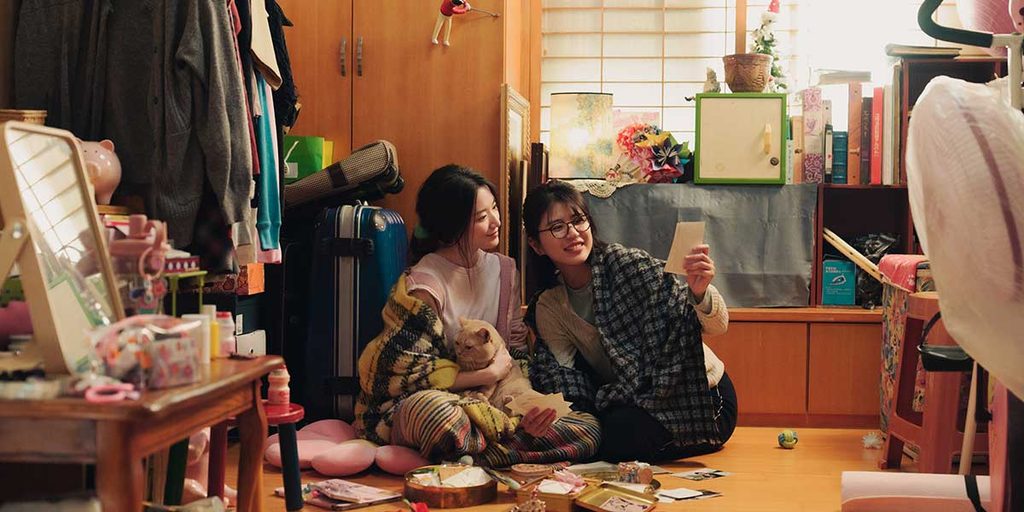
Making its world premiere at this year’s Toronto International Film Festival (TIFF), Happily Ever After follows 29-year-old Kitty Lin (Shuhua Yeh), whose world is suddenly thrown into motion when her devoted boyfriend, Ledo, proposes. Seeing marriage as a chance at love, security, and the future she has always envisioned, Kitty eagerly begins preparing for the next chapter. Her older sister Claire (Xuan Chen), an independent writer who has resisted many of society’s expectations while still living at home and keeping her relationship with her girlfriend from their conservative mother, isn’t convinced Kitty is making the right choice. As Kitty takes in an abandoned orange cat and finds herself increasingly entangled in the expectations of Ledo’s traditional family, the sisters’ already complicated relationship begins to fracture. Kitty sees Claire’s criticism as hypocritical, while Claire views Kitty’s compromises as a surrender of the independence she once valued. Beneath their disagreements is a more complicated question: how do you know whether the life you’ve chosen is truly yours?
The film’s two central characters, Kitty and Claire, played by Shuhua Yeh and Xuan Chen, respectively, are strikingly different women who nonetheless share an important similarity: from the outside, both appear to be doing fine. Neither is simply positioned as the supporting player in the other’s story. They are fully realized protagonists, each carrying her own contradictions, disappointments, desires, and ideas about what adulthood is supposed to look like. Neither is in the film solely to serve the other’s journey. Their conflict isn’t really about one sister being right and the other being wrong; it comes from two people who have chosen different ways of navigating the same pressures and are increasingly forced to question whether those choices have actually brought them happiness.
American Girl director Feng-I Fiona Roan’s sophomore film is particularly effective when it settles into the messier realities of being an adult. Finding personal fulfillment becomes considerably more complicated when your decisions affect a partner, children, parents, finances, or an entire family. The idea of simply following your dreams can sound appealing until those dreams have to coexist with rent, relationships, caregiving, cultural expectations, and the needs of people who depend on you. Happily Ever After understands that growing up doesn’t necessarily mean arriving at a definitive answer about what you want.
Rather than presenting happiness as a destination that can be reached by checking off the correct milestones, Happily Ever After argues for something more personal. Roan suggests that audiences should decide for themselves what a fulfilling life actually looks like. Marriage can be meaningful without being mandatory. Independence can be liberating without automatically making someone fulfilled. Wanting a conventional life doesn’t make someone less ambitious or progressive, just as rejecting convention doesn’t guarantee happiness. The film’s most compelling insight is that these seemingly contradictory truths can exist at the same time. There isn’t always a dramatic revelation that tells us which path was the right one, and sometimes the most honest answer is simply that we have to figure out what happiness means for ourselves.
Leading the film is K-pop star Shuhua Yeh, who brings a gentle warmth to Kitty that makes her uncertainty all the more affecting. Kitty initially presents as optimistic and openhearted, but Yeh gradually reveals the hesitation beneath that sunny exterior. The performance is especially interesting because it allows Yeh to move beyond the persona audiences may already associate with her as a performer. Away from the stage, she gets to explore a quieter and more vulnerable side of herself, and she gives Kitty an appealing sincerity even when the character is making choices that frustrate those around her. T
Ultimately, Happily Ever After isn’t interested in telling its characters—or its audience—what a happy life should look like. Instead, it recognizes how difficult it can be to separate our own desires from the expectations we’ve absorbed from family, culture, relationships, and the people around us. Its two sisters may take very different paths, but both discover that looking successful from the outside is no guarantee of feeling fulfilled on the inside.
VERDICT: 8/10
Making its world premiere at this year’s Toronto International Film Festival (TIFF), Happily Ever After is a thoughtful and emotionally grounded exploration of adulthood, happiness, and the complicated space between the life we want and the life we think we are supposed to want. Anchored by strong performances from Shuhua Yeh and Xuan Chen, the film gives both sisters room to wrestle with their own contradictions without reducing either of them to a simple lesson about choosing independence or embracing convention. Its greatest strength is its understanding that there isn’t always a clear answer waiting at the end of a difficult decision. By allowing Kitty and Claire to remain uncertain, imperfect, and deeply human, Happily Ever After offers a refreshing reminder that there is no universal timeline for a fulfilling life and no single definition of what it means to be happy.