
By George & Josh Bate
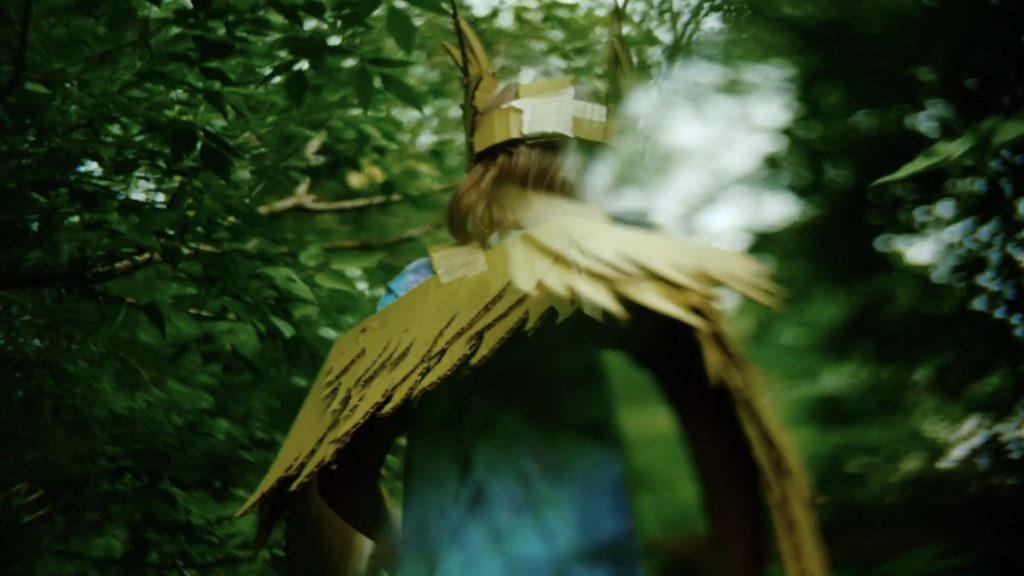
Filmmaker Cody Calahan conceived Death of a Yellow Bird from a deeply painful place. In the aftermath of losing his mother, a death he wasn’t present for after running from the hospital the night before she passed, his childhood friend and longtime collaborator Ari Millen was diagnosed with cancer and, rather than allow himself to be consumed by the fear and uncertainty of his illness, he turned to filmmaking. The two approached the project as a way to process emotions they didn’t quite know how to articulate, embracing the creative process with the same philosophy the filmmaker’s mother, an art teacher, had always encouraged: enjoy the process. Made with an extremely small crew of just three people, Death of a Yellow Bird becomes something of a cinematic act of therapy or catharsis, a way of facing death rather than running from it. The result is a deeply personal horror film that uses the genre not simply to scare, but to confront some of life’s most challenging topics.
Making its world premiere at this year’s Fantastic Fest, Death of a Yellow Bird follows an unnamed man (Ari Millen), who, after refusing treatment for his terminal illness, returns to his childhood home in search of some kind of closure. There, he discovers the family’s long-lost VHS camera, containing a tape of old home movies. But something disturbing begins bleeding through the static, eventually giving way to a disembodied voice that seems to belong to something still lurking within the house. Initially assuming the medication he is taking is affecting his perception, he soon realizes that whatever is haunting him is very real. With his days numbered and the supernatural activity escalating, he steadily uncovers a dark family secret before the past consumes him entirely.
On the surface, Death of a Yellow Bird bears some striking similarities to Posthumous, another film premiering at Fantastic Fest this year. There is also a clear connection to Undertone, which makes sense considering Callahan also produced that movie. All three find horror in sound and, perhaps more importantly, in the absence of it. Recordings become vessels for something potentially malevolent, turning familiar sounds from the past into something deeply unsettling. But where Posthumous and Undertone play with the unnerving possibilities of what might be hiding within a recording, Death of a Yellow Bird goes somewhere considerably darker.
Callahan’s film is slow-paced, perhaps too slow paced for the average horror fan, but it is undoubtedly atmospheric one. Much of the film unfolds within the familiar confines of a cabin-in-the-woods horror movie, yet the film isn’t particularly interested in filling every moment with scares. The analog sequences are particularly effective, carrying an unsettling quality even when nothing overtly frightening is happening. The grainy footage, static, distorted sounds, and antiquated technology give the film an appropriately haunted quality, as though the past itself has become corrupted. There is something inherently creepy about watching these old home movies and waiting for something that shouldn’t be there to appear. When the film does decide to jolt the audience, there are a couple of well-crafted jump scares and effective shocks, although none are particularly revolutionary. The horror is more effective when it settles into the film’s meditation on death.
It is here that Death of a Yellow Bird becomes decidedly more novel and interesting. Beneath its supernatural trappings is a film about the lengths our minds will go to protect us from memories that are simply too painful to confront. It threatens at times to become almost overwhelmingly bleak, and is undeniably a heavy watch, but it is more likely to induce tears of love than tears of anguish by the time the credits roll. In many ways, the film is better characterized as a drama about grief, akin to A Ghost Story, than a traditional supernatural horror film, akin to Hereditary. Death, sacrifice, fatherhood, unresolved trauma, and the certainty of mortality all loom large over the story. Most poignantly, the film understands that grief isn’t necessarily something you simply get over. It can disappear for years before creeping back in when you least expect it, attaching itself to a sound, an image, a place, or a memory.
Throughout this journey, Ari Millen offers an arresting and truly captivating lead performance. Despite being the titular character in the recently released Ice Cream Man, Millen’s crazed killer was arguably the least interesting part of that movie, largely because his character was so sidelined. Here, he is essentially the only actor on screen, and that isolation works in the film’s favor. There is nowhere for the character to hide, and Millen’s performance gives the movie an intimate quality that would be difficult to achieve with a larger ensemble. His presence makes the film feel less like a traditional horror production and more like an intensely personal experiment.
VERDICT: 8/10
Death of a Yellow Bird is a heartbreaking, personal, dreamlike yet grounded depiction of reliving the past. Its horror is occasionally conventional and its slow pace won’t work for everyone, but Cody Callahan’s film’s emotional core gives its supernatural elements a genuine weight. The analog horror and cabin-in-the-woods setting give the illusion that this is a horror film, but it is ultimately something far more personal and dramatic. This is a film about what happens when the things we’ve buried refuse to stay buried, and about the painful realization that confronting them may be the only way forward. Gut-wrenching without being entirely bleak, Death of a Yellow Bird makes for one of the more personal, existential, tragic, and moving watches of the year.