
By George & Josh Bate
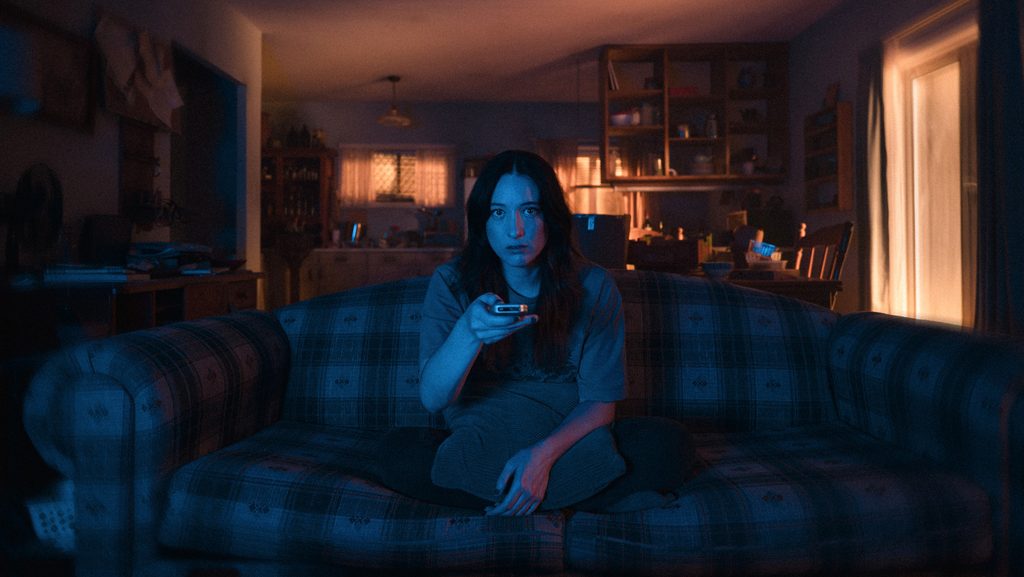
Horror movies have long used ghosts as a way to interrogate grief. The best ghost stories understand that the scares are often secondary to the emotional wounds underneath them, something Posthumous exemplifies with precision and craft.
Written and directed by Josh Tanner and co-written by Jade Vanderlay, Posthumous follows Zoe (Sophie Lowe), a young woman who begins watching a collection of VHS birthday tapes left behind by her deceased mother. What starts as an intimate connection to a parent she never had the opportunity to know soon becomes increasingly unsettling as the recordings reveal clues about the circumstances surrounding her mother’s life and death. Zoe begins investigating a mysterious neighbor with a connection to her mother, while her father appears increasingly determined to keep certain details hidden. As the pieces begin falling into place, Zoe finds herself confronting a past that has remained buried for far too long.
Posthumous, which makes its world premiere at this year’s Fantastic Fest, features an interesting hook for a horror film. There is an inherent tragedy baked into the premise of a woman watching VHS birthday tapes recorded by her deceased mother, who she never met. These aren’t simply home movies documenting childhood memories; they’re messages from a mother to a daughter she would never get the chance to raise. Every smile, birthday greeting, and carefully recorded moment carries the knowledge that the person behind the camera knew she wouldn’t be there for the moments she was documenting. Tanner finds horror and tragedy in this concept, making the VHS tapes both an effective storytelling device and an emotional time capsule.
Although many of the film’s scares come in the form of found-footage-style jump scares, Posthumous is not entirely a found-footage movie. Some of these scares are exceptionally well executed, with the degraded VHS imagery creating an analog horror aesthetic that is inherently unnerving. Tanner plays into the format brilliantly, understanding that there’s something deeply uncomfortable about watching old footage when you know something is lurking just outside the frame. But Zoe’s investigation expands beyond the tapes. Her search leads her toward a neighbor next door who has a mysterious connection to her mother, while her father clearly knows more than he’s willing to admit. These elements give the movie a more traditional mystery component that works alongside the supernatural horror.
Zoe makes for a compelling protagonist to propel this supernatural mystery forward. This is particularly true as Tanner and Vanderlay don’t resort to heavy-handed exposition to explain who she is. Instead, small pieces of dialogue gradually tell us about her history, her relationships, and the complicated emotions surrounding a mother she never actually knew. There’s an interesting angle to assessing grief for a family member you’ve never had the chance to meet. How do you mourn someone whose voice you may only know from a recording? How do you miss someone who was never there? Posthumous uses Zoe to explore these tragic and fascinating questions, and the strong lead performance from Lowe gives the character an emotional grounding that makes her investigation compelling even when the supernatural elements become increasingly elaborate.
Where Posthumous occasionally stumbles is in its explanation of those supernatural elements. Some of the mythology becomes a bit convoluted, and the film could have benefited from a tighter script that made its ultimate explanation for everything feel more cohesive. The final stretch in particular gets a little too cosmic and confusing, introducing ideas that are intriguing in concept but aren’t always presented with enough clarity to fully land. The movie’s emotional storytelling is often at its strongest when it keeps things intimate, making some of the larger supernatural explanations feel less effective by comparison.
Nonetheless, Posthumous unwaveringly triumphs with the atmospheric it cultivates. The analog horror aesthetic, combined with the film’s color grading, gives the entire movie an eerie visual identity. Tanner creates a constant sense of unease, allowing suspense to build around what might be hiding within the frame. Not every scare arrives exactly when you expect it to, either. The film understands that anticipation can sometimes be more frightening than the actual reveal, and its use of VHS imagery gives even seemingly innocuous moments an unsettling quality. There’s a persistent feeling that something is wrong, even when nothing overtly frightening is happening.
Ultimately, what makes Posthumous memorable is that it delivers the emotional catharsis that many ghost stories struggle to achieve. Beneath all the VHS glitches, supernatural mysteries, and jump scares is a story about a mother’s love and sacrifice for a child she doesn’t even know. The fact that she has cancer but refuses chemotherapy because the treatment could harm her unborn child gives the film’s central premise an especially heartbreaking dimension. This decision transforms the tapes from creepy artifacts into something profoundly personal and ensures that the film delivers a touching message about how the people we love can remain with us even after they’re gone. Posthumous may occasionally get lost in the complexity of its mythology, but its heart is never difficult to find. By the time the credits roll, you may find yourself wanting to give your mom a very big hug.
VERDICT: 7/10
Making its world premiere at this year’s Fantastic Fest, Posthumous is an atmospheric and emotionally resonant ghost story that uses analog horror to explore grief, memory, and the beautiful power of a mother’s love. While some of its supernatural mythology becomes a bit convoluted and the final stretch gets too cosmic and confusing, director and co-writer Josh Tanner’s strong visual direction, unnerving VHS imagery, and suspenseful scares, in addition to aa compelling lead performance by Sophie Lowe, make the film an effective supernatural mystery thriller. Most importantly, Posthumous delivers an emotional catharsis that many ghost stories struggle to achieve, turning its frightening premise into a touching story about sacrifice, loss, and how the people we love can remain with us even after they’re gone.