
By George & Josh Bate
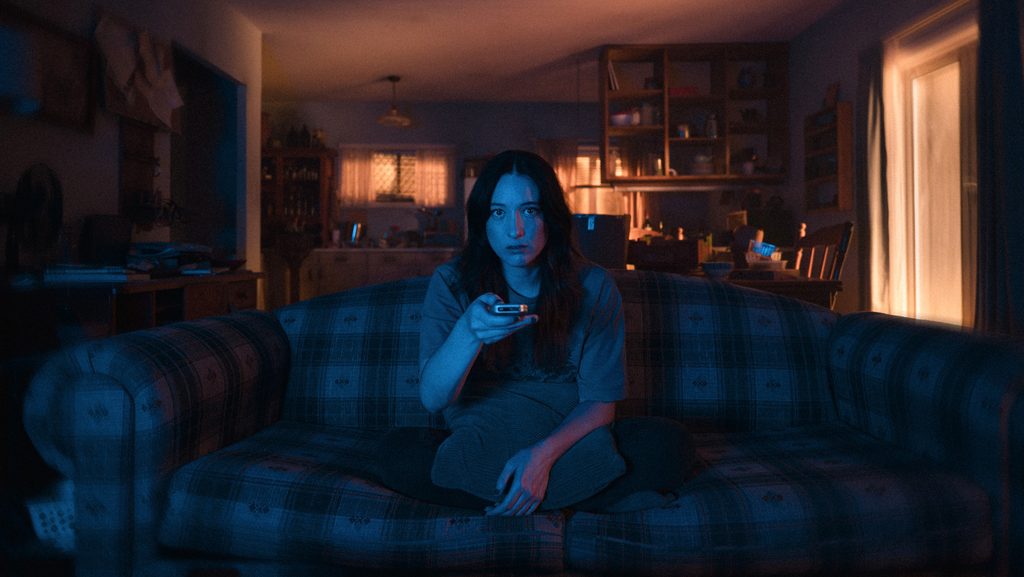
Some memories are meant to fade. Others refuse to. In Posthumous, a birthday message preserved on an old VHS tape becomes the gateway to something much more frightening than a simple recording from the past. What begins as a deeply personal connection between a mother and daughter gradually turns into an unsettling ghost story about grief, memory, and destines predetermined without our knowledge.
Making its world premiere at this year’s Fantastic Fest, Posthumous follows Zoe, who receives a posthumous birthday video message from her mother — a woman who died before she could raise her daughter. As Zoe begins engaging with the recordings left behind, the boundary between memory and the supernatural starts to blur, transforming what initially feels like an intimate connection with a lost parent into something increasingly terrifying. Tanner uses the aesthetics of VHS and analog horror to explore grief and the lingering power of the past, creating a ghost story that isn’t simply interested in frightening its characters, but in asking what happens when the people and experiences we’ve lost continue to exert control over our lives.
The HoloFiles spoke exclusively with writer-director Josh Tanner about the origins of Posthumous, creating its VHS imagery in-camera, crafting scares, the importance of emotional catharsis in ghost stories, Australian horror, Lake Mungo, and what comes next.
The initial idea for Posthumous came from the film’s opening image: a mother leaving behind birthday messages for a child she would never get the chance to raise. “The initial sort of kernel of an idea was very much how the film opens with the posthumous video birthday message from Zoe’s mom,” Tanner explained. “It was really just that very simple idea of a mother leaving messages for a child that they’ll never get to raise that I thought was incredibly sad, but also tapped into a lot of the potential of VHS, being that it’s analog horror.”
For Tanner, the emotional and horror elements immediately felt connected. “I just thought there was a real hand-in-hand of deep emotion but also a lot of horror potential to go down,” he said.
The connection between VHS technology and the film’s emotional core extends into the way Posthumous was actually made. Rather than simply adding VHS effects during post-production, Tanner and his team incorporated the technology directly into the filmmaking process. “We had a really amazing fellow named Dan Rice on the film and he was our VHS or analog supervisor,” Tanner said. “So what we did was we shot a lot on VHS-C cameras, but we had them pipe the images live through the TV on set. A lot of the glitching and stuff that happens was actually live on set. The actors got to interact with it. We had Dan out the back of the set with his little CRT TV pulling on cables and tweaking things and it’s a lot of fun.”
At its heart, however, Posthumous is a ghost story, which Tanner believes inherently means a story that confronts grief. But rather than allowing the film to simply linger in sadness, he wanted to build toward something more emotionally satisfying. “If you’re going to tell a ghost story, it’s got to deal with someone who has passed,” Tanner said. “It’s very hard to avoid the topic of grief. But what I think that I’ve realized in the sort of the back half, but obviously instinctively as we wrote it and everything, was that I don’t feel like a lot of these films have a lot of catharsis at the end. They tend to wallow a lot in that sadness and maybe we’ll get through it, but they don’t have a really emotional payoff to it.”
The filmmaker also saw the concept of grief as part of a broader exploration of the past and the power it can continue to have over us. “Thematically, just this idea of grief but also the past in general being this big force within itself that follows us and grows as we get older and kind of controls us,” Tanner reflected . “I just felt like there was enough there that felt unique that we chart our own course.”
The delicate balance between emotional storytelling and horror also carries over to the film’s scares. Tanner approaches the construction of sequences with considerable preparation, using animatics to figure out exactly how a scene should unfold before cameras begin rolling. “I do a lot of animaticing in pre-production,” Tanner said. “Essentially, if I know there’s a certain sequence, I’ll do rough storyboards and I’ll bring the images into a video editor and add sound effects and temp score. You can really start to engineer how pacing and go in like, ‘I think it’s going to be this shot and I think it’s going to be that shot.'”
Tanner’s commitment to subtlety isn’t something he developed alone, either. His wife and co-writer, Jade Vanderlay, played a major role in shaping the film’s restrained approach to exposition. “My wife and co-writer Jade Vanderlay, she is a big part of why things are so subtle,” Tanner said. “I tend to overwrite things in the first instances sometimes and she’s really just a masterful sculptor of not saying too much and playing things where you’re giving a lot of credence to the audience that they’re going to figure it out and they’re going to connect the dots.”
Posthumous arrives as part of an increasingly prominent run of Australian horror. Tanner has noticed that international audiences have begun to develop a particular expectation for horror coming out of Australia. “I just realized that now people are thinking of Australian horror like J-horror,” Tanner said. “That is crazy. [Australian horror] is super eclectic, but it’s solid. “I don’t know what it is that makes us good storytellers within the genre, but it’s maybe the isolation. We’re at the bottom of the world and we’re almost like an only child left with their crayons, drawing their ideas.”
One of the most significant Australian horror films connected to Posthumous is Joel Anderson’s Lake Mungo, a film whose influence can be felt in Tanner’s approach to grief, documentary-style imagery, and supernatural storytelling.
Interestingly, Anderson’s connection to Posthumous goes beyond inspiration. “Joel Anderson, who directed Lake Mungo, was an executive producer on Posthumous and is a mentor of mine that’s helped with script development all the way through to the end,” Tanner revealed. “So there’s a lot of inspiration of him in Lake Mungo,” he added.
Anderson’s mentorship gives Posthumous an especially interesting connection to one of the defining works of Australian supernatural horror, while Tanner is simultaneously using VHS imagery and his own approach to grief to chart a different course.
For Tanner, however, Posthumous is hopefully only the beginning. The filmmaker is already hoping to expand another ghost story he previously made into a feature. “We’re hoping to get up the feature version of a short film we made called Wondering Soul, which is a ghost story set during the Vietnam War,” Tanner said.
If Posthumous demonstrates anything, it’s that Tanner is interested in horror that lingers beyond the scare itself. With his Fantastic Fest premiere, the Australian filmmaker announces himself with a penchant for mining the inherent tragedy and unease of a ghost story.
Watch our full interview with Posthumous director Josh Tanner below….
