
By George & Josh Bate
Some movies are meant to be watched. Others are meant to be experienced.
In an era in which audiences are increasingly accustomed to exposition-heavy storytelling, elaborate character development, and carefully constructed narrative arcs, there is something undeniably appealing and refreshing about a film that throws viewers into the deep end (figuratively and literally) and refuses to let them catch their breath. Prioritizing visceral thrills, mounting anxiety, and sensory overload over traditional storytelling conventions, these movies can make for an almost physically exhausting viewing experience, akin to riding a rollercoaster or navigating a haunted house. It is an approach that has served filmmakers like the Safdie brothers exceptionally well in movies like Good Time and Uncut Gems, and one that directors Idris Elba and Martin Owen embrace wholeheartedly in Above the Below, a survival thriller that is less concerned with allowing audiences to get comfortable than with making them feel every terrifying second of its protagonists’ harrowing predicament.
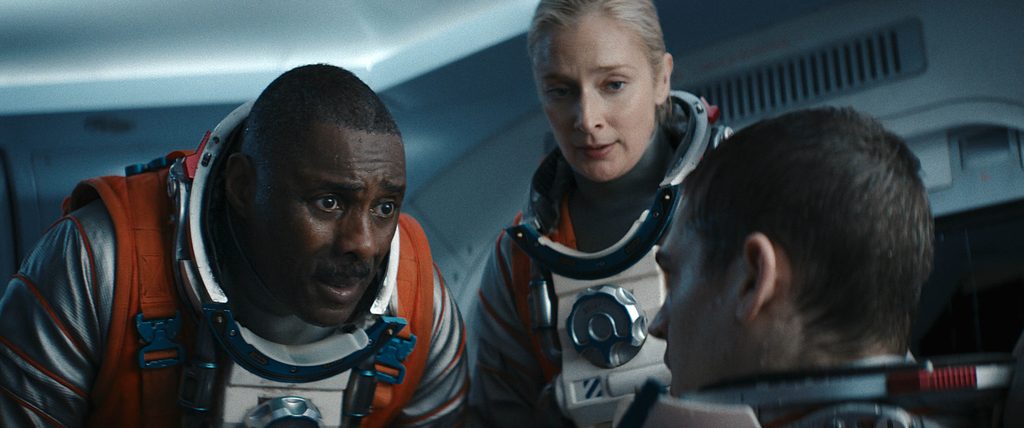
From directors Elba and Owen, Above the Below follows three astronauts — Jackson (Elba), Brooks (Caitlin FitzGerald), and Rhodes (Hero Fiennes Tiffin) — whose spacecraft is struck by a meteorite shower, sending them hurtling toward an unexpected crash landing in the depths of the ocean. With their capsule sinking, oxygen rapidly running out, and no way to communicate with Mission Control, the three find themselves in an increasingly desperate fight for survival. As their attempts to escape one predicament repeatedly plunge them into another, the astronauts must navigate a seemingly endless series of perilous obstacles, with every decision carrying life-or-death consequences.
The HoloFiles recently had the opportunity to interview Above the Below director and co-writer Martin Owen about crafting the film’s relentless, edge-of-your-seat intensity, approaching the movie as an immersive cinematic experience, collaborating with Idris Elba as a co-director, and overcoming the considerable technical challenges of bringing its claustrophobic underwater survival story to life.
‘Above the Below’ Is an Experience, Not Just a Movie
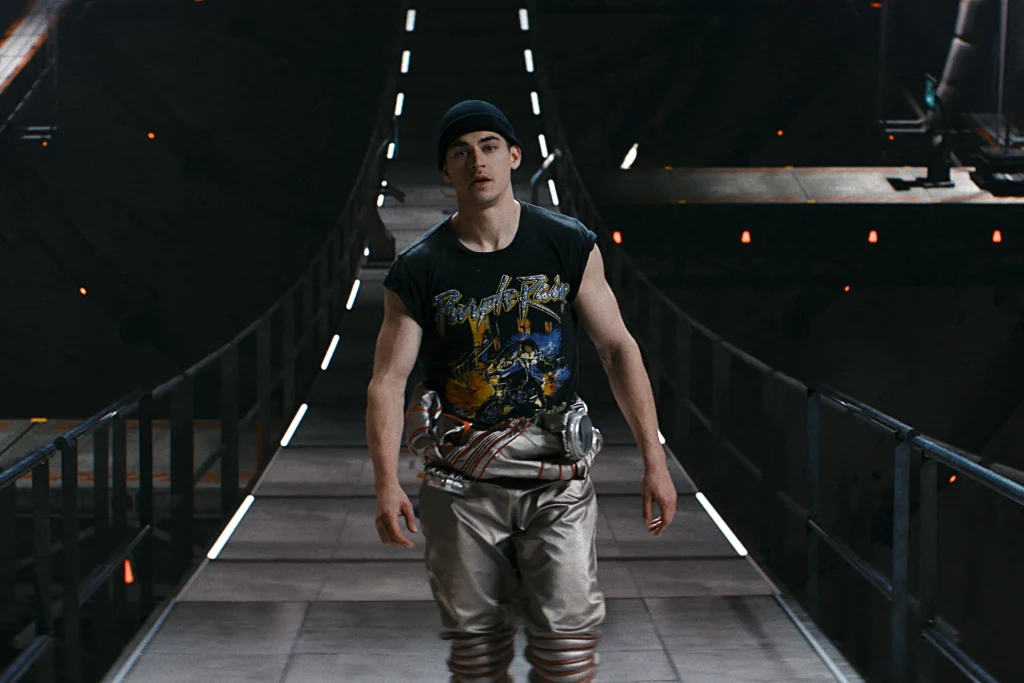
One of the most immediately striking qualities of Above the Below is its ability to sustain an almost unbearable level of tension throughout its nearly 90-minute runtime. Much like the aforementioned Safdie brothers movies, the film adopts a narrative structure in which every apparent solution creates another problem, sending its characters into an increasingly frantic spiral of desperation. Coupled with overlapping dialogue, an oppressive sense of claustrophobia, and the ever-present threat of drowning, the result is an anxiety-inducing viewing experience that rarely allows audiences to settle.
Maintaining that intensity was central Owen’s approach from the outset. Rather than simply focusing on the technical mechanics of suspense, he and Elba were particularly interested in considering the audience’s emotional and physical response to the movie.
“[Idris Elba and I] saw the movie as a story, but also simultaneously it’s an experience,” Owen explained. “It’s like going on a theme park ride. But as you say, the challenge is: how do you maintain that for the length of the film? So I think the process was, in the edit in particular, was how does this movie make an audience feel? As opposed to always looking at the usual things and the technicalities and all of that aside, which we obviously did, [but] it was about how does this make the audience feel and when is the moment that, pardon the pun, they can take a breath and can come up for air.”
Owen specifically points to Uncut Gems as an example of a movie that successfully sustains this kind of breathless momentum, explaining that the goal was to capture a similar sense of relentless escalation without sacrificing the cinematic scale of a relatively contained story.
“We wanted it to be relentless,” Owen remarked. “Uncut Gems, for example, as a movie has two things. One, it has that relentlessness. It kind of has that thing where you hold your breath and then you realize, ‘I’ve not, I’ve actually not breathed for the last six minutes watching this film.’ And so I think that was important to us. And just as you say, trying to keep the balance of a very contained, claustrophobic movie, but at the same time still giving it a scale and a cinematic look.”
The film’s relatively lean 87-minute runtime certainly reflects this philosophy. Instead of pausing for extensive backstory, unnecessary flashbacks, or lengthy character introductions, Above the Below quickly establishes its central crisis and spends the remainder of its runtime escalating it. For Owen, this was a deliberate storytelling decision, with the shared ordeal itself serving as the foundation for the relationships between the three astronauts.
“I think choices were made up front about wanting this to be this kind of an edgy, experience movie,” Owen said. “What we realized was rather than giving loads and loads of backstory and loads of reference continually to backstory or what we’re trying to get home for, it was about creating a bond between those three characters. And this shared journey is their bond. They’ve gone through so much together in a short period of time, and the idea was that the audience do the same thing. Rather than giving and telling the audience loads of stuff, let’s just show them. Let’s see the bond between these three people who all have the same thing in common: hope and trying to get home to who or whatever it is they want to get home for.”
It is such an approach that renders Above the Below an especially compelling example of experiential filmmaking. While the movie certainly prioritizes momentum over traditional character development, its willingness to throw audiences directly into the action allows its escalating survival scenarios to take center stage.
When asked to distill the film’s appeal into a recommendation for potential moviegoers, Owen offered a particularly fitting response: “If you like an experience, you will like Above the Below.”
Finding a Rhythm With Co-Director Idris Elba
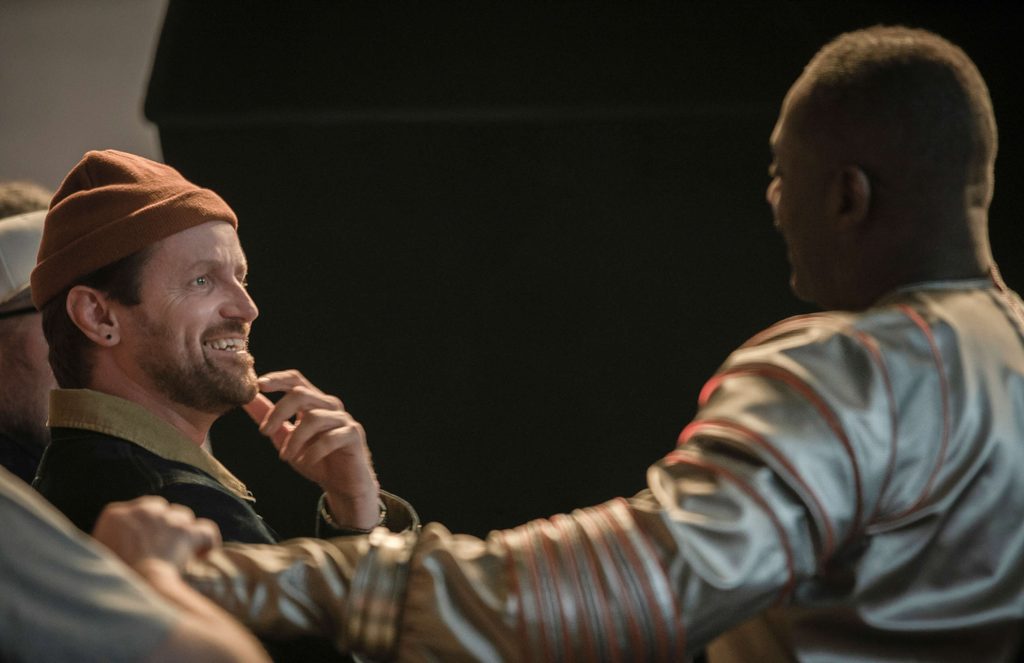
Although Owen was initially set to direct Above the Below on his own, the project ultimately became a collaboration with Elba, who was drawn to the screenplay and expressed an interest in getting involved behind the camera. The two filmmakers found themselves aligned in their vision for the movie, both in terms of its storytelling and its visual presentation.
Owen speaks particularly highly of Elba’s ambition and instincts as a filmmaker, emphasizing how quickly the pair established a productive working relationship.
“Look, Idris is, first of all, he’s a great filmmaker,” Owen stated. “He has a relentless, relentless ambition for what this film needed to be. I think from our first conversation about the project, we realized we’re very aligned with what this should be as an experience and what this should be as a story and what this should be visually as well.”
As for how the two divided their directorial responsibilities, Owen explains that there was no rigid arrangement in which each filmmaker was assigned specific aspects of the production. Instead, they developed a collaborative rhythm organically, a facet of their work that proved particularly important given the demanding environment in which the movie was being made.
“In terms of the working together thing, it was obviously slightly unusual,” Owen admitted. “It was new. But we just found our footing. We found a way to go, ‘Okay, we’re not just saying you do all do this and you’re doing that.’ We found it as a team in a very intense environment that was intense for the actors and the water work and everything. We were just, as I say, fortunate to kind of find a rhythm. That was it. We found a rhythm day one and we stuck to it.”
The Technical Challenges of Bringing an Underwater Nightmare to Life
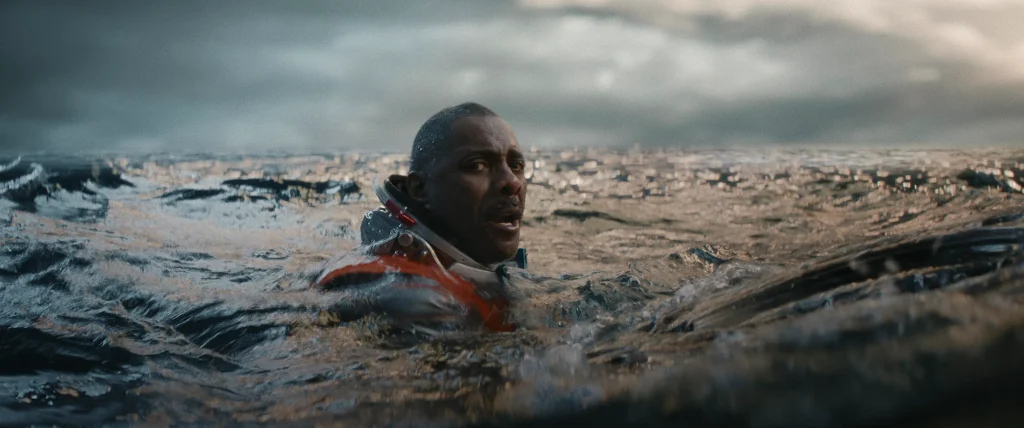
Considering how much of Above the Below takes place either underwater or inside a spacecraft rapidly filling with water, it is hardly surprising that the production presented a considerable number of technical challenges. The filmmakers utilized multiple stages at Pinewood Studios, including an underwater stage, a large water tank for above-water sequences, and a separate setup featuring the spacecraft mounted on a moving rig.
But the difficulties extended beyond simply filming in water. Creating a visually engaging movie while maintaining the claustrophobic atmosphere of its central setting required careful consideration of everything from lighting and camera movement to sound design.
“Water was really challenging,” reflected Owen. “We had the underwater stage, we had a tank that we built for the above the water things. We had a third stage where we had the spacecraft on a gimbal, on a rig. So in general, it was super challenging with limited time and resources and we had to pick our battles.”
Owen elaborated on the particular difficulties of photographing underwater environments, where lighting and reflections can make achieving the desired visual presentation especially complicated.
“I think the biggest technical challenges obviously is water and lights,” Owen explored. “Those two things don’t naturally go together. You know, reflections, the way it looks, the way it feels. I think that the technicality of how do you keep a contained story, not feeling small, and keep elevating it with the correct lighting choices, the correct camera movement. And ultimately it was everything worked backwards from: we want the audience to feel like the fourth astronaut. We want them to be sat in there with them as close as we can and be feeling what’s going on around them.”
Owen credits cinematographer James Friend with playing an instrumental role in realizing this vision, alongside the film’s sound design and other technical elements.
“I think that was hopefully reflected well in the cinematography, which James [Friend] did an amazing job. And then the sound design, all those things kind of went hand in hand to create this experience. Like when you walk into a haunted house, it’s that kind of thing, that making sure that everything is being treated in the right way.”
One of the film’s most memorable sequences occurs early on, when the spacecraft crash lands from the depths of outer space into the ocean and begins taking in water, creating a particularly terrifying scenario for the three astronauts. Owen explored how he and the team pulled off such a complex sequence.
“We basically built the craft,” Owen explained. “The team did an amazing job of building this craft that was kind of like segments so you could lift pieces out of it and get the camera in. And we had it on a rig on a gimbal, on a rig that allowed it to move and shake.”
The practical construction of the spacecraft was critical in creating an environment that felt convincing for the performers. Rather than relying exclusively on visual effects to suggest the chaos of a spacecraft spiraling out of control, Owen and Elba wanted the actors to physically inhabit a space that could move around them, which, in turn,, would contribute to their performances.
“It was about trying to the best we could to create an environment for the actors that felt like it was as close as you could imagine replicating a spacecraft hurtling through space out of control,” Owen said. “But then at that point, you’re down to really the performances from the three actors. Really, at that point, you’re leaning on those guys to sell it. So we had a great team with great choices. But then it came down to those three to sell it in that very kind of contained environment.”
The result is a sequence (one of many, mind you) that encapsulates what makes Above the Below so effective: practical physicality, an increasingly oppressive environment, and performances that communicate the sheer panic of people confronting circumstances far beyond their control.
Owen’s comments in our interview offer a fascinating glimpse into the thought process behind a film whose greatest asset is the audience’s visceral, physical investment in the experience. From its relentless pacing and claustrophobic cinematography to the practical construction of its spacecraft and elaborate underwater production, Above the Below is designed to keep viewers on the edge of their seats. Whether audiences emerge from the experience breathless, exhilarated, or simply grateful to be back on dry land, Owen and Elba have clearly set out to deliver a movie that is anything but a passive viewing experience.
Above the Below crash lands into theaters on December 4, 2026.
Watch the full interview with Above the Below director and co-writer Martin Owen below.
