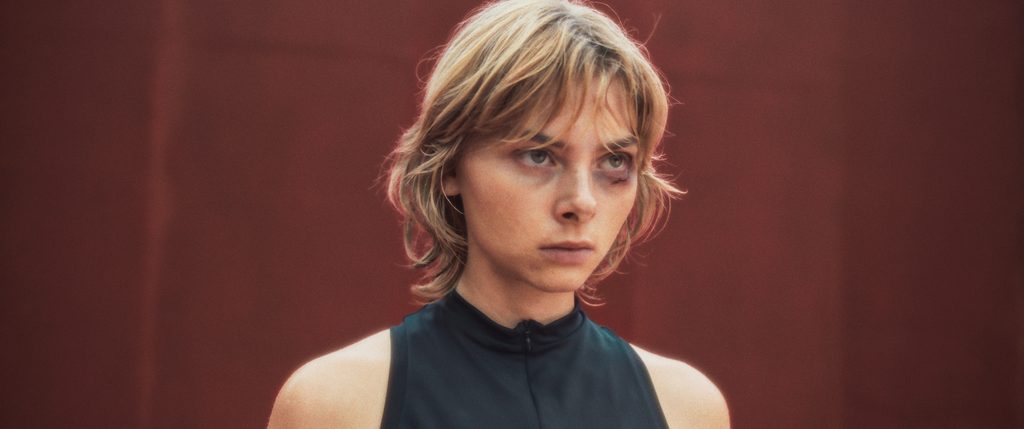
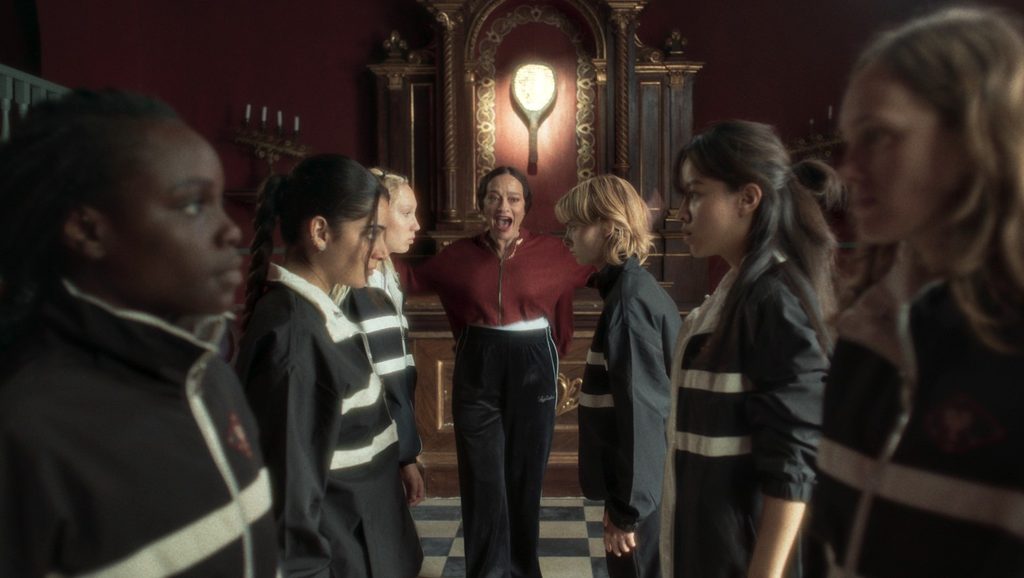
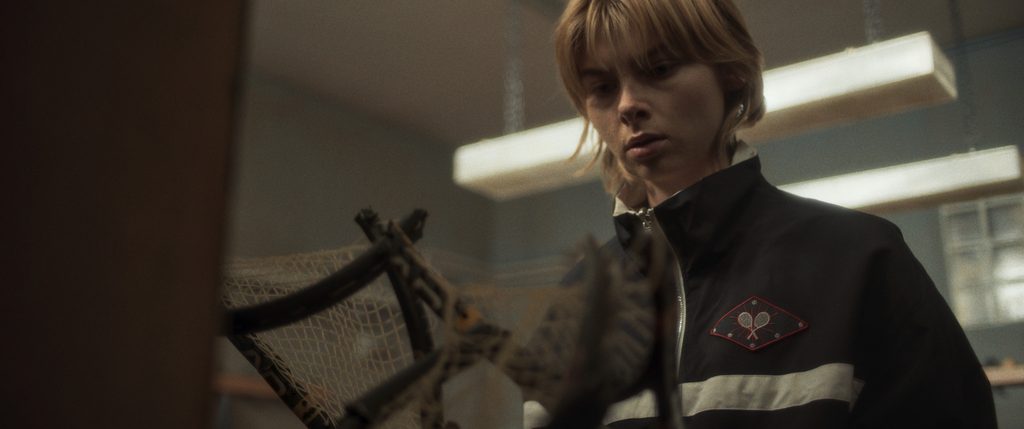
An image from Nikias Chryssos’ BLOODY TENNIS. Courtesy of Shudder. A Shudder Release.
Sports dramas and horror movies make for a surprisingly natural pairing. The cutthroat nature of competition, the physical toll of pushing the body beyond its limits, and the crushing pressure to succeed all create an environment already filled with anxiety, obsession, and fear. Add coaches demanding perfection, teammates willing to do whatever it takes to get ahead, and the ever-present possibility of failure, and the world of elite athletics begins to look like a horror movie waiting to happen.
Director Nikias Chryssos takes that inherent darkness and pushes it into increasingly grotesque territory with Bloody Tennis, a surreal sports-horror film set inside an elite tennis academy where the pursuit of greatness gradually becomes indistinguishable from something far more sinister.
The film, which makes its North American premiere at this year’s Fantastic Fest, follows Sophie (Sandra Guldberg Kampp), a young American tennis player who earns a coveted spot at an elite academy hidden away in Southern Europe. What initially appears to be the opportunity of a lifetime quickly reveals a much darker side. Surrounded by fiercely ambitious players, demanding instructors, strange rituals, and an environment where failure is simply unacceptable, Sophie begins to discover that the academy operates according to rules that extend far beyond the tennis court.
The HoloFiles recently had the opportunity to speak with Bloody Tennis writer-director Nikias Chryssos about his new film, its horror take on the sports drama, and more.
Bloody Tennis Exists At the Intersection of Sports Drama and Horror Movie
An image from Nikias Chryssos’ BLOODY TENNIS. Courtesy of Shudder. A Shudder Release.
Chryssos, whose previous films include Der Bunker and A Pure Place, approaches the premise by deliberately embracing the contrast between the pristine image of elite athletics and the physical ugliness lurking beneath it. The result is a movie that can feel like Suspiria collided with Challengers, before taking a detour into body horror and something considerably stranger.
“The entry point was basically the contrast between the sunny world of a tennis academy, the aspirations, young people coming here with a dream, and they come into this environment and everything is beautiful, and they have this big dream of becoming an athlete and the underlying darkness of it,” said Chryssos regarding the genesis of the film’s premise.
Chryssos recalled being struck by the disconnect between the immaculate appearance of elite performance and the physical reality taking place behind the scenes, comparing it to stories he had heard about ballet schools.
“Someone told me a story about ballet school once,” Chryssos recalled. “And you have these perfect dancers and everything’s so beautiful and controlled, but behind the scenes there’s the smell of bulimia and other body functions.”
It is an uncomfortable image, but it gets directly at what makes Bloody Tennis so effective as a horror concept. The academy looks beautiful. The players are young and talented. The courts are pristine. Everyone appears to be pursuing something aspirational. But the human body cannot remain separate from that pursuit forever.
Chryssos found this contradiction particularly fertile ground for horror. “There’s this physical aspect that is behind this that I found very interesting and also to make something horrible that has this sunny side to it a little bit,” the filmmaker remarked.
That idea helps explain the peculiar tone of Bloody Tennis. Unlike a traditional dark sports drama, the film is not interested in simply making its academy grim from the beginning. Instead, there is something almost inviting about the environment. The promise of becoming an elite athlete is intoxicating, particularly for someone like Sophie, who has already committed herself to the belief that reaching the highest level is worth whatever sacrifices are necessary.
At the center of Bloody Tennis is an uncomfortable question: What happens when competition becomes the organizing principle of someone’s entire existence? Chryssos sees something inherently disturbing in the winner-versus-loser structure of competitive athletics. “The horrific aspect, I think, [of sports movies] is that it’s so distinct that you put people in categories of winners and losers, it’s the fundamental thing, right?” the filmmaker said.
For recreational athletes, losing a tennis match can simply mean losing a tennis match. At the highest levels, however, competition becomes something much more consuming. Every victory validates the enormous investment required to reach that point. Every loss threatens to undermine it. And that creates the kind of obsessive mindset that Bloody Tennis takes to its logical extreme.
For Chryssos, there is something inherently strange about that world. And because the dream of becoming an elite athlete is so heavily idealized, enormous numbers of young people are willing to enter the system despite knowing that only a tiny fraction will ultimately succeed. “Because there’s so much competition, and because this goal of becoming an athlete is so idealized, it also means that so many people try, and so many people will also fail,” Chryssos said.
One of the film’s most effective elements is the way its atmosphere gradually changes. The academy does not immediately reveal every aspect of its brutality; rather, the tension grows incrementally.
Chryssos describes the steady progression of tension as beginning with something relatively recognizable before becoming increasingly extreme. “I think [the tension and menace] gradually grow, in a way,” Chryssos reflected. “It starts with something more psychological, like a little bit of bullying, but it’s already ingrained into the [sport] somehow, and then you build it from there.”
Bloody Tennis‘ escalation of tension is crucial to the film’s depiction of the academy. The students are not simply subjected to violence from outside. They gradually learn the rules of the environment and begin adapting themselves to them. And, eventually, violence becomes normalized. “[Sophie] also gets kind of accustomed to the violence and accepts it,” Chryssos said. “You have to follow the rules of this place, if you want to stay in this, and I think that is interesting.”
The film then pushes the concept of athletic ambition and excellence into stranger, more surreal territory.
“We just try to make it more, in a way, more nasty, but also more surreal,” Chryssos said. The result is a movie that frequently feels as though it is drifting between a recognizable sports drama and a fever dream. The audience understands the competitive environment, even as the academy’s increasingly bizarre rituals make it clear that something else is happening beneath the surface.
From Boarding School Horror to Suspiria and Bring It On
An image from Nikias Chryssos’ BLOODY TENNIS. Courtesy of Shudder. A Shudder Release.
The film’s isolated academy immediately recalls a long tradition of boarding-school and institutional horror. There is an oppressive authority figure overseeing young people, secretive rules, a sense of separation from the outside world, and the uncomfortable intimacy of having a group of young people living, training, competing, and fighting together in a confined environment.
Chryssos says the project evolved through a mixture of influences. “In the beginning, it was a little bit like these boarding school films from the 70s, meeting something more modern,” he explained. “I was thinking of these 90s high school films like Mean Girls or Bring It On.”
Chryssos also points to La Residencia, the 1969 Spanish horror film set in a secluded boarding school, as an important reference. What interested him was not simply the film’s setting, but the combination of physical intimacy, claustrophobia, violence, and sexuality. “There’s also something like a mixture of claustrophobic setting, something almost erotic, because they’re all kind of crouched together and they’re young, and then the brutal aspects of it, and I think that was interesting to play with that.”
Sophie and the Price of Ambition
An image from Nikias Chryssos’ BLOODY TENNIS. Courtesy of Shudder. A Shudder Release.
Sandra Guldberg Kampp’s Sophie serves as the audience’s entry point into this world. She is notably restrained, which gives the character an unusual quality for a horror protagonist.
Rather than constantly telegraphing fear, Sophie often seems to absorb what is happening around her, a quality that makes her increasingly difficult to read as the film progresses.
“I think it’s a story of corruption,” Chryssos said. “We can call it that…There were moments of, let’s say, small moments of solidarity between the players in the school also, but again, they get kind of destroyed in the end.”
It is through its examination of moral corruption that Bloody Tennis moves beyond simply being a horror movie about a strange tennis academy. The academy becomes a microcosm for a larger society in which success is measured through domination and where empathy becomes a rarity.
When Winning Means Losing Yourself
An image from Nikias Chryssos’ BLOODY TENNIS. Courtesy of Shudder. A Shudder Release.
The third act of Bloody Tennis takes the film into increasingly bizarre territory, but Chryssos’ comments suggest that the underlying idea is remarkably straightforward: What happens to people when they spend too long living according to a system that rewards winning above everything else?
“If you live in a world that is kind of ruled by these principles of violence, where you have to always think about how do I come out as a winner in a certain situation, then that will lead to also moral sacrifices, and I think you lose empathy,” Chryssos explained. “That can happen very gradually, but then surprisingly quickly.”
The gradual erosion of empathy is arguably the film’s most unsettling idea. The grotesque imagery may be what audiences remember, but the horror underneath it is much more recognizable.
The film’s increasingly nightmarish third act takes those ideas somewhere surreal, even potentially supernatural, but its central anxiety remains grounded in the real world.
Chryssos ultimately sees Bloody Tennis as an argument for something that exists outside the academy’s winner-take-all philosophy. “I think still we should strive for a society that is based more on empathy and cooperation, and not just destruction or dominating the other,” the filmmaker said.
Bloody Tennis proves there’s plenty of horror to be found in the pursuit of athletic greatness. By placing the relentless winner-versus-loser mentality of elite sports inside an increasingly grotesque nightmare, Nikias Chryssos has created a film that is simultaneously a coming-of-age story, a boarding-school horror movie, a body-horror exercise, and a dark examination of what ambition can cost.
Check out our full interview with Bloody Tennis writer/director Nikias Chryssos below….
Bloody Tennis made its North American premiere at Fantastic Fest following its world premiere at the Locarno Film Festival. The film arrives on Shudder on September 25, 2026.
The HoloFiles is a website and series of social media accounts, including Star Wars Holocron, Marvel Tesseract, DC Motherbox, Film Codex, and Horror Necronomicon. We love cinema and television, and aim to spread positivity across different fandoms. Come to us for news, reviews, interviews, trivia facts, quotes, behind the scenes photos, analytic features, and more!