
Genre movies are uniquely positioned to place their characters and, in turn, their audiences into the most harrowing of dilemmas. In 2004, Saw chained two strangers in a grimy bathroom and forced them to play a sadistic game of survival. A year later, a group of women were trapped in a cave and hunted by subterranean predators in The Descent. Ryan Reynolds was buried alive in Buried a few years after that. Whalefall, a new film from 20th Century Studios and filmmaker Brian Duffield (No One Will Save You), exists in a similarly agonizing lineage, subjecting its protagonist to the more excruciating of survival battles and its audience to a visceral, nail-biting thriller that unfortunately goes awry with its heavy focus on a strained father-son relationship.
Based on the novel of the same name by Daniel Kraus, Whalefall follows Jay Gardiner (Austin Abrams), a young man who embarks on a search for the remains of his father (Josh Brolin) in the ocean. While scuba diving, Jay is swallowed by a massive sperm whale and only has one hour to escape before his tank of oxygen runs out.
The premise of Whalefall alone is enough to induce terror and dread in moviegoers. The idea of being swallowed by a sperm whale, trapped inside its digestive system, and only having an hour to escape rivals Saw, Buried, The Descent, and a number of other similar claustrophobic survival thrillers in just how agonizing its lead character’s predicament is.
But the concept of a man being swallowed by a sperm whale and somehow surviving long enough to attempt an escape is admittedly rather ridiculous, something Whalefall doesn’t quite understand. Rather than embrace the silliness of its concept and lean into the absurdity of it all, Duffield approaches the material with decided sincerity. Tonally, such a decision has the potential to raise the stakes and tension, yet the ultimate result is that the film isn’t nearly as entertaining as one might expect.

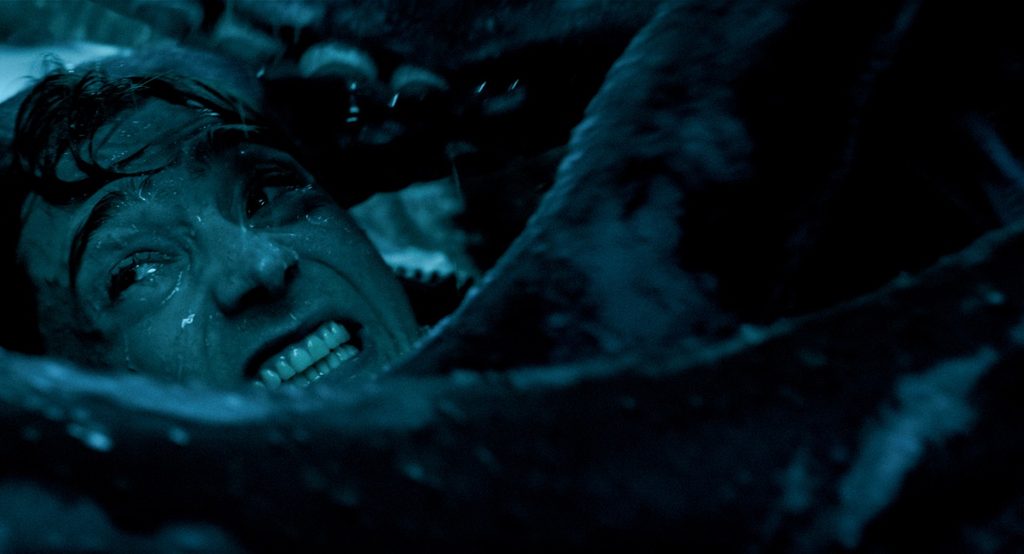
In spurts, Whalefall makes for unreservedly visceral and intense viewing. Numerous sequences inside the whale’s digestive system are crafted with such precision, attention to detail, and penchant for exploiting claustrophobia that moviegoers will likely find themselves holding their breaths for far too long in anticipation of how Austin Abrams’ protagonist is going to overcome the next obstacle in his way. It is through these scenes alone that make Duffield’s film a worthwhile watch, despite its many missteps.
While many of the nail-biting scenes inside the whale are effectively suspenseful and dread-inducing, just as many are undercut by how disorientingly Duffield shoots his film. The filmmaker commits to having the audience immersively experience what it feels like to be swallowed by a whale, but this dedication to accuracy and immersion often comes at the expense of making sense of what’s actually going on. Extreme close-ups, shaky camera movement, and a lack of geographical orientation of the whale’s anatomy collectively render Whalefall more confusing than nerve-racking at times.
The film’s tendency to disorient the audience far too much continues with its sound design. Flashbacks aside, the majority of the film follows Abrams’ protagonist as he navigates the bowels of a whale with a scuba diving mask fitted inside his mouth. But this barrier doesn’t stop Duffield from tasking Abrams to deliver quite a bit of dialogue, usually in the form of quips to himself and, eventually, more abstract conversations with his deceased father. A problem arises, however, as Abrams’ dialogue while wearing the scuba diving mask proves exceedingly difficult to understand, suggesting that some form of internal narration may have been better suited to conveying his character’s emotional state.
Difficulties understanding dialogue aside, Austin Abrams triumphs in Whalefall, carrying the entire film on his back from start to finish. Abrams has impressed in supporting turns in the likes of Euphoria and Wolfs in recent years, but the last couple months have seen him proudly proclaim leading man status after headlining the immensely successful Resident Evil reboot and now Whalefall. While Abrams’ performance in Resident Evil leaned more more heavily into humor, his performance in Whalefall is more solemn and reserved, yet just as compelling. Abrams nails the panic and terror of a man being trapped inside a whale, while similarly excelling in various flashbacks depicting the strained relationship with his father.
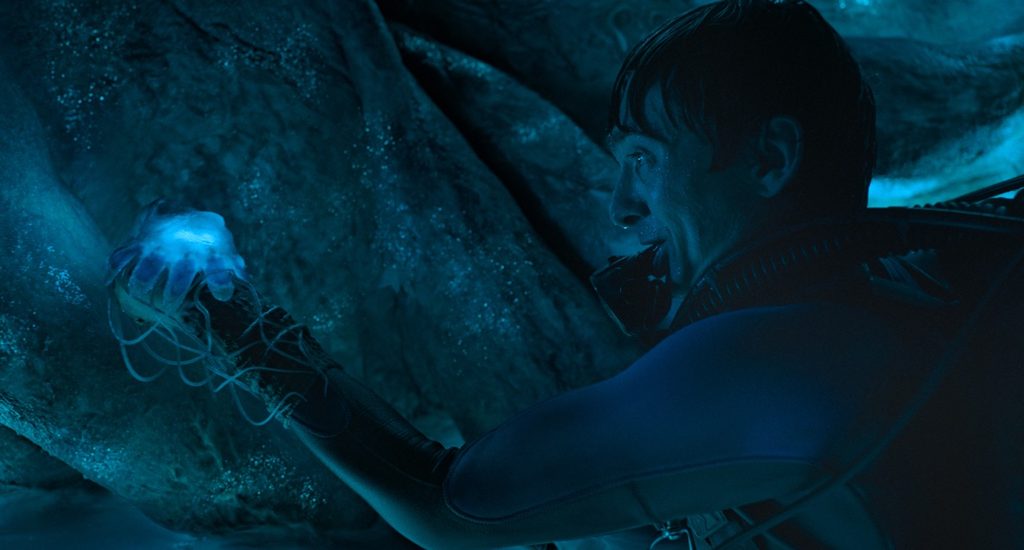
While showcasing Abrams’ capacity as an actor, these flashbacks and the disproportionate focus on the father-son relationship are ultimately Whalefall’s undoing. Despite Abrams’ Jay going into the open water to find his father’s remains, Jay did not have a solid relationship with his father, played by Josh Brolin. His father pressured, belittled, and undermined him, all with the intent to have his son embrace the way of the water and nature in a manner that would seemingly set him up for success and safety in the future.
The various flashbacks between Jay and his father give Abrams and Brolin meaty material to work with as their relationship is neither naively wholesome nor stereotypically toxic. There’s great love between the two men, although this love is accompanied by strain, resentment, disappointment, and more.
While anchoring the story emotionally and providing its protagonist a worthy reason to dive into open waters in the first place, the father-son dynamic emerges as such a prominent fixture of the film that it ultimately feels more like a relationship drama than it does a survival thriller. It is not an exaggeration to state that Whalefall feels like a grief therapy session conducted within the digestive system of a massive whale.
The disproportionate focus on the relationship lends itself to a repetitive storytelling structure that the film quickly falls into. As Jay faces different challenges inside the whale, the film cuts back to a flashback in which Brolin’s father, despite being off-putting and even cruel at times, teaches his son a valuable lesson about survival. When returning to the present, Jay applies this lesson to overcome a specific obstacle in his way. Such a sequence of scenes occurring once or twice would be tolerable, but Whalefall employs this structure throughout much of its runtime, in turn creating surprisingly monotonous viewing out of such a compelling premise.
The third act of the film sees Duffield embrace the relationship drama aspect of the story even more explicitly. Certain storytelling decisions see the film increasingly delve into hallucinogenic and abstract territory, which have the unintended effect of being more unintentionally funny than emotionally moving. This is not to say that the film doesn’t resonate emotionally at times – there is an admittedly effective throughline about the complexities of grieving someone we had a complicated relationship with and a handful of genuinely touching moments in the final act. However, all of these moments are undermined by how heavy-handed the emotional material and the central metaphor it ultimately arrives upon are.
VERDICT: 5/10
Whalefall is a visceral, nail-biting thriller in spurts, but is ultimately undone by its misguided focus on a father-son relationship drama. Numerous sequences of the protagonist being trapped inside the digestive system of a sperm whale are crafted with such extraordinary precision, attention to detail, and penchant for exploiting claustrophobia that audiences will find themselves holding their breaths in anticipation. Austin Abrams triumphs, carrying the entire film on his back from start to finish, nailing the panic and terror while delivering a solemn, reserved, yet compelling performance in flashbacks. However, the film’s disorienting cinematography, difficult-to-understand dialogue, and disproportionate focus on a strained father-son relationship ultimately undermine its compelling premise. Rather than fully embrace the absurdity of its premise, Whalefall approaches the material with decided sincerity, creating surprisingly monotonous viewing out of such a compelling premise. Although there is an effective throughline about the complexities of grieving someone with whom we had a complicated relationship and a handful of genuinely touching moments, the heavy-handed emotional material ultimately prevents Whalefall from being as entertaining and nerve-racking as one might expect.