
By George & Josh Bate
Few film composers have built a career quite like Carter Burwell. With a filmography spanning more than four decades, Burwell has become one of the most distinctive voices in modern cinema, creating memorable scores for everything from dark comedies and crime thrillers to period dramas, documentaries, and animated adventures. His ability to find the musical identity of a film, often through unexpected instrumentation and unconventional arrangements, has made him a sought-after collaborator for some of Hollywood’s most celebrated filmmakers.
Perhaps best known for his longstanding partnership with Joel and Ethan Coen, Burwell has composed music for classics including Blood Simple, Raising Arizona, Miller’s Crossing, Fargo, The Big Lebowski, No Country for Old Men, and True Grit. Outside of that collaboration, his work includes Spike Jonze’s Being John Malkovich and Where the Wild Things Are, Todd Haynes’ Carol, and Martin McDonagh’s In Bruges, Three Billboards Outside Ebbing, Missouri, and The Banshees of Inisherin. His work on Carol, Three Billboards, and The Banshees of Inisherin also earned him Academy Award nominations for Best Original Score.
Rather than relying on a recognizable musical formula, Burwell often looks for instruments, melodies, and arrangements that reflect the characters and environments on screen. This approach has resulted in everything from the unsettling minimalism of Fargo to the playful, melancholic instrumentation of The Banshees of Inisherin.
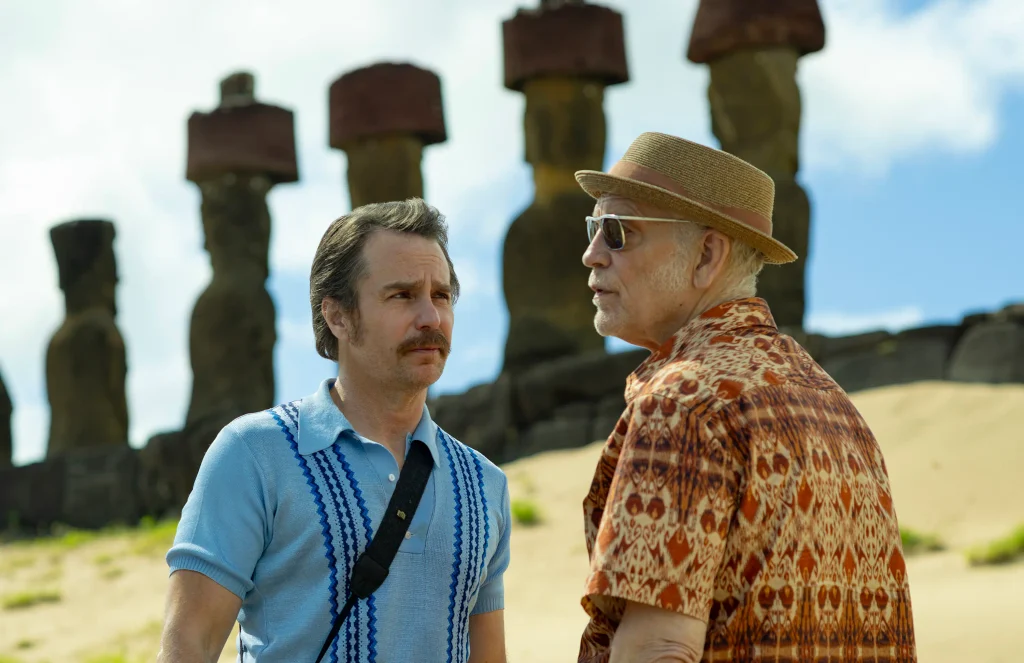
Burwell’s latest collaboration with McDonagh, Wild Horse Nine, provides another fascinating example of his razor sharp creative instinct. Set shortly before the 1973 Chilean coup, the film follows two CIA agents, Chris (John Malkovich) and Lee (Sam Rockwell), who are dispatched from Santiago to Easter Island by their bureau chief, MJ (Steve Buscemi). What begins as an assignment on a remote island becomes a complicated journey involving political intrigue, personal relationships, and two longtime partners confronting their pasts. With its distinctive setting, dark humor, and underlying melancholy, the film offers plenty of opportunities for Burwell to explore different musical textures.
The HoloFiles recently had the opportunity to speak with Carter Burwell about his work on Wild Horse Nine, his evolving creative relationship with Martin McDonagh, the influence of Chilean and Andean music on the score, and how he approached balancing the film’s humor with its more melancholic qualities.
“This is my fifth time working with [McDonagh],” Burwell said when discussing his relationship with the filmmaker. “We’ve developed sort of a short hand at this point.”
That shorthand has clearly allowed the pair to experiment with some interesting musical ideas, and Wild Horse Nine might be one of their most distinctive collaborations yet.
Finding the Sound of Wild Horse Nine
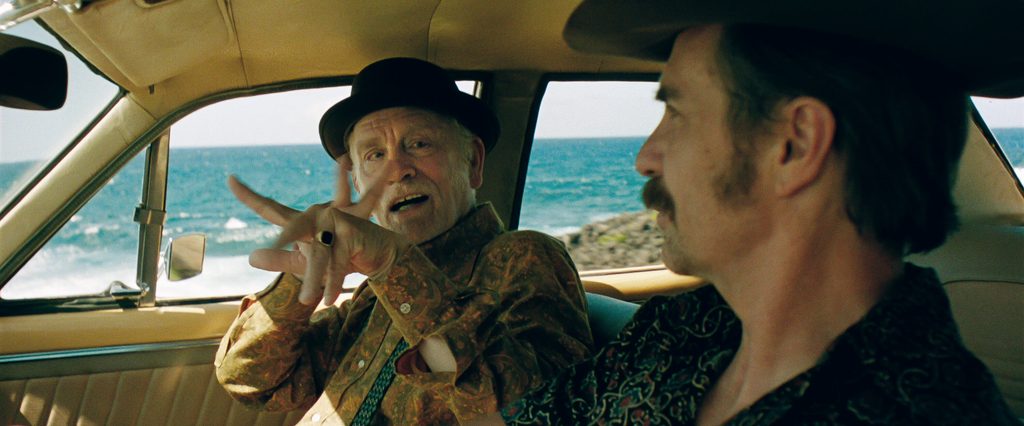
Although Burwell has worked with McDonagh on several occasions, every new film presents its own challenges. With Wild Horse Nine, the composer was immediately drawn to the specific time and place of the story. Set in 1973, the film takes place against the backdrop of political upheaval in Chile, with much of the action unfolding on the remote island of Rapa Nui, also known as Easter Island.
Rather than simply creating a traditional period score, Burwell began considering how the music could reflect the film’s geographical setting while also expressing the relationship between its two central characters.
Burwell explained that his first instinct upon reading the screenplay was that the music needed to communicate the affection between Chris and Lee, although he wasn’t initially sure how to accomplish that. “In a way, it’s like a romance,” Burwell said. “Not romantic, but it’s about the love these two men have for one another.”
“I got the chance to use some different instruments for the movie,” Burwell continued. “One was the charango, which is a 10-string lute. It’s small. It has this warm sound to it.”
The charango became an important starting point for the score. Traditionally associated with Andean music, the instrument has a particularly rich history, with its development reflecting the intersection of Indigenous musical traditions and European influences in South America.
As he began experimenting with the instrument, a melody emerged that seemed to capture the relationship between Chris and Lee. Interestingly, the result wasn’t necessarily what audiences might expect from a film set in Chile.
Instead, Burwell found himself gravitating toward the musical language of classic Hollywood Westerns. The melody featured a guitar-like sound backed by an orchestra, although Burwell deliberately avoided the more muscular brass arrangements traditionally associated with the genre.
The Western influence made sense for the characters. Chris and Lee are essentially two aging gunslingers, men who have spent their lives navigating violence and moral uncertainty. Their relationship is complicated, but there is clearly affection beneath the constant bickering.
Burwell’s approach also reflects something particularly interesting about McDonagh’s writing of male characters. His characters frequently struggle to express their feelings directly, instead communicating through humor, aggression, and sharp exchanges of dialogue. A traditional, wholesome romantic melody might have felt completely out of place, whereas the Western-inspired theme offered a more fitting way to express their connection.
Balancing Melancholy, Humor, and the Music of 1973
Burwell developed several different musical threads that help establish the film’s period, atmosphere, and emotional complexity.
Songs from the 1970s remind audiences when the story takes place, while also offering a glimpse into the musical tastes of its CIA protagonists. There are also three haunting choral pieces by Carl Orff, which help communicate the strangeness of the island and the presence of its wild horses. These are pre-existing musical works rather than original compositions by Burwell, but they form an important part of the film’s overall musical identity.
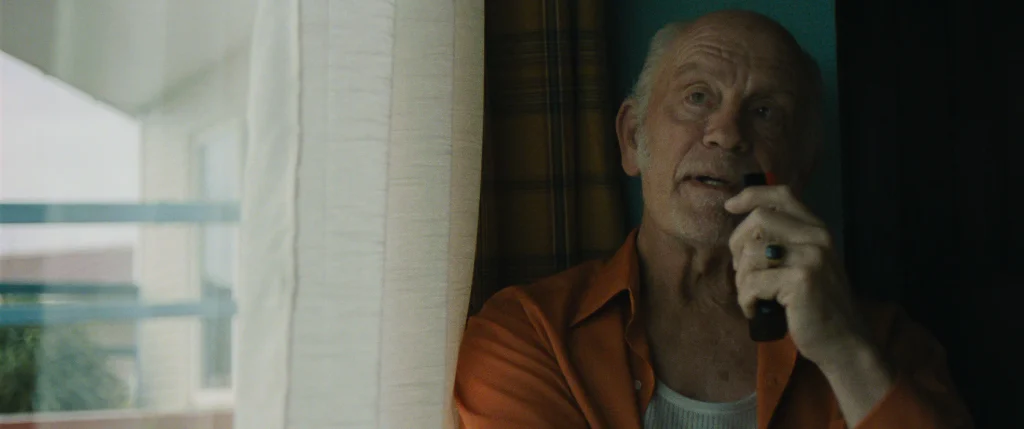
Perhaps the most unexpected material appears during the sequences in which Chris dictates his memoirs into a dictaphone. Although his recollections frequently involve assassinations and political violence, Burwell noticed something unusual about the character’s language: it almost resembles that of a child. “I thought of those scenes of [Chris] dictating [his autobiography] as almost childlike,” Burwell said. “Kind of innocent and whimsical, although it’s not.”
This observation inspired a series of compositions for celesta and tuned percussion. The pieces have an almost lullaby-like quality, providing a striking contrast to the violence and darker themes surrounding Chris’ hardened CIA agent, who has had his hand in toppling governments around the world.
The Tonal Balance of Wild Horse Nine

McDonagh’s films are frequently as funny as they are melancholic, often finding humor in characters and situations that are deeply troubled. This paradoxical combination can be difficult to translate into music without allowing one emotion to overwhelm the other.
When asked how he approached that challenge, Burwell acknowledged the importance of getting the balance right.
“Martin’s movies are quite melancholic, but also very clever and funny,” he explained. “You need to strike that balance carefully.”
It’s an approach that seems particularly well suited to Wild Horse Nine. The Western-inspired melodies give the film a sense of romance and nostalgia, while the gamelan introduces an unsettling atmosphere that reflects the island’s mystery. Meanwhile, the more delicate celesta pieces offer glimpses into the vulnerability hiding beneath Chris’s hardened exterior.
Burwell’s work on Wild Horse Nine is another reminder of why he remains such an important figure in film composition. Even after decades of working on some of cinema’s most recognizable films, he continues to find unexpected ways to approach a story. Instead of simply following the conventions of a genre or setting, he searches for the sounds that best communicate what a film is really about, both thematically and emotionally.
Wild Horse Nine is now in theaters.